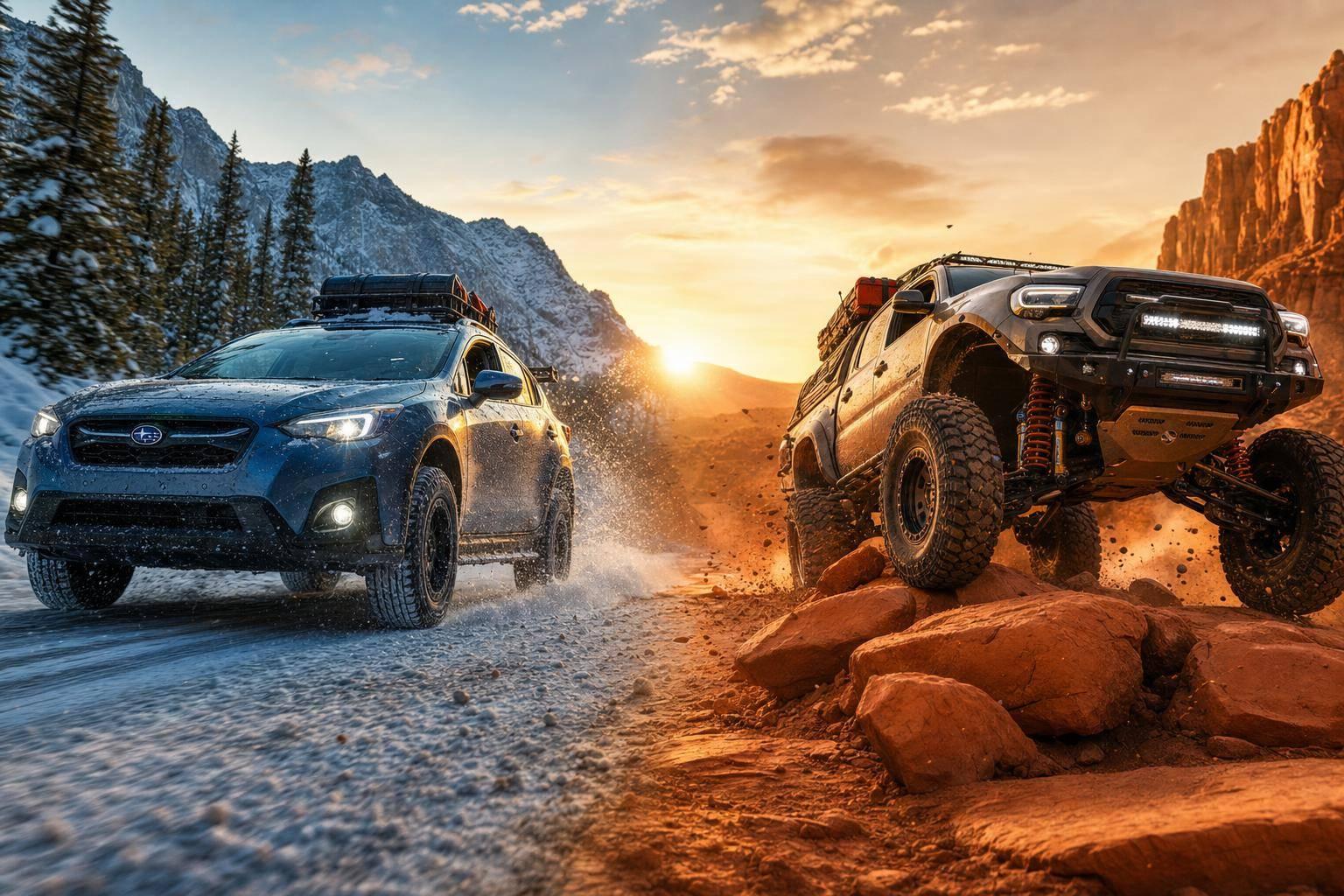
If you drive on-road most of the time, AWD is usually the better pick. If you deal with rocks, deep mud, sand, or steep climbs, 4WD is the better tool.
I’d sum it up like this: AWD is for grip with no driver input, while 4WD is for low-speed control in rough terrain. The big split comes down to low range, tire limits, suspension needs, driveline stress, towing, and maintenance.
Before I’d buy or build anything, I’d look at these points first:
- Control: AWD works on its own; 4WD uses 2H, 4H, and 4L
- Low range: AWD usually has none; 4WD uses 4L for slow climbs and descents
- Best use: AWD fits pavement, snow, ice, gravel, and light dirt roads
- Trail use: 4WD fits rock crawling, deep mud, sand, and recovery work
- Build limits: AWD usually reaches its ceiling sooner with lifts and larger tires
- Wear points: AWD often struggles with heat and tire mismatch; 4WD needs more service on transfer case, axles, and steering parts
- Tire fitment: Even small tire diameter differences can stress both systems
- Common tire sizes: Moving to 35-inch or 37-inch tires often leads to re-gearing to 4.56:1 or 4.88:1
- Suspension changes: Long-travel kits can add about 4.5 inches per side, which changes alignment, CV angles, and brake line needs
My short take: choose AWD for a daily driver that sees winter and mild trails. Choose 4WD if you want low-range control, heavier trail use, more room for suspension changes, or a stronger towing base.
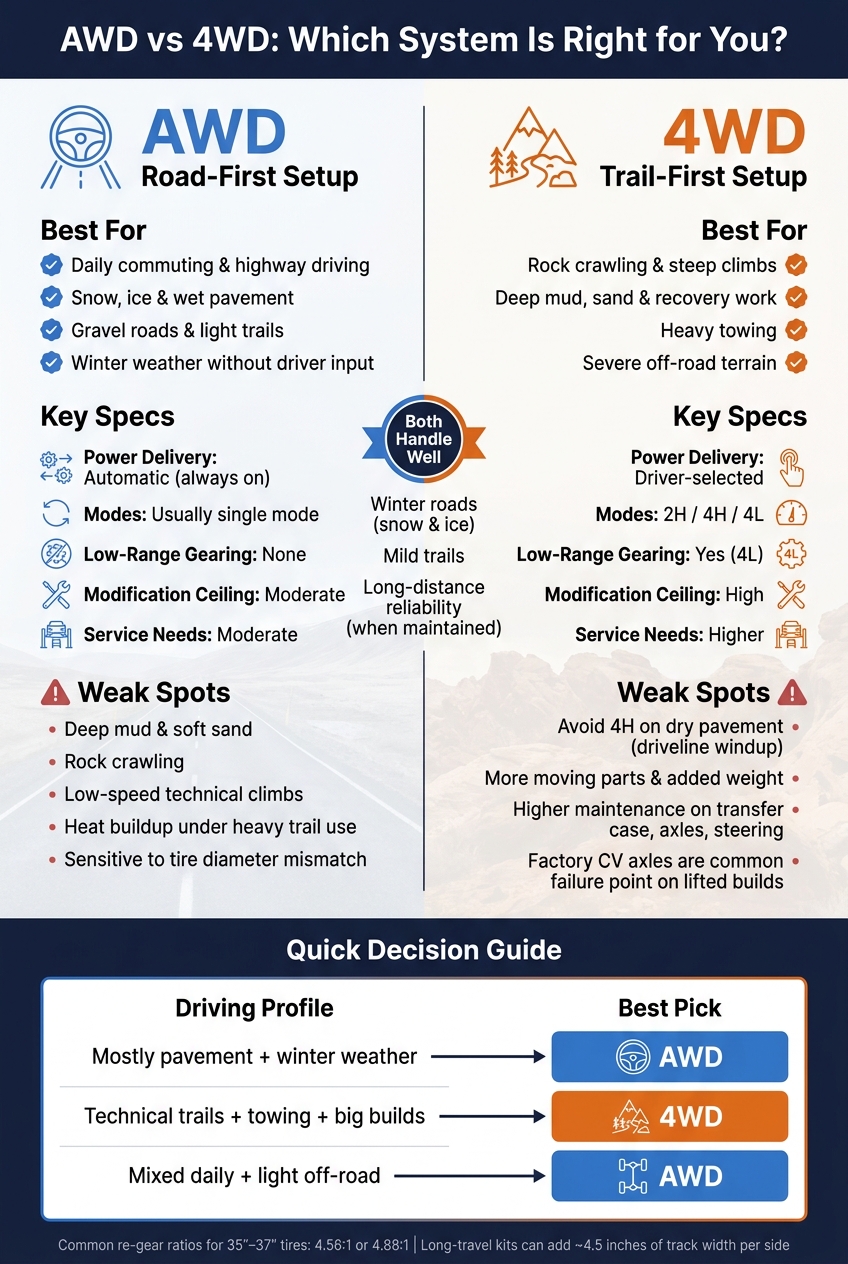
AWD vs 4WD: Which System Is Right for You?
4WD vs AWD | What Is The Actual DIFFERENCE Heavy Mechanic Explains
sbb-itb-afc4690
Quick Comparison
| Criteria | AWD | 4WD |
|---|---|---|
| Power delivery | Automatic | Driver-selected |
| Modes | Usually always on | 2H, 4H, 4L |
| Low-range gearing | No | Yes |
| Best for | Daily driving, winter roads, light trails | Rough trails, sand, mud, rocks, towing |
| Dry pavement use | Strong | Best in 2H |
| Snow and ice | Strong | Strong |
| Soft sand and deep mud | Limited | Strong |
| Rock crawling | Not built for it | Built for it |
| Larger tires and lifts | More limited | More room to build |
| Service needs | Moderate | Higher |
Bottom line: AWD is the road-first setup. 4WD is the trail-first setup.
AWD: Daily Driving, Winter Roads, and Light Trails
AWD works best for people who spend most of their time on pavement but still want extra traction when road conditions change. In plain English, it’s a road-first setup, not something built for deep trails or heavy off-road use.
Where AWD Performs Well
AWD does a good job with commuting, highway driving, and winter weather because it can react fast when traction changes. That’s a big reason so many daily drivers lean on it when roads go from dry to slick in a hurry.
It also fits maintained gravel roads and light dirt trails pretty well. If your idea of “off-road” means backroads, trailheads, or a rough path to a campsite, AWD is usually in its comfort zone.
Where AWD Falls Short
The weak spots show up when the terrain asks for more ground clearance, suspension articulation, and slow-speed control. That’s where AWD starts to run out of room.
Repeated driving in mud, sand, or over rocks can put too much strain on CV joints, axle shafts, and steering parts that were built with pavement in mind. Add bigger tires and a lift, and the load on the driveline and steering goes up even more unless the build gets extra support.
Put simply, AWD usually hits its limits in three places: heat, clearance, and component load.
| Condition | AWD Capability | Notes |
|---|---|---|
| Dry/wet pavement | ✅ Strong | Best daily use |
| Snow and ice | ✅ Strong | Handles winter well |
| Gravel roads and light trails | ✅ Strong | Fits maintained backroads |
| Soft sand | ⚠️ Limited | Traction drops quickly |
| Deep mud | ❌ Limited | Clearance and heat are issues |
| Rock crawling | ❌ Not suited | Drivetrain strength is limiting |
| Low-speed technical climbs | ❌ Not suited | No low-range gearing |
When the trail calls for low-range control and more clearance, 4WD is the better tool for the job.
4WD: Low-Range Control and Severe Terrain
This is where low-range control matters more than on-road comfort. In deep mud, loose sand, steep climbs, and recovery work, 4WD gives you the kind of control that matters when things get rough. That’s why it’s a common pick for off-road rigs built to handle heavy loads and harsh use.
4L multiplies torque and slows wheel speed. In plain English, you get better climbing power, finer throttle input, and stronger engine braking on descents.
When to Use 4H vs 4L
4H makes sense when you need more traction but still want to move at normal trail speeds. Think gravel roads, snowy tracks, or light mud. 4L is for the slow stuff, where control comes first: crawling over rocks, climbing steep grades, pushing through deep sand, or handling winching and recovery work.
| Mode | Best Surface | When to Use | Primary Purpose |
|---|---|---|---|
| 2H | Dry pavement, daily driving | Normal driving | Fuel economy, daily use |
| 4H | Gravel, light mud | Engage before traction is lost | Added traction at trail speeds |
| 4L | Rock, deep mud, sand, recovery | Engage at low speed, usually in Neutral | Torque multiplication, crawl control |
Operating Limits to Know
Most part-time 4WD systems lock the front and rear axles together. On loose terrain, that usually works fine because the tires can slip a bit and relieve the strain. On dry pavement, it’s a different story. That locked connection can cause driveline windup, which puts stress on the transfer case, axles, and differentials. Run 4H on dry pavement long enough, and you can damage parts.
There’s another trade-off too: 4WD adds weight and more moving parts. Factory axles are often a weak spot, especially on long-travel setups where suspension angles increase a lot. Those builds often need stronger axle parts to deal with the extra angle and stress. More control sounds great – and it is – but it also puts more pressure on tire choice, axle strength, and suspension geometry.
Build Planning: Tires, Suspension, and Driveline Support
Once you pick AWD or 4WD, the next steps should line up with that choice. Tire size, suspension geometry, and underbody armor all need to work with the system you have. Those limits shape how far you can go with tires, how much suspension change makes sense, and what kind of driveline support you’ll need. In most cases, AWD builds need matched tires and moderate geometry correction. 4WD builds more often need gear changes, axle support, and limit straps.
Tire and Wheel Choices That Protect the Drivetrain
All four tires need to match in diameter and wear. If they don’t, the drivetrain can bind up and differentials can wear out faster.
Moving to 35-inch or 37-inch tires is common, but there’s a cost. A larger rolling diameter works like a taller gear ratio. That means less low-end punch and more strain on the drivetrain. Builds on 35-inch or 37-inch tires often need a re-gear to ratios like 4.56:1 or 4.88:1 to get that lost torque back and take some load off the system.
Wheel offset and backspacing matter too. This part gets overlooked all the time, but it can make or break fitment. Many long-travel kits are built around a set wheel spec, such as a 17×9 wheel with 4.5-inch backspacing, so the suspension geometry stays where it should and parts like spindles and control arms have enough room.
Once tire size changes, suspension geometry and steering clearance usually need attention too.
Suspension Upgrades for Trail Use and Long Travel
A basic lift gives you more ride height. A long-travel kit goes much further. It replaces factory control arms, spindles, and steering parts with longer, stronger pieces to add wheel travel.
When you install longer control arms and new spindles, caster, camber, and toe all shift. That’s why a professional alignment after suspension work is so important. Skip that step, and the rig can drive poorly, wear tires fast, or both.
Long-travel kits often widen the track by 4.5 inches per side and push the wheelbase forward a bit to help clear larger tires at full compression and steering lock. These builds also need longer brake lines and tighter control over CV angles. On 4WD long-travel setups, extended RCV axle assemblies are often used to deal with the added angle and travel. Limit straps are not optional here. They stop shocks from topping out and help protect CV joints.
LSK Suspension offers long-travel kits, control arms, and weld-it-yourself kits for this kind of setup, which makes sense because these systems often call for permanent frame changes.
After the geometry is handled, the next job is keeping the expensive stuff underneath from getting wrecked.
Protection and Reliability Parts to Add First
Before you go bigger on tires or add power, start with the parts that keep the vehicle alive on the trail. Skid plates help shield the transfer case, differentials, and fuel tank when the terrain gets rocky. Control arms with serviceable pivots are a smart early move because they’re easier to maintain over time. A machined steering clevis replaces the factory tie-rod connection, which can bend during hard off-road use.
Use the table below to match your next upgrade to the system you have.
| Modification Category | AWD Priority | 4WD Priority |
|---|---|---|
| Tires | Closely matched diameter and wear | Closely matched diameter and wear |
| Gearing | Keep gearing matched front to rear | Keep gearing matched front to rear |
| Suspension geometry | Control arm upgrades and alignment correction | Long-travel arms, new spindles, limit straps |
| Driveline protection | Skid plates | RCV axle assemblies and skid plates |
| Cooling | Transmission and differential cooling | Watch front diff heat |
| Protection | Skid plates and reinforced underbody parts | Skid plates and reinforced underbody parts |
Maintenance, Weak Points, and Choosing the Right Setup
Once you change the build, longevity comes down to maintenance and weak spots.
The basics are the same for both systems: service fluids, boots, joints, bearings, bushings, brake lines, and wiring. After any hard trail day, get under the vehicle and look for leaks, cracked boots, and loose connections. That kind of quick check goes a long way. Spot a torn CV boot early, and you may save the axle.
Common Failure Points to Check
AWD systems tend to struggle with center-coupling heat, sensor faults, and mismatched tire diameter. If a sensor goes bad, traction control can stop working the way it should. And even a small front-to-rear tire diameter difference keeps steady stress on the coupling, which can wear it out sooner.
4WD systems come with a different set of trouble spots. The transfer case takes a lot of load in low range, so fluid service matters. On modified long-travel builds, factory CV axles are often the first part to give up. It also pays to inspect upgraded axles and steering parts for play, cracks, and boot damage. Modified setups need longer brake lines and extended ABS wiring that can handle full droop and full lock. Uniballs and rod ends are wear items, so check them for play after every hard run and swap them out once they start to loosen up.
Those weak points tell you a lot about which system makes sense for your kind of driving.
A Direct Checklist for Choosing AWD or 4WD
Use these questions to make the call:
- How much of your driving is on pavement? If most of it is, AWD is usually the better fit.
- Do you drive in winter weather regularly? AWD deals with snow and ice well without driver input.
- How technical is your trail use? Mild trails lean toward AWD. Rocky climbs, deep mud, and sand lean toward 4WD low range.
- Do you plan on larger tires and more suspension work? 4WD usually gives you more room to build.
- Do you tow? A properly built 4WD truck platform is the stronger match for heavy-duty use.
- Are you willing to modify and maintain the drivetrain? AWD is easier to live with; 4WD needs more service and more parts.
Key Takeaways
This is the fastest way to separate the two systems in actual use.
| Use Case | AWD | 4WD |
|---|---|---|
| Daily driving | ✅ Strong fit | ⚠️ Works, but overkill |
| Winter roads | ✅ Strong fit | ✅ Strong fit |
| Mild trails | ✅ Capable | ✅ Capable |
| Technical trails | ⚠️ Limited | ✅ Strong fit |
| Sand and mud | ⚠️ Limited | ✅ Strong fit |
| Towing | ⚠️ Moderate capacity | ✅ High capacity |
| Suspension modification potential | ⚠️ Moderate | ✅ High |
| Long-distance reliability | ✅ Strong fit | ✅ Strong fit when maintained |
FAQs
Is AWD enough for camping and trailhead trips?
Yes. For camping and most trailhead trips, AWD is usually enough if your tires are in good shape and you keep your speed in check. It also helps to be honest about what the terrain will allow. AWD can get you through a lot, but it doesn’t turn every vehicle into a trail rig.
When the road gets rougher – think washboard sections or rocky trails – suspension and tires often matter more than AWD by itself. That’s where many people get tripped up. AWD helps with grip, but it won’t do much if your suspension gets overwhelmed or your tires can’t handle the surface.
For harder use, dedicated off-road suspension kits are made for exactly that kind of job. They’re built around usable wheel travel, which makes a big difference when the trail stops being smooth and starts knocking the vehicle around.
When do I need 4L instead of 4H?
Use 4L instead of 4H when you need more low-speed control and stronger engine braking.
That usually comes up on steep climbs, careful descents, or slow crawling where lower gearing helps more than normal 4H driving.
Do bigger tires hurt AWD or 4WD reliability?
Yes. Bigger tires put more stress on drivetrain parts, and that can hurt reliability if the vehicle isn’t set up for the extra load.
With larger tires, including common 37-inch off-road setups, upgraded parts and a properly engineered suspension system can help maintain 4WD reliability. They do this by handling the added forces more effectively and keeping the vehicle’s geometry in check under hard use.
Leave a Reply