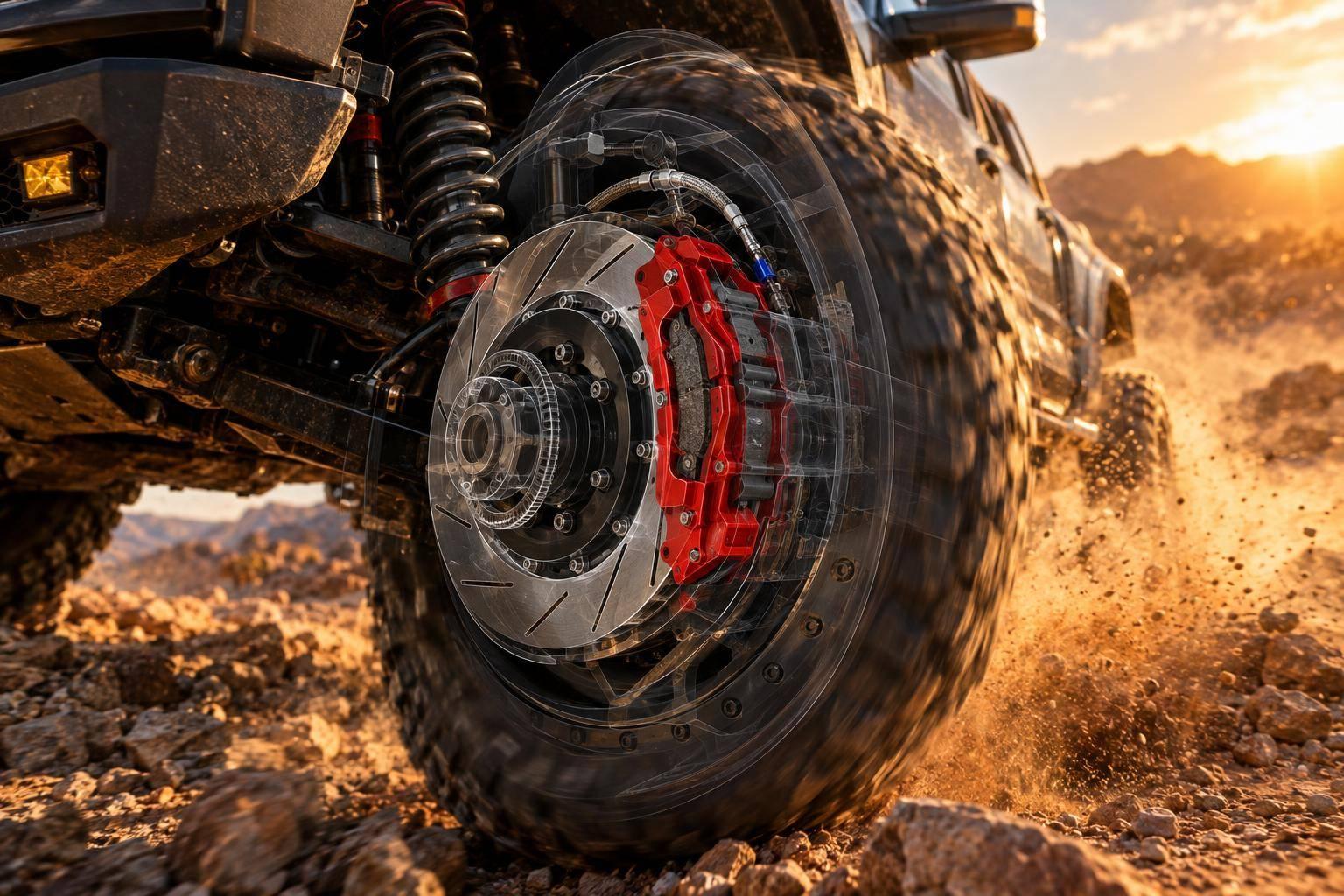
I’d choose a big brake kit for heat control – not a promise of shorter stops. Before buying, I’d check your truck’s loaded weight, wheel clearance, and brake hydraulics. With 37-inch tires, tire leverage and wheel-and-tire weight belong on that list, too.
Here’s what I’d check:
- Use: Cold bite for trails, heat control for loaded descents and towing, or high-temperature pads for racing.
- Parts: Rotor size and thickness, caliper piston area, and pad temperature range – not piston count alone.
- Fit: Your exact truck, wheel barrel and spokes, hub, steering, and suspension travel.
- Compatibility: Master cylinder, brake balance, ABS, stability control, parking brake, and hose routing.
- Total cost: Kit contents, extras, labor, testing, and replacement parts, priced in U.S. dollars.
My final rule: <u>get written fitment confirmation before paying</u>. Bigger brakes don’t change your truck’s factory payload or towing ratings.
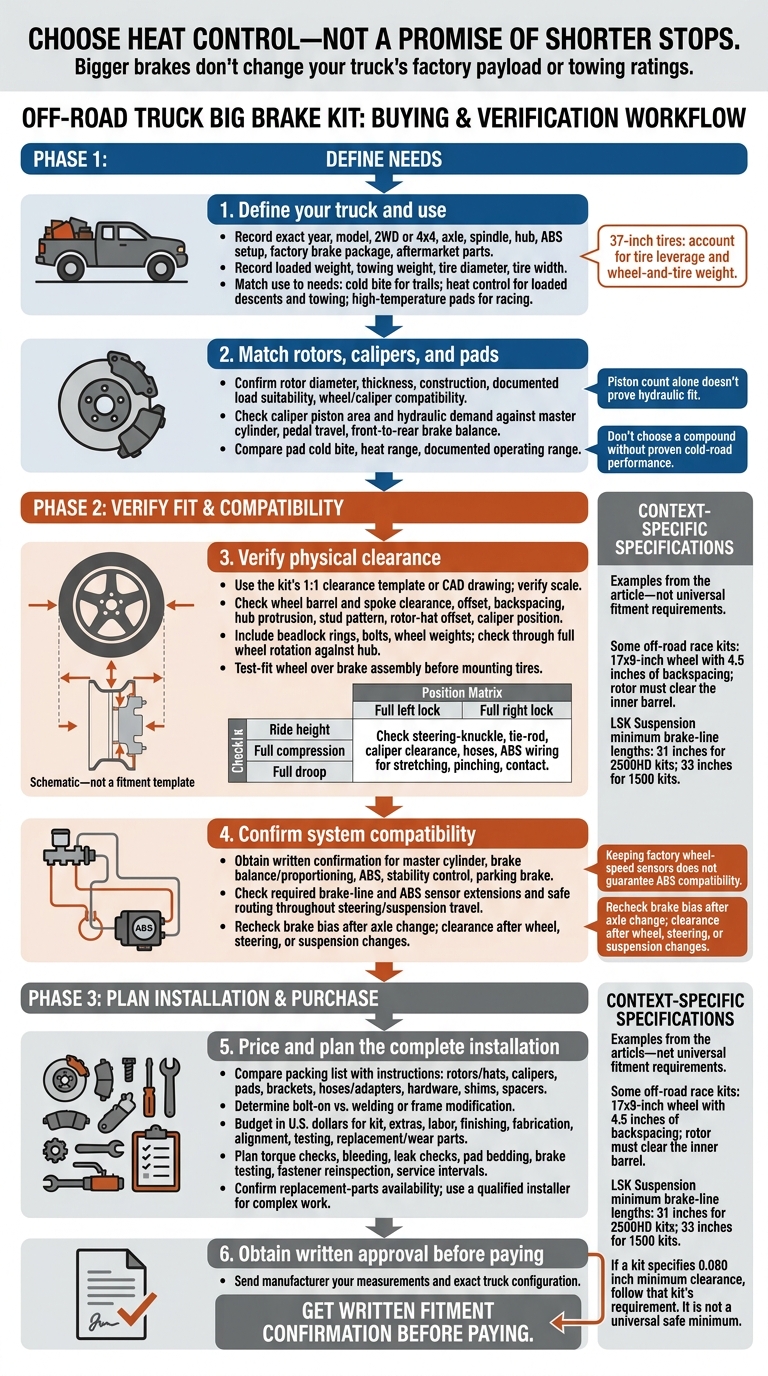
Off-Road Truck Big Brake Kit Buying Checklist
Step 1: Match Rotors, Calipers, and Pads
Choose Rotor Size and Construction
Use the weight, tire, and brake-condition notes above to narrow your rotor options. Vehicle-specific fitment data matters more than diameter alone. Ask the kit manufacturer to confirm rotor diameter, thickness, construction, and compatibility with your wheels and calipers.
If your truck runs 37-inch tires, account for the extra leverage they place on the braking system.
For a loaded heavy-duty truck, look for documented load suitability and heat capacity. Check the complete rotor-and-caliper package against the wheels you actually use.
Some off-road race kits are built around a 17×9-inch wheel with 4.5 inches of backspacing, and the rotor has to clear the wheel’s inner barrel.
Check Caliper Design and Hydraulic Fit
Match the caliper piston area and hydraulic demand to your truck’s master cylinder. Piston count alone doesn’t prove hydraulic fit. Ask the supplier for documentation of piston area and caliper design to confirm compatibility with the stock master cylinder, pedal travel, and front-to-rear brake balance. Check brake bias after any axle change.
Long-travel setups also need enough brake-line length. LSK Suspension specifies minimum lengths of 31 inches for 2500HD kits and 33 inches for 1500 kits.
Choose Pads for Cold Braking and Heat
Match the pad compound to how you drive. Compare cold bite, heat range, and documented operating range, then choose for cold trail braking, hot descents, or sustained race heat. Don’t choose a compound without proven cold-road performance.
sbb-itb-afc4690
Step 2: Measure Wheel and Suspension Clearance
Once you’ve chosen the rotor, caliper, and pad package, check that it fits within the wheel and clears the suspension.
Measure Wheel, Caliper, and Hub Clearance
Wheel diameter alone doesn’t confirm brake clearance. Use the kit’s 1:1 clearance template or CAD drawing. Verify its scale, then check radial and spoke clearance against the wheel before ordering.
| Item | Specification check | Physical check |
|---|---|---|
| Wheel diameter and design | Compare the kit’s clearance envelope with the wheel’s barrel and spoke profile. | Check barrel-to-caliper, spoke-to-caliper, and rotor-to-wheel gaps. |
| Wheel position and hub fit | Confirm offset, backspacing, hub protrusion, stud pattern, rotor-hat offset, and caliper position. | Check clearance with the wheel fully seated against the hub. Make sure the rotor hat and wheel seat clear each other. |
| Beadlock hardware and wheel weights | Include their locations in the clearance check. | Check that rings, bolts, and weights clear the caliper through a full wheel rotation. |
If the kit specifies a minimum clearance, such as 0.080 inch, follow that requirement. It’s not a universal safe minimum. Test-fit the wheel over the brake assembly before mounting tires. A template can’t confirm every hardware or wheel-weight clearance.
Check Clearance Through Steering and Suspension Travel
Check steering-knuckle, tie-rod, and caliper clearance at ride height, full compression, and full droop, with the steering at full left and right lock. At each position, inspect flexible brake hoses and ABS wiring for stretching, pinching, or contact with the wheel and chassis. Repeat these checks after any wheel, steering, or suspension change.
Fabricated spindles and suspension changes can affect available space and hose routing. Confirm fit with a physical test-fit at ride height, full compression, and full droop. Complete these checks before moving to kit contents and installation requirements.
Step 3: Check Kit Contents and Installation Requirements
Once you’ve confirmed clearance around the wheels and suspension, check the kit’s parts, hydraulics, and installation requirements before ordering.
Match the kit to your exact truck: year, model, 2WD or 4×4, axle, spindle, hub, ABS setup, factory brake package, and aftermarket parts. Fabricated spindles and HD trims can affect fitment, so confirm compatibility with the supplier before buying.
Confirm Included Parts and Required Extras
Check what comes in the box – and what you’ll need to buy separately.
Compare the packing list with the installation instructions. Look for rotors or rotor-and-hat assemblies, calipers, pads, vehicle-specific brackets, hoses or adapters, hardware, shims, and any required spacers. Also confirm whether the kit bolts on or needs welding or frame modification.
Budget for the full installed cost in U.S. dollars, including the kit, labor, finishing, fabrication, alignment, and wear parts.
Check Hydraulics and ABS Compatibility
Confirm that the kit works with your truck’s hydraulic and ABS setup.
Check whether you need brake-line or ABS sensor extensions. Route lines and sensor wiring so they stay clear at full steering lock and throughout suspension compression and droop. Keeping the factory wheel-speed sensors does not guarantee ABS compatibility.
Plan Installation, Brake Testing, and Service
Follow both the kit and vehicle instructions for torque settings, bleeding, leak checks, and pad bedding. Have a qualified installer handle work beyond your skill level. Recheck fasteners on the specified schedule, align the truck after major suspension changes, and set service intervals for wear parts.
Conclusion: Complete the Checklist Before Ordering
Choose brakes for your truck’s actual load and heat demands – not rotor size alone. Check fitment, hydraulics, and installation requirements. Before ordering, use this checklist to confirm the measurements and specs.
| Check | Confirm before ordering |
|---|---|
| Vehicle data | Exact truck, drivetrain, factory brake package, loaded weight, towing weight, tire diameter, and tire width. |
| Performance needs | How you’ll use the truck, rotor specs, and pad operating range. |
| Fitment | Caliper mounting, hydraulic requirements, wheel size and width, backspacing, hub clearance, and suspension clearance. |
| Hydraulics | Written confirmation of compatibility with the master cylinder, proportioning, ABS, stability control, and parking brake. |
| Maintenance | Service procedures, replacement parts, and parts availability before ordering. |
| Installation | A documented plan for brake testing, reinspection, and alignment that follows kit and vehicle procedures. |
Send the manufacturer your measurements and truck configuration. Get written confirmation before paying.
FAQs
Do I need bigger brakes for 37-inch tires?
37-inch tires alone usually don’t require bigger brakes. The decision depends on your truck’s weight, speed, and the heat generated during braking. Pay closer attention to those factors with heavier builds, technical terrain, or racing.
LSK Suspension’s off-road race long-travel kits are designed around 37-inch tires and include matching components, such as extended brake lines. You’ll still need the right wheels and backspacing for proper fitment and performance.
Should I upgrade both front and rear brakes?
Upgrading both front and rear brakes helps keep braking balanced, especially on high-performance off-road trucks. The front brakes provide most of the stopping force, but upgrading the rear brakes helps maintain steady braking and stability – particularly with larger tires or more horsepower.
Use matching upgraded rotors and pads at both ends for reliable braking on tough trails or during races. Choose a brake setup that fits your vehicle’s weight and how you plan to use it.
Can one pad compound handle trails and racing?
Your vehicle and driving style determine the right pad compound. Some high-performance compounds can handle both uses, but racing often calls for specialized materials that withstand extreme heat and sustained braking pressure.
For off-road trucks – even those driven on the street occasionally – look for a compound that balances initial bite and cold performance on trails with fade resistance during high-speed desert driving or racing.
Leave a Reply