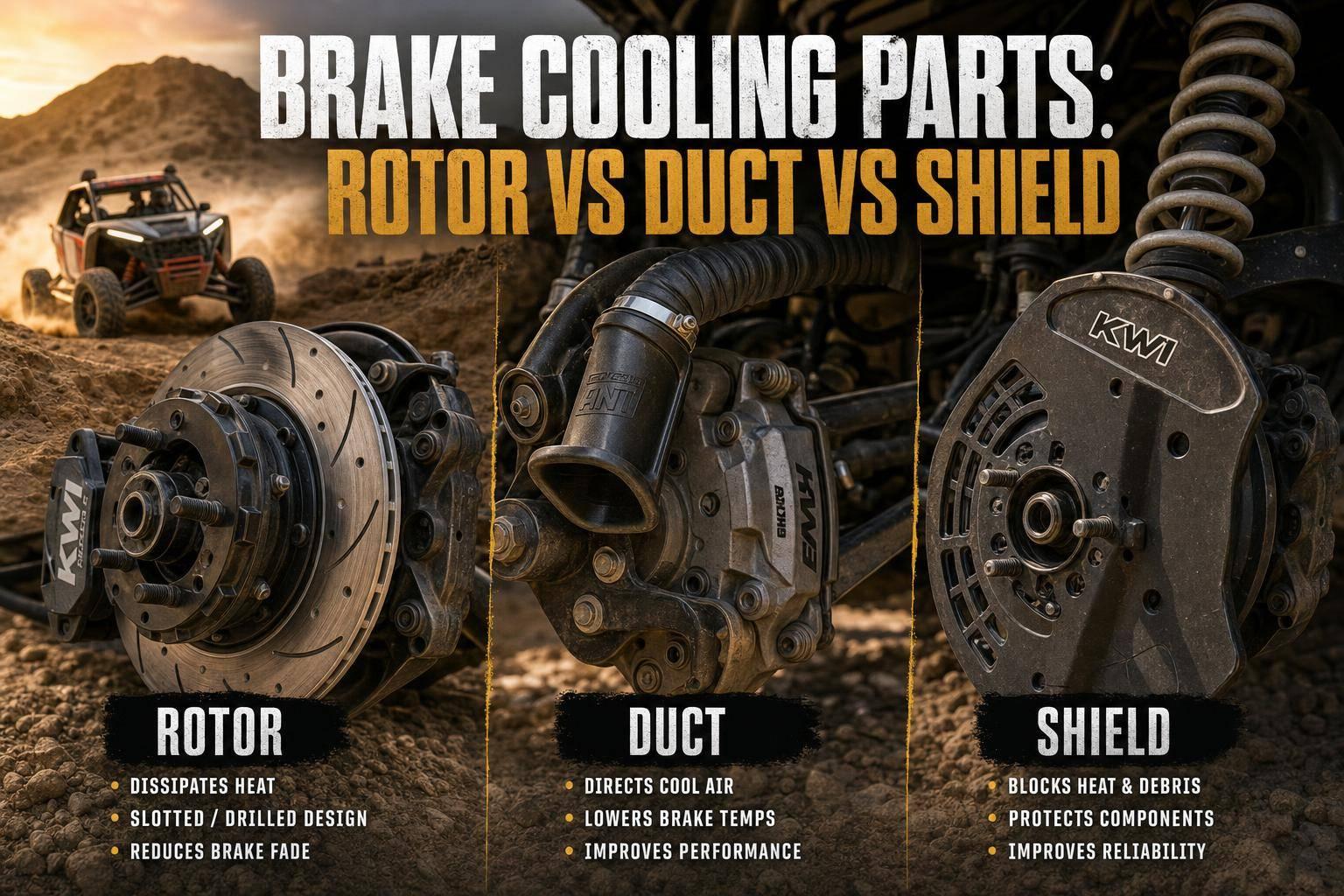
If your brakes get hot off-road, the fix depends on the problem: rotors deal with heat, ducts feed air, and shields guard nearby parts.
I’d break it down like this:
- Vented rotors are the best all-around pick for most rigs
- Brake ducts make sense when the truck spends a lot of time at speed
- Heat shields help protect brake lines, seals, sensors, and rod ends
- On a heavy truck near 8,000 pounds, brake heat can build fast on long descents and repeated stops
- Suspension travel matters too, since long-travel setups can add 4.5 inches per side and up to 19.25 inches of wheel travel, which can make routing and clearance harder
If you want the short answer, I’d say this: pick rotors for heat capacity, ducts for airflow, and shields for part protection. For many overland and trail builds, vented rotors plus heat shields is the setup that makes the most sense.
Quick Comparison
| Part | Main Job | Best For | Cost | Install |
|---|---|---|---|---|
| Vented Rotor | Moves and stores heat | Heavy trucks, towing, trail use, desert use | Moderate to high | Moderate |
| Brake Duct | Sends cool air to brakes | Fast desert running | Moderate | High |
| Heat Shield | Blocks heat from nearby parts | Crawling, slow trails | Low | Low to moderate |
So before buying parts, I’d first ask one simple question: are you fighting brake heat, low airflow, or heat damage to nearby parts?
Brake Cooling Basics and Quick Comparison
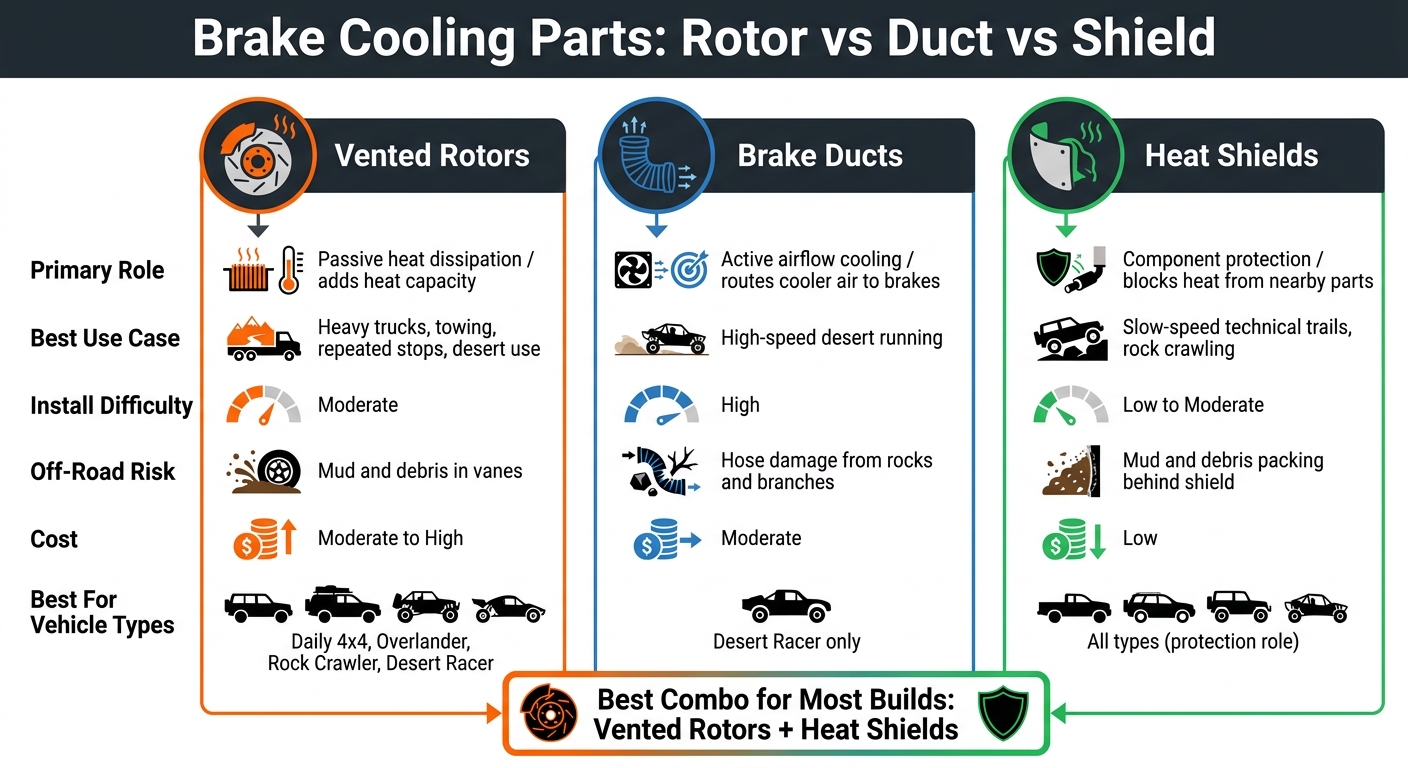
Brake Cooling Parts Compared: Rotor vs Duct vs Shield
How Heat Leaves the Brake System
Brake heat starts with kinetic energy. When a heavy off-road rig slows down, that moving energy turns into heat at the brakes.
On long descents or during repeated stops, temperatures can climb fast. And on bigger, heavier builds, that happens even faster. At that point, you usually have three ways to deal with it: add more rotor capacity, push more air to the brakes, or block heat from reaching nearby parts.
Large tires and long-travel suspension also put more strain on the brake system. Put simply, the harder the brakes have to work, the more heat they make.
Rotor vs Duct vs Shield: Side-by-Side Comparison
Here’s the quick comparison.
| Vented Rotor | Brake Duct | Heat Shield | |
|---|---|---|---|
| Primary Role | Add heat capacity and passive cooling | Route cooler air toward the brakes | Protect nearby components from heat |
| Best Fit | Heavy trucks and high-speed desert rigs | High-speed desert runs | Rock crawling and rough trails |
| Typical Cost | Moderate to high | Moderate | Low |
| Install Effort | Moderate | High | Low |
Pick the part based on the main problem you’re trying to solve: heat capacity, airflow, or shielding. The next section breaks down which option makes sense for each off-road setup.
sbb-itb-afc4690
Vented Rotors vs Brake Ducts vs Heat Shields
These three parts do different jobs, so the best pick comes down to how the rig is used.
Vented Rotors: Passive Cooling and Heat Capacity
Vented rotors use internal vanes to move heat out of the rotor without any extra plumbing or routing. That makes them a good match for heavy trucks, towing, and repeated stops where brakes keep getting worked.
On many bolt-on setups, install is fairly direct. The big off-road issue is simple: mud and debris can get packed into the vanes. A quick inspection now and then helps keep them from clogging up.
If airflow matters more than rotor mass, ducting is the next thing to look at.
Brake Ducts: More Airflow, More Install Work
Brake ducts send cooler air to the brakes through hoses and custom ducting. They work best when the vehicle stays at speed for long stretches, which is why they make more sense for desert running than crawling.
Off-road, ducts are the easiest to damage. Rocks, branches, and suspension movement can all beat up the hoses or routing. Install is also the most involved of the three. You need custom routing, and that routing has to work around ABS sensor lines and extended brake lines.
Heat Shields: Component Protection with Lower Install Effort
Heat shields help protect brake lines, seals, and ABS sensors from heat coming off the rotor and caliper. They make the most sense on slow-speed technical trails and rock-crawling setups, where airflow is limited but nearby parts still need a barrier from heat.
The main tradeoff is buildup. Mud and debris can collect behind the shield, so it’s smart to check the area after muddy runs.
| Feature | Vented Rotors | Brake Ducts | Heat Shields |
|---|---|---|---|
| Primary Benefit | Passive heat dissipation | Active airflow cooling | Component protection |
| Best Use Case | Heavy trucks, towing, repeated stops | High-speed desert running | Slow-speed technical trails, rock crawling |
| Install Difficulty | Moderate | High | Low to moderate |
| Off-Road Risk | Mud and debris in vanes | Hose damage from rocks and branches | Mud and debris packing behind shield |
| Cost | Moderate to high | Moderate | Low |
Next, it helps to match the cooling part to the rig’s actual job: overlanding, crawling, desert running, or daily driving.
Which Part Fits Your Off-Road Setup
Best Choices for Overlanders, Crawlers, Desert Trucks, and Daily 4x4s
Start with how the vehicle is used most of the time. That alone cuts through a lot of the guesswork. Daily driving, crawling, overlanding, and desert running each put different demands on the brakes, so the right part depends on whether you need more heat handling, more airflow, or just extra protection.
| Vehicle Type | Vented Rotors | Brake Ducts | Heat Shields |
|---|---|---|---|
| Daily 4×4 | Best fit | Limited use | Protection only |
| Overlander | Best fit | Limited use | Protection only |
| Rock Crawler | Best fit | Skip | Protection only |
| Desert Racer | Best fit | Best fit | Protection only |
For most overlanders, the sweet spot is vented rotors plus heat shields. That combo handles heat well and adds protection underneath. Brake ducts usually add more work than payoff for this kind of build.
Rock crawlers can usually forget ducts altogether. At crawl speeds, there just isn’t much airflow to push through them, so they don’t do much. Vented rotors make more sense here because they help deal with heat from repeated low-speed braking on technical sections.
Desert trucks and pre-runners are a different story. They spend enough time moving fast that brake ducts can actually do their job. In that setup, directed airflow can help keep brake temps in check.
How Suspension and Fabrication Affect Brake Cooling
Cooling parts have to fit the truck you built, not the one in the catalog. On lifted and long-travel setups, fitment can matter just as much as the cooling gain.
Long-travel suspension changes brake line length, hose slack, and clearance through the full range of movement. Long-travel kits like those from LSK Suspension can extend track width by 4.5 inches per side and increase wheel travel to 12.5 to 19.25 inches. That kind of change can get in the way fast. Custom shock towers and fabricated spindles may block duct routing or make heat shields hard to mount.
Before you lock anything in, cycle the suspension through full droop and compression, then turn the steering lock-to-lock. It’s the simplest way to catch rubbing, binding, or routing problems before final installation.
Conclusion: Choosing Between Rotor, Duct, and Shield
After looking at heat capacity, airflow, and protection, the choice comes down to what each part actually does. Vented rotors add heat capacity, ducts add airflow, and heat shields protect nearby parts.
The best pick depends on your budget, how much install work you’re willing to take on, how well the part holds up, and how you use the truck. For daily 4x4s, bolt-on parts that keep the job simple usually make the most sense. For desert trucks, crawlers, and hard-used tow rigs, vented rotors and heat shields are often the better match, while ducts take the most work to install.
Once your use case is clear, fitment is what decides whether the part will work on the truck.
Before install, check wheel, caliper, and duct clearance. Then verify clearance through full droop, compression, and steering lock. Check fitment before final assembly.
FAQs
How do I know if my brakes need rotors, ducts, or shields?
It comes down to how you drive and where you drive.
Vented rotors help shed heat on higher-output setups, especially if you’re running larger tires or extra horsepower. Brake ducts can help during long off-road stretches by pushing more airflow toward the brakes when heat starts to pile up. And heat shields help block radiant heat from reaching nearby parts that don’t handle it well.
If you’re dealing with brake fade or braking that feels uneven on trips, that’s often a sign your current cooling setup may need an upgrade.
Are vented rotors enough for most overland builds?
It depends on vehicle load and how hard you drive.
Vented rotors shed heat better than solid discs. That helps in many setups. But for heavier rigs or long stretches of high-speed off-road driving, vented rotors alone may not be enough.
In more demanding builds – especially heavy-duty or long-travel setups – you may need extra brake cooling beyond standard vented rotors. The goal is simple: keep braking feel steady and keep stopping power safe when heat starts to build.
Will brake ducts survive long-travel suspension use?
Usually not. Long-travel suspension setups use a lot of wheel movement and more complex geometry, which leaves very little space for brake ducts. On top of that, those ducts are easier to damage or yank loose when the suspension is working hard.
For off-road rigs with long-travel systems, high-performance rotors and pads are usually the safer bet for heat control. They handle brake heat well without the added risk that comes with auxiliary ducting.
Leave a Reply