When deciding between Weld-It-Yourself (WIY) and Pre-Built Kits for your off-road build, it boils down to your skills, budget, and goals. WIY kits are cheaper (about 50% less) and allow flexibility during assembly but require welding skills, tools, and more time. Pre-built kits are ready to install, saving effort and offering professional finishes, but they cost significantly more and have limited customization.
Quick Overview:
- WIY Kits: Lower cost, high customization, requires welding and tools, takes more time.
- Pre-Built Kits: Higher cost, ready-to-install, minimal tools required, limited flexibility.
Quick Comparison
| Factor | WIY Kits | Pre-Built Kits |
|---|---|---|
| Upfront Cost | ~$600–$1,200 | $3,450–$5,999+ |
| Customization | High | Limited |
| Skill Required | Welding and fabrication experience | Basic mechanical skills |
| Time Investment | 6–16+ hours | 6–10 hours |
| Shipping | Cheaper (standard parcel) | More expensive (freight) |
| Finish | DIY (paint/powder coating needed) | Professional |
Choose WIY kits for budget-friendly, flexible builds if you have the skills and tools. Opt for pre-built kits for convenience and professional-grade results if cost isn’t a concern.
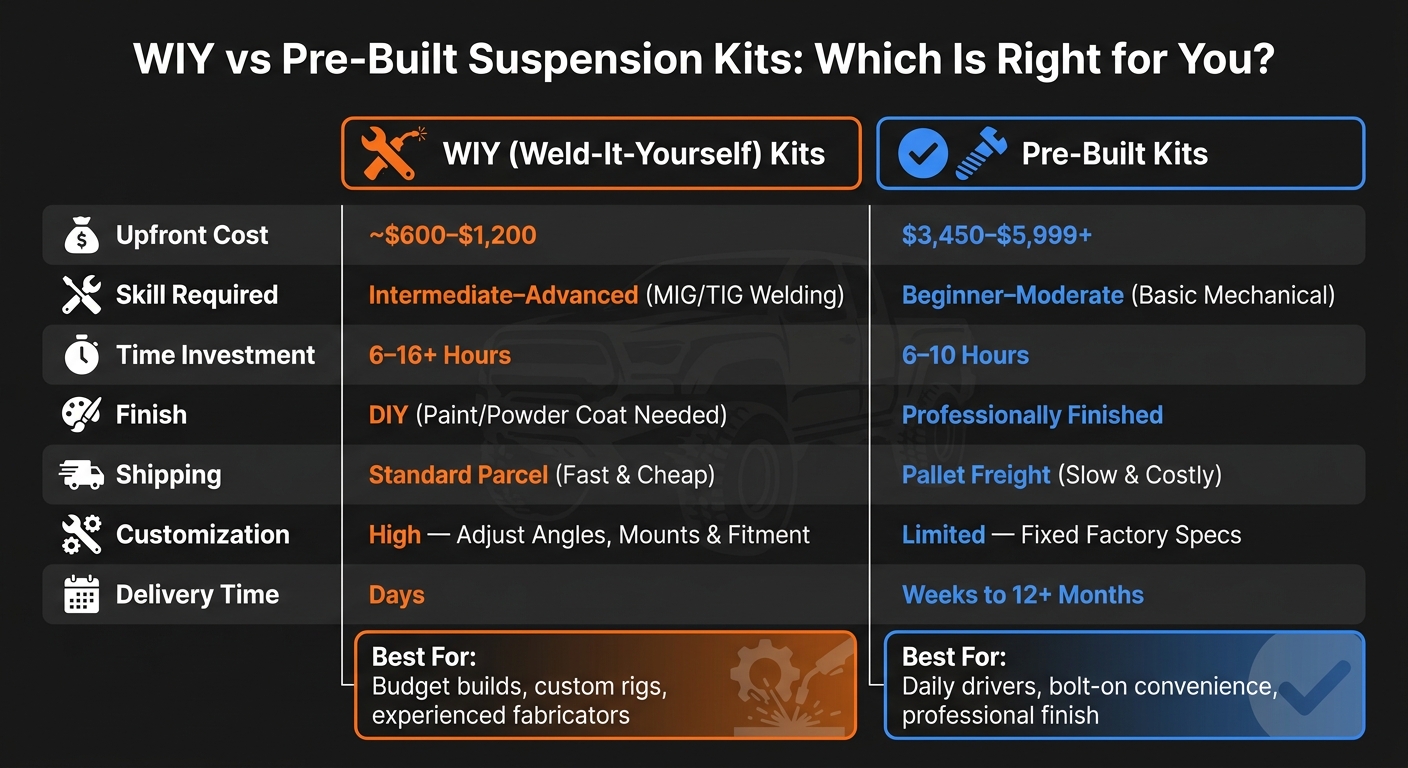
WIY vs Pre-Built Suspension Kits: Side-by-Side Comparison
What Are Weld-It-Yourself Kits?
Weld-it-yourself (WIY) kits provide all the pre-cut and pre-machined raw materials you need to assemble a suspension component or structural part on your own. Instead of receiving a finished product, you get the necessary pieces and take on the task of assembly yourself. These kits are a more affordable option and give you greater control over the final outcome.
What Comes in a WIY Kit
Typically, WIY kits include precision CNC laser-cut and notched DOM tubing, mounting brackets, gussets, and specialty tabs like brake line mounts or limit strap tabs. Pivot hardware is another common inclusion, such as poly bushings, rod ends, and weld-on tube ends. You’ll also usually find Grade 8 bolts and nylock nuts for critical connections. For example, LSK Suspension offers weld-it-yourself options like roll cage kits and impact wrench mounts that integrate directly into your build.
That said, some essentials aren’t included. Welding wire, shielding gas, grinding discs, primer, and paint are your responsibility. Since the kits arrive as raw steel, you’re in charge of all finishing work from the start.
While the kits provide the components, the assembly process depends heavily on your skills, tools, and workspace setup.
Skills, Tools, and Workspace Needed
WIY kits demand a certain level of expertise. You need to be confident in producing strong, clean welds on structural steel – because when it comes to suspension components or bumpers, weak welds aren’t just an aesthetic issue; they’re a safety hazard. MIG welding is the go-to method, and a 220V welder is strongly recommended over a 110V one for working with steel in the 3/16" to 1/4" thickness range.
Aside from a welder, you’ll need an angle grinder (with flap and grinding discs), magnetic clamps or C-clamps, a tape measure, and a level. For suspension-specific projects, additional tools like a torque wrench, floor jack, and a press for bushings may be necessary. Your workspace should have proper ventilation and a stable 220V power supply. And for larger assemblies, having a second person to help hold and tack-weld heavy steel pieces is crucial.
"Why spend days taking measurements of your vehicle and cutting out pieces of metal by hand when you can leave those tedious and time consuming steps to the robots!" – Coastal Offroad
WIY Kits: Pros and Cons
Once you’ve considered the components and skills required, it’s worth weighing the advantages against the time and effort involved.
One major benefit is cost. For example, WIY bumper kits are priced around $600 compared to over $1,200 for pre-assembled options. That’s roughly a 50% savings, which can be significant for larger projects. Shipping is also more affordable and quicker since the flat-packed raw materials ship via standard parcel instead of pallet freight.
However, the trade-off is time and skill. An experienced fabricator using proper jigs might complete a parallel 4-link suspension kit in 4–6 hours of welding. For a DIY builder, that timeline could easily double. And if your welds don’t meet the necessary standards, you’re risking structural failure.
| Factor | WIY Kits |
|---|---|
| Upfront Cost | ~50% less than pre-built |
| Customization | High – adjust mounts, angles, and fitment during assembly |
| Time Investment | 6–16+ hours depending on complexity |
| Skill Required | Intermediate to advanced MIG/TIG welding and fabrication |
| Finish | Raw steel – requires painting or powder coating |
| Shipping | Standard parcel; cheaper and faster than freight |
| Risk | Errors during assembly can lead to structural failure |
These factors paint a clear picture of what WIY kits offer and the effort they require compared to pre-built alternatives.
sbb-itb-afc4690
What Are Pre-Built Kits?
Pre-built kits are essentially ready-to-install suspension systems made of professionally fabricated components. These kits are designed to bolt directly onto your vehicle, eliminating the need for cutting, welding, or fabricating parts on-site. Instead of starting from raw materials, you simply remove the stock parts and replace them with these pre-engineered components.
What Comes in a Pre-Built Kit
A typical pre-built kit includes a variety of key suspension components, such as:
- Upper and lower control arms (often reinforced for added strength)
- Fabricated spindles
- Extended heim-jointed tie rods
- Coilover adapters
- Grade 8 hardware with stainless misalignment spacers
For instance, LSK Suspension offers the 07–21 Tundra Bolt-On Long Travel Kit for around $5,975. This kit includes all the components mentioned above and increases wheel travel from the stock 8–10 inches to approximately 14.5 inches.
It’s important to note that shocks are usually sold separately. Items like coilovers, bypass shocks, bump stops, and limit straps are not part of the base kit price. These additional components often have lead times of 8–10 weeks, so planning ahead is crucial.
Once you know what’s included, the next step is preparing for the installation.
Installation Requirements and Tools
While these kits are labeled "bolt-on", installing them does require some basic mechanical know-how. Here’s what you’ll need:
- A complete socket set (both standard and metric)
- Torque wrench
- Floor jack and heavy-duty jack stands
- Ball joint separator
- Spring compressor (if the kit involves strut or coilover assembly)
In some cases, minor welding may still be required, such as for installing cam lockout plates or bump stop mounts. The installation process typically takes 6–10 hours and involves removing factory components, securing the new hardware, adjusting ABS and brake lines, and getting a professional alignment. Alignments usually cost between $100–$200.
These installation requirements highlight both the benefits and the challenges of using pre-built kits.
Pre-Built Kits: Pros and Cons
Pre-built kits are all about consistency and reliability. Every component is engineered, welded, and quality-checked before shipping. For example, LSK Suspension products boast a 4.71 out of 5 rating from 347 reviews, with customers frequently praising the "awesome fit and finish". This level of precision is difficult to achieve with DIY fabrication.
However, this convenience comes at a price. Pre-built long-travel kits from LSK start at $3,450 for the 19+ Silverado 1500 and go up to $5,999 for the Duramax Front Long Travel Kit. When you add shocks, extended brake lines, and professional labor (which can cost $800–$2,000), the total expense of a full build can approach $20,000. Unlike weld-it-yourself kits, pre-built options offer little flexibility to adjust mounting angles or geometry during assembly.
For those who value ease of installation and dependable performance, pre-built kits are an excellent choice, though they do come with a premium price tag.
| Factor | Pre-Built Kits |
|---|---|
| Upfront Cost | Higher – kits start at $3,450 and up, excluding shocks |
| Customization | Limited – components are pre-fabricated to fixed specs |
| Time to Install | 6–10 hours of professional labor |
| Skill Required | Mechanical; minor welding may still be needed |
| Finish | Professionally welded |
| Risk | Low fabrication risk; errors are more likely during installation |
WIY vs Pre-Built Kits: A Direct Comparison
Let’s break down these kits side by side to understand how they differ in practical terms.
Side-by-Side Attribute Comparison
| Factor | WIY Kits | Pre-Built Kits |
|---|---|---|
| Up-Front Cost | Lower – about 50% of pre-built equivalents | Higher – includes labor for manufacturing and finishing |
| Skill Required | Intermediate to advanced (welding is necessary) | Beginner to moderate (bolt-on; some minor welding possible) |
| Delivery Time | Days | Months – sometimes over 12 months |
| Shipping | Standard parcel (fast and cost-effective) | Pallet freight (slower, pricier, and may include shop fees) |
| Customization | Customizable during assembly | Limited – fixed specs can cause fitment issues |
| Fitment Flexibility | Adjustable for frame variances | Fixed specs may create challenges in certain setups |
| Finish | Owner-applied (paint or powder coating) | Professionally finished |
Source:
This table gives a quick overview of how these kits measure up. Next, let’s dive into how they align with different build goals.
How Each Kit Type Fits Different Build Goals
Choosing the right kit boils down to what you want from your build and how you plan to use your vehicle.
For something like a daily driver or an overland rig, a pre-built bolt-on kit is often the better choice. It offers a professionally engineered solution with predictable installation times and avoids the need for specialized tools or a fabrication space. Take the LSK Suspension 07–21 Tundra Bolt-On Long Travel Kit, for instance. It provides about 14.5 inches of wheel travel right out of the box – significantly more than the stock 8–10 inches – without requiring any cutting or custom fabrication.
On the other hand, if you’re building a dedicated off-road or race vehicle, WIY kits deliver unmatched flexibility. They allow you to tweak geometry, add custom light cutouts, or adjust mounting points to fit your specific needs. This is especially useful for vehicles that have been modified, such as those with body lifts or frame adjustments.
"With DIY bumper kits, you get to customize your bumper to your liking… DIY bumper kits give you the ability to customize your bumper to be uniquely your own and match your vision of the ultimate offroad bumper." – Coastal Offroad
These differences go beyond just assembly; they shape your entire approach to the build and its long-term value.
Total Cost and Long-Term Factors
Initial costs only tell part of the story. While WIY kits are budget-friendly up front, you’ll need to factor in additional expenses for welding equipment, safety gear, and finishing materials. Even with these added costs, they can still be more affordable when compared to pre-built kits, which often come with higher shipping fees due to pallet freight and possible shop receiving charges.
Pre-built kits, while convenient, come with a heftier price tag. Labor for installation alone can range from $800 to $2,000, and when you add shocks, brake lines, and alignment services, a complete build can approach $20,000. Plus, modifying a pre-built kit later can be tricky. Adjusting a mounting angle or adding a custom bracket often means working against a finished product, whereas WIY kits let you shape the design to your exact needs from the start.
Conclusion: Which Kit Should You Choose?
Choosing the right kit boils down to three key factors: your skills, your budget, and your build goals.
If you’ve got access to tools like a welder and grinders, along with the confidence to tackle fabrication – or the willingness to learn – WIY (Weld-It-Yourself) kits offer unmatched flexibility. They can save you around 50% upfront and allow you to tweak fitment as needed during the build process.
On the other hand, if you’d prefer to avoid fabrication entirely, a pre-built kit might be the better choice. These kits are designed for bolt-on installation, eliminating the need for a shop setup. They arrive ready to install and deliver a polished, professional finish. However, keep in mind that pre-built kits often come with longer lead times and higher shipping expenses due to pallet freight. If you’re looking for a middle ground, weigh the trade-offs between customization and long-term maintenance.
For a weekend trail rig, it’s worth considering maintenance needs and the type of bushings or joints you prefer. Heim joints offer excellent articulation but require lubrication every 10,000 miles. Meanwhile, rubber or urethane bushings are a lower-maintenance option, ideal for lighter use and less frequent upkeep.
LSK Suspension offers solutions for both WIY and pre-built kits, catering to a range of needs and experience levels. Whether you’re starting small with a $69.99 weld-it-yourself impact mount or diving into a long travel suspension kit, there’s an option that aligns with your current goals and skill set.
FAQs
Do I need a 220V welder for a WIY kit?
When it comes to weld-it-yourself kits, a 220V welder isn’t always necessary. The voltage you’ll need depends on the type of project and the welder you’re using. In the U.S., many DIY welders are designed to operate on standard household voltage (120V), which is usually enough for most kits. Always double-check the specific requirements of your kit before you begin.
What extra parts or services will I still need with a pre-built kit?
When using a pre-built kit, you might still have to purchase extra components or services. These can include tires, wheels, protective gear, or even lighting upgrades. Depending on the specifics of your off-road setup and personal preferences, other accessories or custom modifications might also be necessary.
Which kit is easier to maintain for a weekend trail rig?
Pre-built kits are a great option for a weekend trail rig because they’re built with ease of maintenance in mind. These kits are specifically designed to be durable and easy to install, which means you’ll spend less time dealing with adjustments or repairs. In contrast, weld-it-yourself kits can be more demanding. Since they involve custom fabrication, there’s a higher chance of issues like weak mounting points or poor fitment cropping up over time. If you’re looking for a low-maintenance and straightforward solution, pre-built kits are the way to go.
Leave a Reply