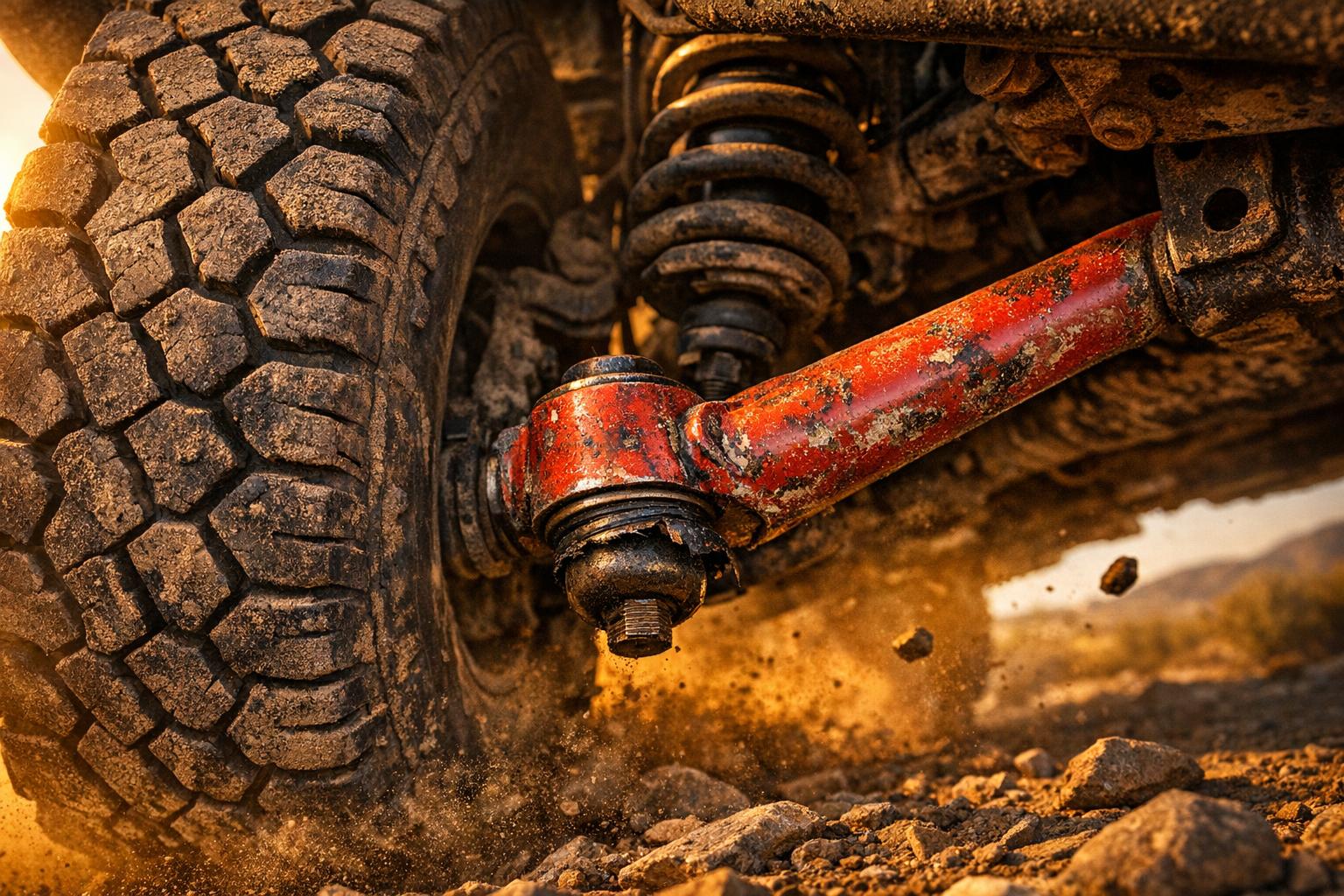
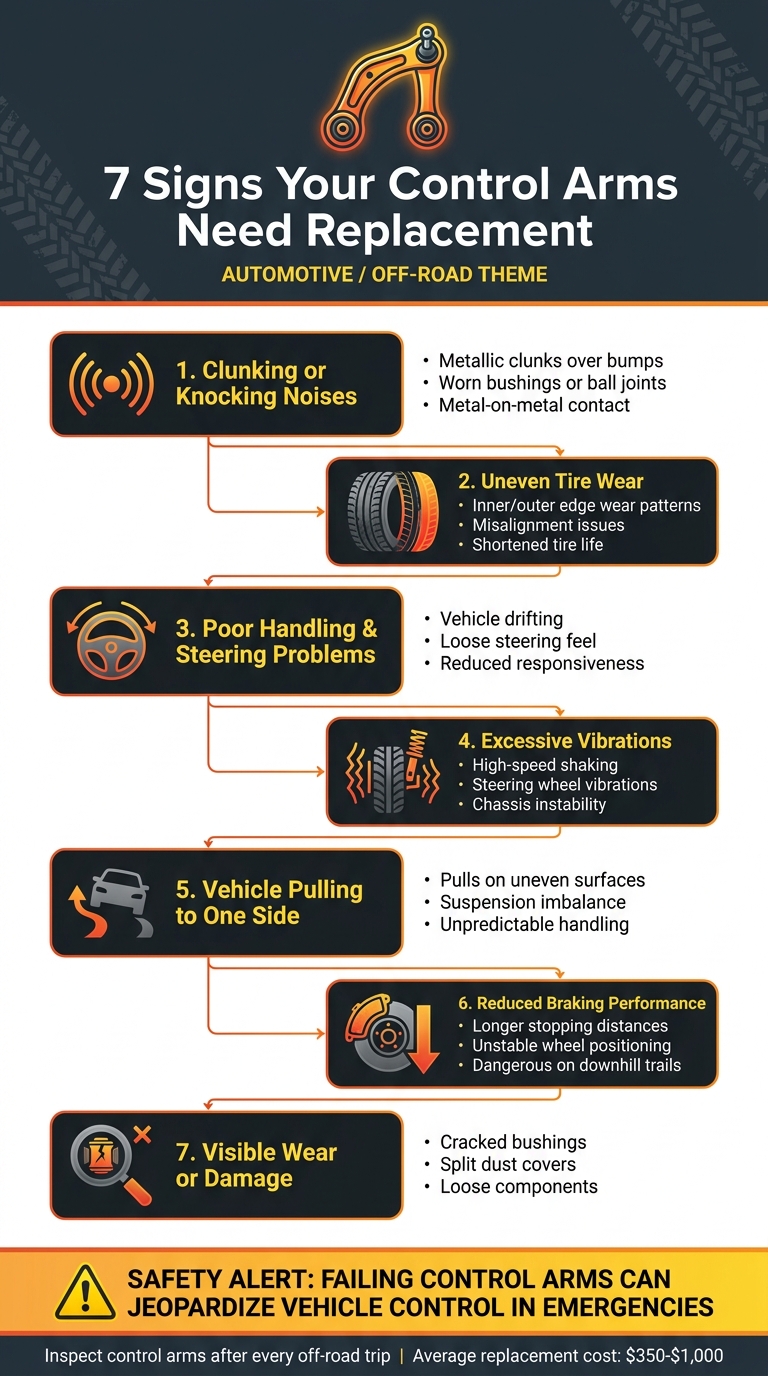
Control arms are critical for your vehicle’s suspension and handling, especially in off-road conditions. Ignoring wear and tear can lead to poor performance, uneven tire wear, and even safety risks. Here are the seven key signs that indicate it’s time to replace your control arms:
- Clunking or knocking noises over rough terrain, often caused by worn bushings or ball joints.
- Uneven tire wear, which signals misalignment due to failing control arm components.
- Poor handling and steering problems, such as drifting or loose steering.
- Excessive vibrations during high-speed off-roading, stemming from worn bushings or ball joints.
- Vehicle pulling to one side on uneven surfaces, indicating suspension imbalance.
- Reduced braking performance on downhill trails, caused by unstable wheel positioning.
- Visible wear or damage on control arm bushings and ball joints, such as cracks or loose components.
Regular inspections and timely replacements are essential, especially for lifted trucks or vehicles used in tough off-road conditions. Addressing these issues early helps maintain safety, proper alignment, and suspension performance.
7 Warning Signs Your Vehicle’s Control Arms Need Replacement
Top 7 Symptoms of a BAD Control Arm | Signs Control Arm is BAD
sbb-itb-afc4690
1. Clunking or Knocking Noises Over Rough Terrain
Hearing metallic clunks while driving over bumps or uneven terrain? That could be a sign your control arms are wearing out. These noises often stem from worn-out bushings or failing ball joints, which lead to metal parts coming into direct contact.
The lower control arm is usually the first to wear out since it bears most of the vehicle’s weight and takes the brunt of impacts on rough roads. When bushings wear down, the control arm housing can shift off-center from its bolts, causing knocking sounds during suspension movement. Similarly, ball joints can start making noise if their dust covers crack, letting dirt in and drying out the lubrication.
Impact on Suspension Performance
These noises aren’t just annoying – they’re a warning that your suspension’s performance is compromised. Worn components can cause unwanted movement in the suspension system, throwing off your wheel alignment. Automotive expert Paulster2 explains:
There should be zero deflection between the lower control arm and the spindle.
If there’s any movement, it can lead to steering that feels loose and unpredictable, especially on uneven trails.
Diagnosing the Problem
Start by inspecting the dust covers on the ball joints and tie rod ends. As Paulster2 points out:
If a ball joint or tie rod end dust cover is split/cracked, that joint is most likely in the process of dieing.
You’ll also want to check the control arm bushings. If the rubber appears displaced or the housing isn’t centered around the mounting bolts, the bushings are likely worn. To test ball joints, place a jack under the control arm to relieve spring pressure, then use a pry bar to check for movement. Avoid using a frame jack alone, as the spring tension can mask the problem. These steps can help you identify control arm issues before they worsen.
2. Uneven Tire Wear on Off-Road Tires
Uneven tire wear often points to failing control arms. When control arm bushings crack or ball joints wear out, your wheels struggle to stay correctly aligned with the chassis. This misalignment leads to faster wear on the inner or outer edges of your tire treads. Not only does this shorten tire life, but it also signals problems with your suspension alignment.
Impact on Suspension Performance
Control arms play a crucial role in keeping your wheels in the right position as they move over rough terrain. When these parts start to fail, the suspension can develop looseness, often referred to as "play." This looseness causes wheel misalignment, which results in unstable and wandering steering.
The uneven distribution of weight also reduces the suspension system’s ability to maintain stability on rough surfaces, making off-road driving more unpredictable.
Safety Implications for Off-Road Driving
Uneven tire wear caused by faulty control arms isn’t just an inconvenience – it’s a real safety hazard. When tires wear unevenly, they lose traction inconsistently, making it harder to predict how your vehicle will handle in emergency situations. This issue can compromise both tire performance and overall stability. Supreme Suspensions emphasizes:
A failing control arm is annoying at best and at worst, can be quite dangerous – it could jeopardize your ability to control your car in an emergency.
For lifted trucks navigating tough terrain, the danger escalates. The added height and stress put even more pressure on control arms, increasing the risk of failure.
Ease of Diagnosis Based on Visible Signs
Spotting uneven tire wear is one of the simplest ways to diagnose potential control arm issues. Check each tire for wear patterns that might indicate misalignment. Pay attention to signs like one tire wearing out faster than the others or wear concentrated on just one edge. If one or two tires show these patterns while the rest seem fine, it’s likely time to inspect your control arms.
Catching these signs early is key to maintaining safe and predictable handling, especially on demanding trails. After replacing the control arms, schedule a professional wheel alignment to restore proper geometry and protect your new tires from premature wear.
3. Poor Handling and Steering Problems on Trails
When control arms begin to fail, steering responsiveness takes a hit, especially on rough terrain. You might notice the vehicle drifting or struggling to stay straight, even when the steering wheel is centered. This happens because control arms connect your wheels to the vehicle’s frame using bushings that allow smooth pivoting. Once these bushings wear out, the suspension can’t maintain proper wheel alignment during turns or when navigating obstacles. This not only impacts control in everyday driving but also reduces suspension performance on rugged trails.
Impact on Suspension Performance
Control arms play a key role in ensuring your wheels move smoothly over uneven surfaces like rocks and ruts. As Supreme Suspensions explains:
As you drive your car, traveling over bumps in the road, the control arm pivots, allowing the wheels to move up and down as they encounter uneven terrain.
When this pivoting function is compromised, the suspension struggles to maintain stability during turns. A telltale sign is a constant pull to one side, indicating that the control arm’s geometry is off. Additionally, vibrations that should be absorbed by healthy control arms may transfer directly to the steering wheel and chassis, making off-road driving even more challenging.
Safety Implications for Off-Road Driving
Failing control arms don’t just affect handling – they also increase safety risks, especially during emergency maneuvers. RepairPal emphasizes:
A problem with your control arms can be very serious. Because your control arms are part of your vehicle’s suspension and steering systems, your ability to control and steer your car in an emergency situation could be affected.
For lifted trucks, where extreme suspension articulation is common, the risks are even greater. Faulty control arms can make it harder to navigate steep descents or handle obstacles safely, putting both the driver and vehicle at risk.
Ease of Diagnosis Based on Visible or Audible Signs
In off-road conditions, these handling problems can quickly turn dangerous. Vibrations in the steering wheel are one of the most noticeable signs of control arm issues. You might also hear popping or squeaking noises when turning or driving over bumps. If your vehicle pulls to one side on flat ground, it’s worth checking for a loose or damaged control arm. Once the issue is fixed, be sure to schedule a four-wheel alignment to restore proper handling and avoid further problems.
4. Excessive Vibrations During High-Speed Off-Roading
Feeling strong vibrations while off-roading at high speeds? That could be a red flag for control arm trouble.
When you’re tearing through desert washes or fire roads, excessive vibrations in the steering and chassis often point to worn-out bushings or ball joints. These components are essential for the control arm’s ability to absorb impacts. As Supreme Suspensions explains:
A control arm’s job is to reduce vibrations as you drive, and if it’s broken, it can’t do this job properly.
The metal control arm itself rarely fails; instead, it’s usually the bushings or ball joints that wear down. Once these parts lose their effectiveness, the control arm can no longer pivot smoothly or stabilize the wheel. This allows vibrations to travel directly into the vehicle, making for an uncomfortable – and potentially unsafe – ride.
Impact on Suspension Performance
Control arms play a key role in how your suspension system handles uneven terrain. They guide the movement of shock absorbers and dampers, which are responsible for keeping your tires in contact with the ground. When control arms are compromised, the suspension struggles to respond to bumps, rocks, and dips. This leads to inconsistent tire contact, which can make high-speed off-roading feel unpredictable and unstable. The intense demands of rough terrain, combined with high speeds, accelerate wear on ball joints and bushings, leaving your suspension less capable when you need it most.
Safety Implications for Off-Road Driving
Ignoring these vibrations isn’t just inconvenient – it can be dangerous. Supreme Suspensions emphasizes:
A failing control arm is annoying at best and at worst, can be quite dangerous – it could jeopardize your ability to control your car in an emergency.
When you’re navigating trails at high speeds, a failing control arm impacts steering precision and handling during critical moments. Whether you’re avoiding an unexpected obstacle or correcting your path on a tricky section, worn components can make it harder to react in time, increasing the risk of accidents.
How to Spot the Problem
Fortunately, spotting vibration issues is relatively easy. Look out for a worsening steering-wheel shake at high speeds, clunking noises, or if the vehicle starts pulling to one side. Since the metal part of the control arm usually remains intact, focus your inspection on the bushings and ball joints, as these are the most likely culprits. Catching these signs early can save you from bigger headaches – and safety risks – down the road.
5. Vehicle Pulling to One Side on Uneven Surfaces
If your car tends to pull to one side when driving over uneven terrain, it’s a clear sign that your suspension system isn’t balanced properly. This usually points to worn control arms. While your vehicle might seem fine on smooth roads, uneven surfaces reveal the problem. Worn bushings in the control arm can shift under pressure, causing the vehicle to pull unexpectedly.
Impact on Suspension Performance
Worn-out control arm components can throw off your vehicle’s alignment. On flat, even roads, the issue might not be noticeable. But as soon as you hit uneven ground, degraded bushings allow the control arm to move out of its proper position, which directly impacts how the car handles. Over time, as the bushings deteriorate further – whether through cracking, dry rot, or missing chunks of rubber – the handling becomes even more unpredictable.
How to Spot the Problem
You can start diagnosing this issue with a basic visual inspection. Take a close look at the bushings where the control arm attaches. The mounting bolt should sit squarely in the center. If it’s off-center, the rubber has likely worn out or shifted. For ball joint concerns, lift the vehicle and use a pry bar to check for vertical movement between the control arm and the spindle. Any noticeable movement indicates a failing joint.
Why It’s a Bigger Concern Off-Road
On technical trails or steep descents, sudden pulling isn’t just annoying – it’s dangerous. Erratic steering on uneven surfaces makes it much harder to stay in control, especially in challenging terrain. To rule out other potential issues, inspect your steering linkage. Have someone gently turn the wheel while you check for any play or deflection at each joint, from the steering arm to the spindle. This will help confirm whether the control arm is the main issue or if tie rod ends could also be contributing.
Up next, we’ll explore how reduced braking performance can further point to control arm problems.
6. Reduced Braking Performance on Downhill Trails
Hearing clunking noises or noticing uneven tire wear might be concerning, but experiencing reduced braking performance – especially on steep trails – is a major warning sign. If your braking feels off during downhill rides, worn control arms could be the culprit. These components play a key role in maintaining proper braking, and when they’re compromised, they can negatively impact your vehicle’s ability to handle steep descents.
Impact on Suspension Performance
Control arms are essential for connecting your wheels to the vehicle’s body, enabling them to pivot smoothly over rough terrain. When the control arms wear out, they can cause deflection between the arm and spindle, leading to inconsistent wheel positioning. This is a serious issue during downhill braking, as the wheels may shift unpredictably, reducing the tire contact needed for effective stopping power. The result? A vehicle that may pull to one side, making your downhill journey far less stable and safe.
Safety Implications for Off-Road Driving
On steep, technical trails, reliable braking isn’t just a convenience – it’s a necessity. As Supreme Suspensions points out:
A failing control arm is annoying at best and at worst, can be quite dangerous – it could jeopardize your ability to control your car in an emergency.
Imagine navigating tight switchbacks or needing to make an emergency stop on rocky terrain. Worn control arms can interfere with steering precision, making these tasks much harder. Vibrations caused by damaged control arms can also travel through the steering wheel and chassis, making it challenging to gauge brake performance and apply pressure smoothly – both critical on tricky downhill paths.
Ease of Diagnosis Based on Visible or Audible Signs
Spotting the issue early can save you from bigger problems. Start by inspecting the ball joint and tie rod dust covers for cracks, as well as checking the control arm bushings for wear. Paulster2, a Stack Exchange moderator, explains:
If a ball joint or tie rod end dust cover is split/cracked, that joint is most likely in the process of dieing.
A cracked seal allows dirt to get in and grease to escape, speeding up wear. Look closely at the control arm bushings – if the rubber is cracked or missing, or if the housing around the mounting bolts appears shifted, it’s a sign the bushing is failing. For a more detailed check, raise the vehicle on jack stands and use a lever under the tire to test for vertical movement between the control arm and the spindle. Any movement here confirms it’s time to replace the control arm.
Next, we’ll delve into how visible signs of wear on control arm components can indicate it’s time for a replacement.
7. Visible Wear or Damage on Control Arm Bushings and Ball Joints
If you’ve been hearing clunking noises or experiencing poor handling, it’s time to take a closer look at your control arm bushings and ball joints. A visual inspection can often reveal clear signs of wear or damage, confirming what those earlier symptoms have been hinting at.
Impact on Suspension Performance
Visible wear on bushings and ball joints is a red flag that your suspension is no longer functioning as it should. When these components wear out, they lose their ability to keep the steering knuckle stable. This instability causes the tires to lose consistent contact with the ground, especially on uneven terrain or rocky trails. Misaligned wheels can rotate off-axis, reducing stability and control. As todde702, a member of the Jeep Patriot Forums, explains:
The lower control arm is quite flimsy though (you can flex it with just your hands right at the ball joint by grabbing the front and back and push/pull up/down with opposite hands).
This kind of manual flex is a clear sign that the structural integrity of the control arm has been compromised.
Safety Implications for Off-Road Driving
Worn bushings and ball joints can lead to excessive movement in your suspension, making the steering feel loose and unpredictable. This is especially dangerous when navigating technical trails or rough off-road paths. The Toyota Parts Center blog highlights the risks:
If a ball joint separates from a control arm or the control arm separates from the vehicle, loss of vehicle control is likely!
Keeping these components in good condition is crucial for maintaining control and safety during off-road adventures.
Diagnosing Issues Through Visible or Audible Signs
The good news? You don’t need high-tech equipment to check for worn control arm components. Start by lifting your vehicle and inspecting the control arms. Grab the front and back of the control arm near the ball joint and push and pull in opposite directions – there should be no noticeable flex or movement. With the wheels off the ground, check for excessive up-and-down or side-to-side play by grabbing each wheel.
Also, take a look at your tire wear patterns. Uneven wear can be a strong indicator of control arm issues. Inner tread wear often points to problems with the lower control arm, while outer tread wear suggests trouble with the upper control arm. Combined with physical testing, these visual signs can help you assess the condition of your control arms before they fail completely. Addressing these issues promptly is key to maintaining safety and performance, especially for off-road driving.
LSK Suspension Control Arm Replacement Options

Upgrade your off-road performance with control arms from LSK Suspension, designed to handle the toughest conditions. Their lineup includes heavy-duty control arms and long travel kits, built specifically for the demands of lifted suspensions and rugged trail use. Lower control arms play a crucial role, as they bear most of your vehicle’s weight and take the brunt of impacts from rocks, uneven terrain, and ruts. These options are engineered to deliver both reliability and performance for your off-road adventures.
For those who enjoy hands-on projects, LSK Suspension offers Weld-It-Yourself (WIY) kits. These kits include CNC-cut, pre-bent tubes, giving you the precision of factory-quality components without the cost of fully assembled parts. This approach allows you to customize your suspension setup to suit your specific terrain and driving needs while maintaining professional-grade geometry.
Proper suspension geometry is key for staying in control on challenging trails, and LSK’s designs are fine-tuned to keep your vehicle stable across all kinds of terrain. Their long travel kits are perfect for chase trucks and prerunners, offering maximum wheel travel to absorb big impacts at high speeds. Built from durable steel, these components are crafted to endure heavy hits from rocks and debris, denting rather than bending to maintain structural integrity under stress.
LSK Suspension also tailors its solutions to specific platforms, offering parts for popular off-road trucks like the Toyota Tacoma, Tundra, Ford F-150, and Chevy Silverado. They also provide UTV components for models such as the Polaris RZR Pro R, Can-Am X3, Yamaha YXZ, and Honda Talon. This platform-specific focus ensures a precise fit and optimal performance for your vehicle.
Choose the right LSK components to match your off-road style. For high-speed desert driving, go for long travel kits. If you’re tackling technical rock crawling or general trail riding, standard control arms with optimized geometry provide the durability and stability you need.
When to Replace Control Arms for Off-Road Safety
Spotting warning signs early during your off-road adventures is crucial. Ignoring damage can compromise your suspension’s stability and control, making timely replacement of worn control arms essential for maintaining performance and safety.
Make it a habit to inspect your control arms after every off-road trip, especially if you’ve tackled challenging terrain like rocky trails, deep ruts, or high-speed desert runs. Off-road conditions put unique stress on suspension components, far beyond what they endure during city or highway driving. These inspections, paired with the warning signs mentioned earlier, help ensure your vehicle is always ready for the next adventure.
Keeping your suspension in top shape is key to stability and safety. Look for signs of wear, like cracked bushings, bent arms, or loose ball joints. If you spot any of these issues, address them immediately to prevent further damage.
When replacing control arms, choose parts that match your vehicle’s specific modifications. For instance, if you’ve lifted your truck or added larger tires, you’ll need control arms designed to handle the altered geometry and added stress.
Tailor your inspection routine to your off-road needs and pick parts that can handle the demands of your adventures. Regular checks aren’t just about fixing problems – they’re a proactive way to prevent suspension failures from putting your safety at risk. By staying on top of maintenance and replacing parts as needed, you’ll keep your off-road experiences safe and enjoyable.
Conclusion
Control arms play a critical role in ensuring off-road safety. The seven warning signs we’ve discussed – clunking noises, uneven tire wear, poor handling, excessive vibrations, vehicle pulling, reduced braking performance, and visible damage – are clear indicators of suspension trouble that demand immediate attention. Ignoring these signs not only compromises safety but can also lead to expensive suspension repairs.
"A failing control arm is annoying at best and at worst, can be quite dangerous – it could jeopardize your ability to control your car in an emergency." – Supreme Suspensions
When control arms fail, they can throw off your vehicle’s steering geometry, cause uneven tire wear, and accelerate damage to other suspension components. Addressing these problems early can save you from costly repairs, as the average replacement cost for a control arm typically falls between $350 and $1,000.
After every tough trail run, inspect your control arms for issues like cracked bushings, bent arms, or loose ball joints. If your truck is lifted or your off-road rig is modified, opt for replacement parts designed to handle the extra stress and altered geometry that come with these upgrades.
Brands like LSK Suspension offer control arm solutions specifically built for off-road use, helping you maintain proper handling and safety. Regular inspections and timely replacements are essential to keeping your vehicle’s suspension reliable, no matter how challenging the trail.
FAQs
Can I keep driving if my control arms are worn?
Driving with worn control arms isn’t safe. They can cause uneven tire wear, make handling unpredictable, and disrupt suspension stability. These issues not only affect your vehicle’s performance but also put your safety at risk. It’s crucial to address the problem quickly to prevent additional damage and maintain safe driving conditions.
How do I check control arm bushings and ball joints at home?
To inspect control arm bushings and ball joints at home, start with a visual check. Look for any cracks, tears, or signs of wear in the bushings. For ball joints, check for looseness or damage. Securely lift the vehicle and try rocking the wheel by gripping it at the 12 and 6 o’clock positions. If you notice excessive movement, it could signal wear. Additionally, clunking sounds when driving over bumps or uneven tire wear are common signs that these components may need closer attention.
Do I need an alignment after replacing control arms?
Yes, getting an alignment after replacing control arms is a smart move. It helps ensure your suspension system functions as it should, improves handling, and prevents uneven tire wear. This step is especially important if you noticed problems like loose steering or irregular tire wear before replacing the control arms. Proper alignment not only restores your vehicle’s performance but also extends the life of your tires.
Leave a Reply