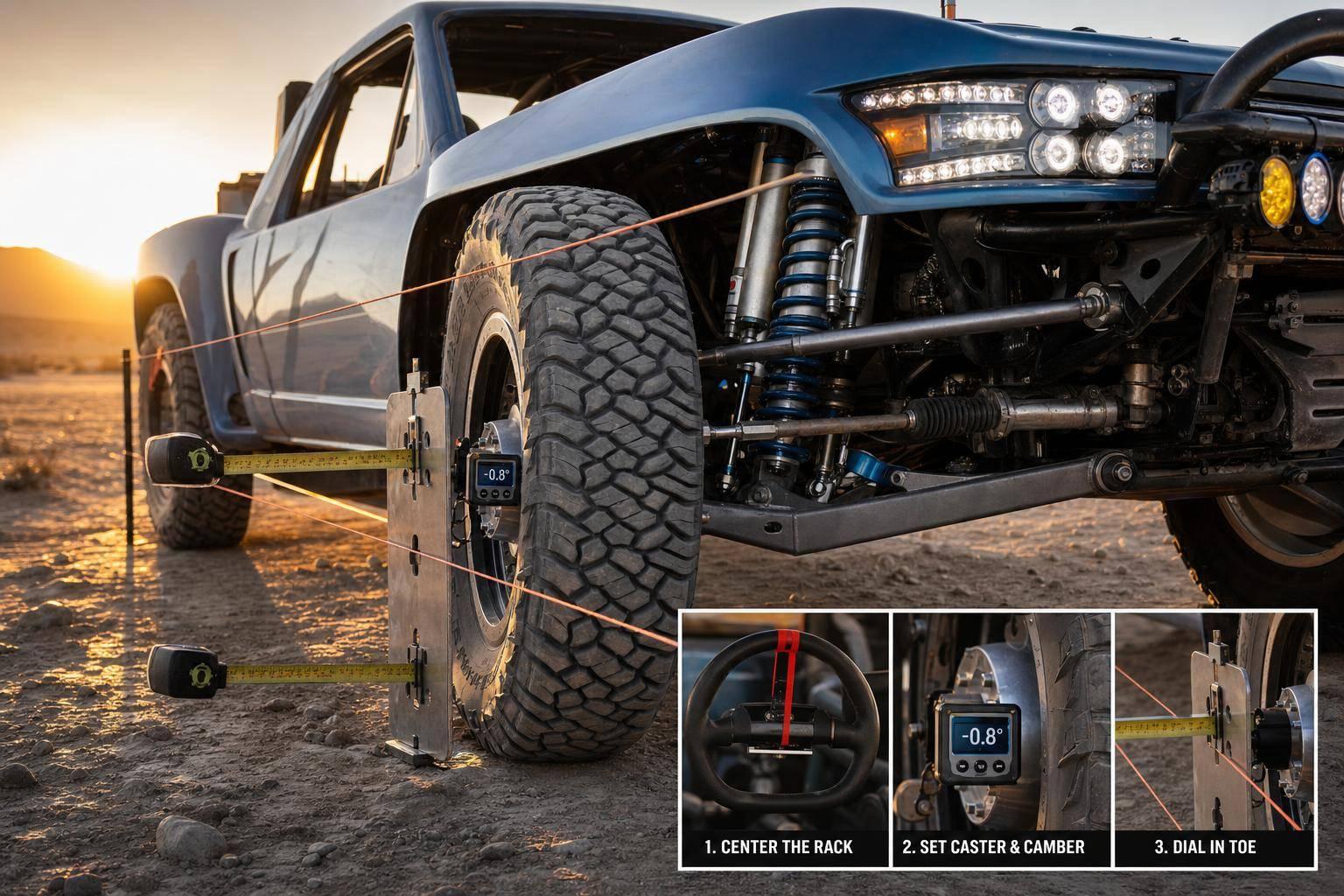
If you install a long travel kit and skip alignment, your truck can wander, steer poorly, and wear out tires fast. In most cases, the main changes hit camber, caster, and toe, and even a small ride-height shift can move those numbers more than you expect.
Here’s the short version:
- I see long travel kits change more than wheel travel – they also change suspension geometry
- That means factory alignment specs often no longer fit
- Toe is usually the fastest way to destroy a set of tires
- A 2-inch height change can cut caster by 1 to 2 degrees and shift camber by 0.5 to 1 degree
- At 3 inches or more, caster can move by 3+ degrees and camber by 2+ degrees
- Alignment should be set at final ride height with bumpers, winches, armor, and cargo already on the truck
- The right order is: ride height, rack center, caster/camber, then toe
- I’d also recheck everything after 500 to 1,000 miles and inspect it after hard off-road use
If you drive mostly on-road, I’d aim for near-zero to slightly negative camber, more positive caster, and slight toe-in. If the truck sees trail use, I’d keep camber near neutral and make sure toe is exact. For desert use, I’d lean toward slightly negative camber and as much positive caster as the kit will allow for better straight-line control.
How To Align Your 4×4 After Installing A Lift Kit
sbb-itb-afc4690
Quick Comparison
| Use | Camber | Caster | Toe | What to expect |
|---|---|---|---|---|
| Street / Daily | Near 0° to slightly negative | More positive | Slight toe-in | Better tracking, more steering effort at low speed |
| Trail / Mixed | Neutral to slightly negative | Moderate positive | Slight toe-in | Balanced feel on dirt and pavement |
| Desert / Fast Off-Road | Slightly negative | Max usable positive | Neutral to slight toe-in | Better high-speed stability, more inner tire wear |
Bottom line: I wouldn’t judge how a long travel truck drives until the geometry is set for its actual ride height and actual use.
How Long Travel Geometry Affects Caster and Camber
How Longer Arms and Wider Track Width Change Camber Curve
Longer control arms and a wider track width change the path the wheel follows in compression and droop, which shifts camber gain.
On most IFS setups, droop pushes the top of the tire outward, toward positive camber. Long travel kits are built to flatten that camber curve, so the tire contact patch stays more even through the suspension’s range of motion.
That matters because factory camber targets often stop making sense after a long travel install. At that point, the better goal is tire contact and suspension movement that feels predictable instead of chasing stock alignment numbers.
That same geometry shift also changes how much caster the front end can hold.
How Wheel Position and Arm Adjustment Range Affect Caster
Long travel kits often move the wheel a bit forward to give the tire more clearance from the firewall. That forward wheel position changes the caster range the kit can support in practice. It can make room for more positive caster, which helps the steering self-center and track straighter.
But there’s a catch. Factory eccentric cams and slotted mounts only have so much adjustment range. After a long travel install, they often hit their limit before caster gets to a usable number. When that happens, adjustable control arms or caster correction hardware are the fix.
That’s why caster and camber need to be checked together, not one at a time.
How Caster and Camber Adjustments Affect Each Other
On many IFS setups, lower control arm eccentrics change caster and camber at the same time, so every adjustment means you need to recheck both angles.
Choosing Alignment Targets for Street, Trail, and Desert Use
Long-travel suspension changes the alignment game. Once you add longer arms, a wider track width, or more ride height, the old factory window doesn’t always fit the truck anymore. That’s why alignment targets should match how the truck is actually driven, not how it looked on paper before the build.
Set alignment at the truck’s final ride height with all permanent weight in place. Bumpers, winches, armor, and cargo all affect the numbers. After ride height is locked in, tune the alignment around the truck’s main job: street driving, trail use, or high-speed desert running.
Camber, Caster, and Toe Goals by Vehicle Use
The best targets depend on use.
For a daily driver, camber near 0° to slightly negative usually works best, along with higher positive caster. That setup helps the truck track straight on the highway without making you constantly correct the wheel. The downside is heavier steering at parking-lot speeds, but tire wear tends to stay even and the truck feels steady.
A trail or mixed-use setup has a bit more room to work with. Camber near neutral at ride height helps keep the tire planted as the suspension cycles. Moderate positive caster keeps steering under control when you’re crawling over rocks or picking through rough terrain. Toe needs to be dead-on here. Even a small error can make the truck feel twitchy and chew through tires in a hurry.
For desert and high-speed off-road builds, straight-line stability matters more than long pavement tire life. Slightly negative camber helps the tire hold contact in harder cornering, and as much positive caster as the kit will allow helps keep the truck from wandering through rough chop. The tradeoff is clear: more inner tire wear on pavement and heavier steering effort.
How Ride Height, Preload, and Added Weight Shift Alignment
Coilover preload sets resting suspension height, and any height change shifts linkage angles across the front end. Even a modest 2-inch leveling kit can reduce caster by 1 to 2 degrees and add 0.5 to 1 degree of negative camber. Move up to 3 inches or more, and caster can shift by 3 or more degrees, while camber can change by 2 or more degrees. That’s more than enough to cause wandering, uneven tire wear, and poor steering feel if you leave it alone.
The smart move is simple: set preload first, install all heavy accessories, and let the suspension settle before you align anything. Then plan a follow-up check after a few hundred miles. New springs and bushings tend to take a final set once the truck sees some actual use.
Alignment Priorities by Build Type: Comparison Table
| Build Type | Camber Target | Caster Priority | Toe Setting | Main Trade-offs |
|---|---|---|---|---|
| Street / Daily Driver | Near 0° to slightly negative | High positive | Slight toe-in | Heavier low-speed steering; best tire longevity |
| Mixed-Use / Trail | Neutral to slightly negative | Moderate positive | Slight toe-in | Balanced wear and feel; may wander slightly more on highway |
| Desert / High-Speed Off-Road | Slightly negative | Maximum usable positive | Neutral to slight toe-in | Accelerated inner tire wear; demands stronger steering components |
Use those numbers as a starting point. Final settings still depend on arm length, wheel offset, and ride height.
How to Align a Long Travel Truck Correctly
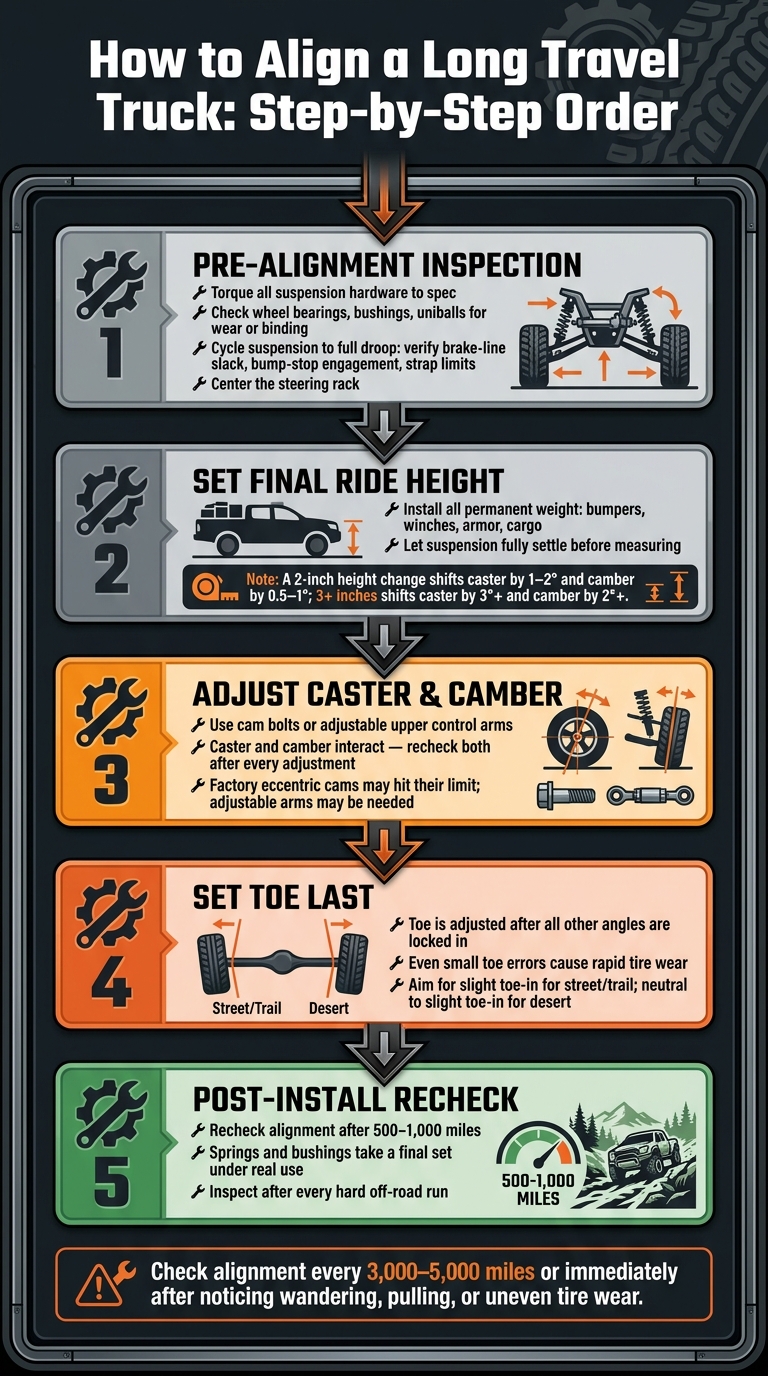
Long Travel Truck Alignment: Correct Order & Key Steps
Good caster and camber numbers don’t help much if you align the truck in the wrong order. After you’ve picked the target settings, the next step is to lock in the suspension geometry step by step.
Pre-Alignment Checks Before Adjusting Any Numbers
Before you touch any adjuster, inspect the truck from top to bottom. Suspension hardware needs to be torqued to spec. If fasteners are loose, parts can move under load, and that makes the alignment readings hard to trust.
Check wheel bearings, bushings, and uniballs or spherical bearings for wear or binding, especially at full droop. A worn joint can look like a camber issue when it’s not, so it’s smart to check for play first.
Cycle the suspension at full droop and confirm:
- brake-line slack
- bump-stop engagement
- strap limits
Once the mechanical side checks out, center the steering rack before anything else. If the rack is off-center, your toe reading starts out wrong.
Set final ride height with all permanent weight installed and the suspension fully settled.
Adjustment Order and Post-Install Recheck
Alignment changes only stick when you set them in the right sequence. The order is simple:
- Set ride height first
- Center the steering rack second
- Adjust caster and camber third
- Set toe last
Toe always comes last because every step before it can change the toe reading.
Recheck the alignment after 500 to 1,000 miles to make sure nothing moved.
Troubleshooting Table: Symptoms, Likely Causes, and Adjustment Points
If the truck still doesn’t feel right after alignment, use the table below to match the symptom with the part that likely needs attention.
| Symptom | Likely Cause | Inspect / Adjust |
|---|---|---|
| Wandering or drifting at highway speeds | Low positive caster | Cam bolts / adjustable upper control arms |
| Pulling to one side | Mismatched caster or camber side-to-side | Cam bolts / eccentric bushings |
| Bump steer / twitchy steering | Incorrect tie rod angles or toe-out | Tie rods / steering links |
| Off-center steering wheel | Rack not centered or tie rods set unevenly | Drag link / tie rods / track bar |
| Steering won’t return to center | Insufficient positive caster | Upper control arms / cam bolts |
| Rapid or uneven tire wear | Incorrect toe or camber | Tie rods / cam bolts |
| Light or vague steering feel | Too little positive caster | Pivot points / caster-correcting arms |
Toe mistakes can chew through tires in a hurry, and an alignment job costs a lot less than buying a new set.
Keeping Alignment and Geometry Consistent Over Time
Long travel alignment drifts over time. Hard use, spring settle, and wear can move caster, camber, and toe out of spec.
Once the truck is aligned, the next job is keeping that geometry from drifting.
What to Inspect After Hard Off-Road Use
After any serious trail or desert run, check these areas before your next drive:
- Cam bolts: Eccentric cams can slip or run out of range under hard use, which shifts caster and camber.
- Tie-rod play: Any tie-rod play changes toe and can quickly lead to feathered tread.
- Wheel bearings and uniballs: Play here changes camber, so check for looseness before making alignment changes.
- Ride height: Spring settle and bushing break-in change ride height, and that shifts caster and camber.
Check alignment every 3,000 to 5,000 miles, or right away if you notice odd steering behavior or uneven tire wear.
How LSK Suspension Components Support Stable Geometry
Parts built around corrected geometry tend to hold alignment range better under load. LSK Suspension offers long travel kits and control arms designed to preserve alignment range through added travel.
Conclusion: The Alignment Points That Matter Most
After hard runs, a quick inspection can catch drift before it turns into tire wear. Inspect cam bolts, tie rods, and bearings before the next drive after hard use.
FAQs
Can I drive before getting it aligned?
No. After you install a long travel kit, get the vehicle professionally aligned before you drive it.
Changing the suspension height changes the alignment angles, including caster, camber, and toe. And that can affect handling, stability, and tire wear.
If you drive it before the alignment is done, the vehicle may wander, pull to one side, or feel unpredictable when you steer. You can also wear out tires and suspension parts sooner than expected.
A professional alignment is required to keep the vehicle safe and predictable on the road.
Do I need adjustable control arms?
Yes, in most cases.
Long travel kits change track width and suspension geometry. That means you’ll usually need adjustable control arms, or parts with adjustability built in, to dial in the alignment.
That adjustability helps correct changes to caster and camber, which keeps the truck stable and predictable instead of feeling off or wandering on the road.
How often should I recheck alignment?
Recheck alignment every 3,000 to 5,000 miles. You should also have it inspected if you notice uneven tire wear or odd steering behavior.
Long travel kits can change factory suspension geometry in a big way. That’s why regular checks help maintain handling, safety, and the life of your LSK Suspension components.
Leave a Reply