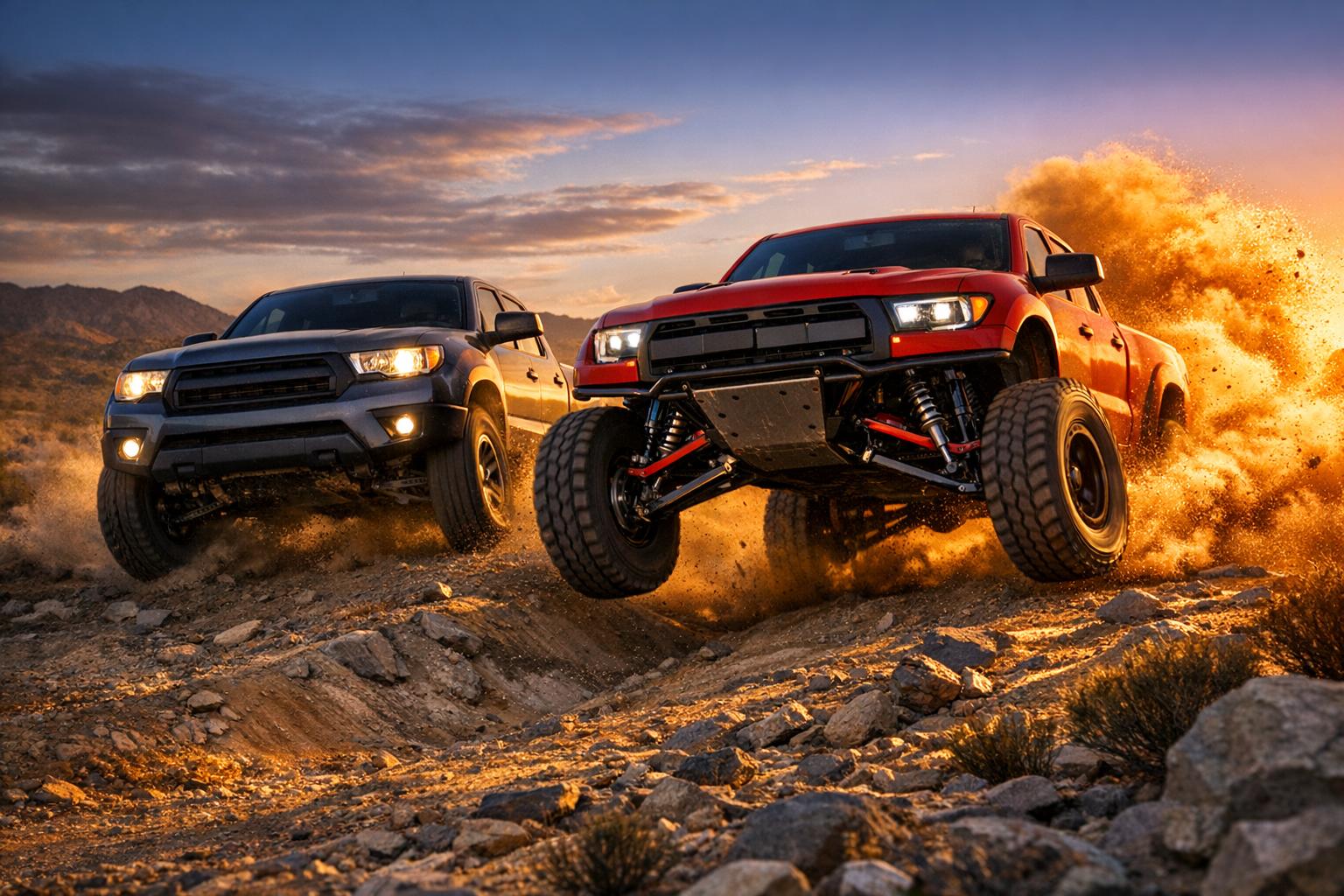
Choosing the right suspension depends on how you use your vehicle. Stock suspension is designed for smooth rides on paved roads and light trails, while long travel suspension is built for tackling rough, high-speed off-road terrain with better stability and wheel travel.
Key Takeaways:
- Stock Suspension: Ideal for daily driving, light off-road use, and maintaining low maintenance costs. It offers comfort on highways but struggles with heavy loads and rugged trails.
- Long Travel Suspension: Designed for extreme off-road conditions, it provides 12–18+ inches of wheel travel, improved stability, and better handling on rough terrain. However, it requires significant modifications, higher maintenance, and comes with added costs.
Quick Comparison Table:
| Feature | Stock Suspension | Long Travel Suspension |
|---|---|---|
| Wheel Travel (Front) | 7–8 inches | 12–14+ inches |
| Terrain Capability | Light trails | Rough, high-speed terrain |
| Comfort (Street) | Smooth | Firm/harsh |
| Cost | Budget-friendly | $8,000–$20,000+ |
| Maintenance | Low | High (frequent upkeep) |
Bottom Line: Stick with stock suspension for casual driving and light trails. Upgrade to long travel suspension if you frequently drive on rugged terrain and need superior off-road performance.
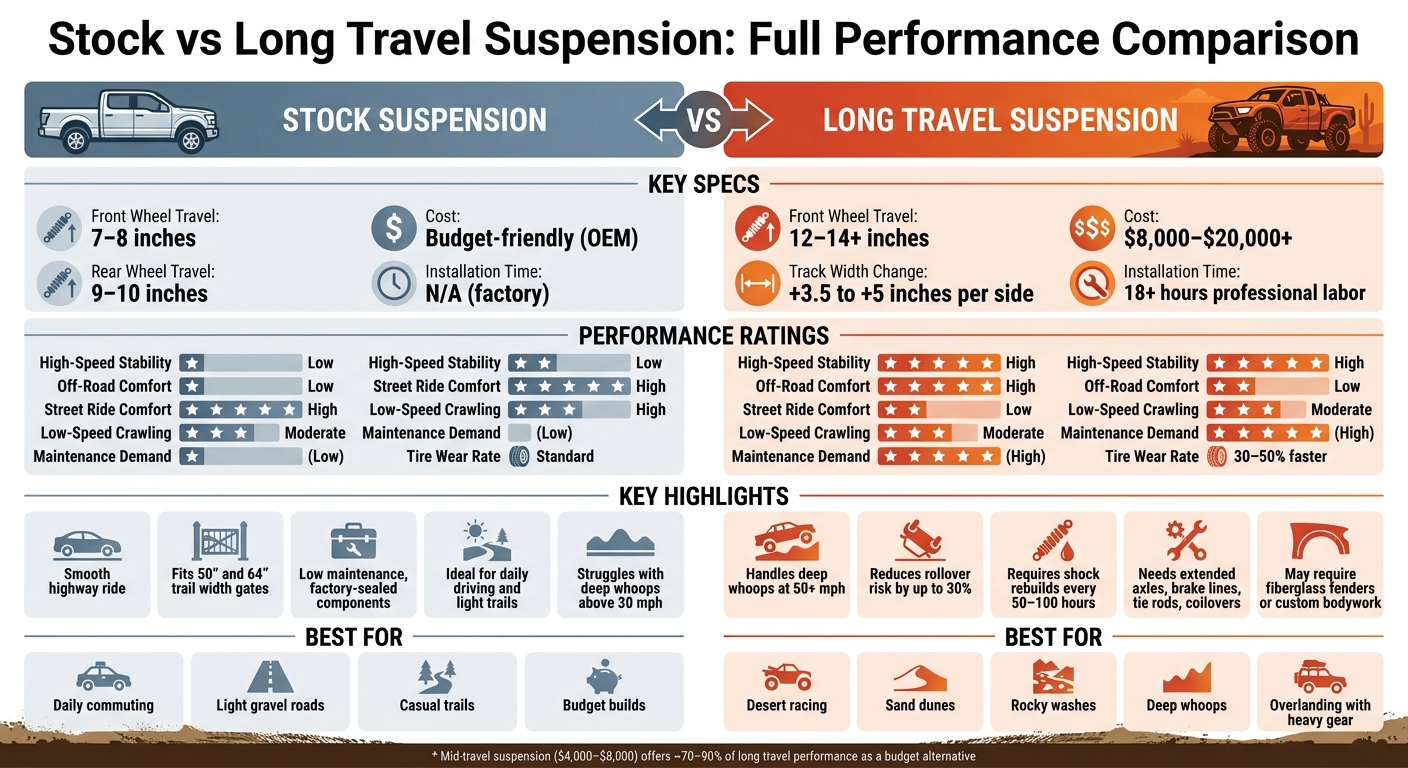
Stock vs Long Travel Suspension: Full Performance Comparison
Shock Therapy LIVE: Does Size Matter? Stock vs. Long Travel
sbb-itb-afc4690
Long Travel Suspension Overview
Long travel suspension tackles challenges that standard setups simply can’t handle. By swapping out factory components for a redesigned geometry, it focuses on increasing wheel movement, improving chassis stability, and absorbing rough terrain more effectively.
Key Features
One standout feature is the use of extended control arms, which are generally 2–5 inches wider than stock. This allows for significantly more wheel travel, providing a greater range of motion without compromising geometry or causing binding issues.
While most stock suspensions offer around 7–8 inches of vertical wheel travel, long travel systems expand that range to an impressive 12–18+ inches. This extra movement ensures that wheels maintain better contact with the ground, even over rocks, ruts, and other tough terrain.
Additionally, long travel setups widen the track width by 3–6 inches per side. This change lowers the center of gravity, improving stability and reducing body roll on uneven trails.
Another key improvement is the reduction of bump steer. By optimizing camber and caster angles throughout the suspension cycle, these systems keep the tire’s contact patch flat, resulting in more predictable handling.
Altogether, these features deliver noticeable performance improvements in rugged environments.
Performance Benefits
The advantages of long travel suspension shine when tackling rough terrain. For example, a stock UTV might handle deep whoops at around 30 mph, but a long travel system allows speeds of 50+ mph while keeping the chassis level.
"The whole point of long travel suspension is to maximize tire contact with the ground while keeping the chassis stable." – CA Tech USA
This added stability doesn’t just improve ride quality – it also enhances safety. Rollovers, particularly in challenging environments like sand dunes, can be reduced by up to 30% with a long travel setup.
Here’s a quick comparison of how stock and long travel suspensions perform:
| Performance Metric | Stock Suspension | Long Travel Suspension |
|---|---|---|
| High-Speed Stability | Prone to bucking in whoops | Glides over whoops at higher speeds |
| Big Hit Absorption | Often bottoms out harshly | Smoothly absorbs large impacts |
| Off-Camber Stability | Higher rollover risk | Significantly reduced tip-over risk |
| Overall Ride Comfort | Rough and jarring in tough terrain | Controlled and smoother experience |
Practical Considerations
While the performance benefits are compelling, installing a long travel suspension requires thoughtful planning and the right components. This isn’t a simple bolt-on upgrade; it’s a complete system overhaul. You’ll need extended heavy-duty axles, longer tie rods, and extended brake lines to handle the increased range of motion. Additionally, factory shocks won’t cut it – long travel systems require shocks with longer bodies and increased stroke to match the extended A-arms.
Fender clearance is another issue to consider. Adding 6–12 inches to your vehicle’s width may exceed the 50-inch or 64-inch trail width restrictions common in many off-road areas. Checking local trail gate measurements before installation is a smart move.
Material choice is crucial, too. For high-impact use or racing, 4130 Chromoly steel is the go-to material for longer control arms. It offers excellent strength while keeping weight in check, outperforming standard DOM tubing.
These features and considerations highlight how long travel suspension compares to stock setups in demanding off-road conditions.
Stock Suspension Overview
Stock suspension is what comes standard from the factory – designed to meet the needs of a broad range of drivers. It’s a well-rounded system meant to handle daily commutes, light gravel roads, and occasional dirt trails, all without requiring much more than basic upkeep.
Key Features
Most factory suspension systems include a combination of coil or leaf springs, shock absorbers, control arms, and bump stops. For modern 4x4s, the front suspension is often Independent Front Suspension (IFS). This setup allows each wheel to move independently, which improves steering precision, provides a smoother ride on mixed terrain, and reduces unsprung weight, boosting fuel efficiency. Many stock pickups pair IFS at the front with a solid rear axle and leaf springs at the back – offering a mix of comfort for daily driving and the strength to carry heavier loads.
| Feature | Solid Axle (Stock) | Independent Front Suspension (Stock) |
|---|---|---|
| Primary Benefit | Durability & Simplicity | Ride Comfort & Handling |
| Wheel Movement | Dependent (linked) | Independent |
| Articulation | High (potential) | Limited |
| Maintenance | Simple / Low Cost | Complex / More moving parts |
| Unsprung Mass | Heavy | Lighter |
Front coilovers are mounted vertically, prioritizing stability on paved roads rather than off-road flexibility. Steering is also tuned to be light and self-centering, making it easy to handle for everyday driving. However, this setup contrasts sharply with the heavier steering inputs needed for long-travel suspension systems. While these factory features are great for daily use, they show their limits when tested in rugged environments. Stock components are primarily designed for comfort and efficiency on the road, not for extreme off-road challenges.
Performance Characteristics
Stock suspension shines on highways and smooth trails, offering reliable handling and a comfortable ride. But off-road performance is where its compromises become clear. It can handle mild trails, but aggressive terrain like deep whoops, rocky paths, or high-speed dirt tracks quickly exposes its limitations.
As Merritt Moore of CA Tech USA explains:
"Stock UTVs manage careful climbing but struggle at higher speeds."
When the terrain becomes more demanding, stock systems reach their limits fast. Caleb Austin of Get Lost Gear Co. highlights this issue:
"The OEM suspension is designed for highway use, and if you get a rig ‘built’ for ‘hardcore’ off-road use (TRD, Rubicon or the like) they are not designed to perform off-road with the kinds of loads we overlanders put on our rigs."
Adding heavy accessories, like roof racks or winches, only worsens the problem, causing factory springs to sag and increasing the risk of bottoming out.
Durability and Limitations
Stock suspension is reliable under normal conditions, but off-road stress reveals its weaknesses over time. Components like factory bump stops, which protect against bottoming out, wear down quickly under repeated impacts. Bushings also deteriorate faster on rough terrain, and solid axle setups can develop "death wobble" vibrations if parts loosen.
Ground clearance is another challenge, especially for IFS systems. While IFS provides a smooth ride on the road, its geometry limits how high the vehicle can sit, making it harder to navigate deep ruts or large obstacles. If you’re considering a lift beyond 3.5 inches on a coil-spring system, be ready to replace several components. Stock geometry isn’t built to handle such modifications without causing excessive wear on ball joints and control arms. These durability concerns highlight why stock suspension often falls short under intense off-road conditions.
Performance Comparison
Comparison Table
The numbers paint a clear picture. Stock suspension provides 7–8 inches of front wheel travel and 9–10 inches in the rear, while long travel systems extend that to 12–14+ inches.
| Criteria | Stock Suspension | Long Travel Suspension |
|---|---|---|
| Wheel Travel (Front) | 7–8 inches | 12–14+ inches |
| Track Width | Standard OEM width | +3.5 to +5 inches per side |
| High-Speed Stability | Poor; prone to bottoming out | Excellent; maintains tire contact |
| Low-Speed Crawling | Adequate for moderate trails | Can be hindered by added width |
| Ride Comfort (Street) | Smooth; optimized for highway | Firm/harsh over small bumps |
| Tire Wear | Standard rates | 30–50% faster due to geometry changes |
| Maintenance | Low; factory-sealed components | High; frequent greasing and rebuilds |
This table highlights the key differences in performance and maintenance between the two systems.
Key Differences
While the table gives a snapshot, let’s break down how these systems perform in real-world scenarios.
High-speed performance is where long travel systems shine. On uneven, high-speed terrain, stock setups often struggle with bouncing and bottoming out, forcing drivers to slow down. In contrast, a long travel system absorbs impacts smoothly, keeping the tires planted and the ride controlled. Merritt Moore from CA Tech USA explains it best:
"A 100-mile desert loop that leaves you beat up in a stock machine feels like a 50-mile cruise with long travel."
The wider track width – up to 5 inches per side – also enhances cornering stability, reducing rollover risks by as much as 30% in conditions like sand dunes.
Low-speed crawling, however, tells a different story. On tight, technical trails, the increased width of long travel systems can become a disadvantage. These setups can struggle with articulation in slow, technical terrain, especially compared to mid-travel systems. Stock suspension, with its narrower footprint, fits more easily through trail gates and performs adequately on moderate trails at lower speeds.
Durability and maintenance are another dividing line. Long travel systems are built to handle hard use but demand regular upkeep. This includes shock rebuilds every 50–100 hours, greasing uniballs every 3,000–5,000 miles, and specialized alignments. Stock components, by contrast, require little to no maintenance. However, the wider geometry of long travel setups accelerates wear on parts like wheel bearings, CV axle boots, and steering racks. Experienced off-roaders understand this trade-off well:
"Daily driving a long-travel rig is not for everyone. It does take a certain mindset… I’m not shy about breaking, maintaining, or just having things that aren’t exactly practical daily vehicles." – Michael Salvador, 5th Gen 4Runner owner
Best Use Cases
Stock Suspension Use Cases
Stock suspension is ideal for paved roads and light dirt paths, offering a smooth and consistent ride with low maintenance needs. It’s also well-suited for moderate off-road trails, forest roads, or casual weekend rides, as the factory setup can handle these conditions without much trouble.
Another advantage of stock suspension is its compatibility with width restrictions. Many trail systems enforce strict gate limits, such as 50-inch or 64-inch widths. Since long travel kits often add 3 to 6 inches per side, stock suspension ensures you can navigate these trails without worrying about gate clearance. If you aim to tackle trails beyond these limits, however, you’ll need a different approach.
Long Travel Suspension Use Cases
Long travel suspension shines in challenging, high-speed environments. Whether you’re tackling desert terrain, sand dunes, rocky washes, or trails filled with deep whoops, this setup is built to handle the roughest conditions. For example, where a stock UTV might struggle to go beyond 30 mph in deep desert whoops, a long travel system allows you to confidently push 50 mph or more.
The wider track width – usually adding 3 to 6 inches per side – also provides greater stability on off-camber trails and technical rock sections. This extra stability can be the difference between navigating a tricky section smoothly and experiencing a rollover. As Merritt Moore of CA Tech USA puts it:
"The real difference between stock and long travel is this: you go from just surviving the terrain to truly commanding it."
For those outfitting their UTVs with heavy overlanding gear – like roof racks, armor, or rooftop tents – long travel systems are better equipped to manage the extra weight. Their wider geometry and higher-capacity dampers are designed to handle the stress that would typically overwhelm factory components.
Build Requirements for Long Travel Suspension
Necessary Components
Upgrading to a long travel suspension involves a complete revamp of your vehicle’s front end. As TacomaBeast explains:
"You can’t just bolt on long-travel lower control arms and call your truck long travel. True long-travel suspension widens your front track width by about 3 to 3.5 inches per side, which requires longer uppers, longer lowers, extended brake lines, and tie rod extensions."
To get the job done right, you’ll need these essentials:
- Extended upper and lower control arms (UCAs and LCAs): These provide the increased width necessary for long travel setups.
- Long travel-specific coilovers: Designed to handle the greater suspension movement.
- Extended brake lines: Required to accommodate the increased travel range.
- Tie rod extensions: Essential for proper steering function with the widened track.
- Extended CV axle assemblies (for 4WD): Factory axles won’t cut it due to the wider stance.
Many builders also choose to add bypass shocks with mounting hoops and limit straps. These extras help prevent internal shock damage and extend the lifespan of your suspension system.
With the components in hand, the next step is tackling the unique challenges of installation.
Setup Considerations
Installing a long travel suspension is no small feat, and attention to detail is key to getting the most out of your build. You’ll need a mix of bolt-on and welded components, such as spindle gussets, upper arm shear kits, and bypass hoops. If welding isn’t in your skill set, plan to enlist the help of a professional fabricator.
Another factor to consider is the wider track width. This can cause interference with your stock bodywork, especially during full tire articulation. To address this, you may need fiberglass fenders, significant trimming, or even a custom-width front bumper. Be prepared to invest at least $5,000 for the kit itself, and account for 18+ hours of professional installation time. While this may seem like a hefty expense, the improved durability and performance make it worthwhile.
Once the suspension is installed, a professional alignment is non-negotiable. A long travel setup drastically alters the caster angle, and most standard alignment shops won’t have the tools or expertise to handle it properly. Finding a specialized alignment shop ahead of time can save you headaches later. If you’re running zero-offset wheels, you’ll likely need additional trimming to prevent tire rub during full suspension articulation.
Following these requirements ensures your long travel suspension delivers the off-road performance you’re aiming for.
Conclusion
When it comes to choosing the right suspension, it all boils down to your driving habits and needs. If you primarily stick to paved roads or take on light trails, your stock suspension should do just fine – there’s no strong reason to overhaul your front end.
On the other hand, long travel suspension is tailored for high-speed, aggressive off-road enthusiasts. It’s not meant for casual driving. As highlighted earlier, switching to long travel suspension comes with some hefty trade-offs: project costs ranging from $8,000 to over $20,000, faster tire wear, and the need for frequent shock rebuilds every 50–100 hours of heavy use. These factors make it clear that such a setup is only practical for those who truly push their vehicles hard in open terrain.
Think back to your last 20 off-road adventures. If bottoming out wasn’t a common issue, a mid-travel suspension might be the smarter, more budget-friendly option. Costing between $4,000 and $8,000, it delivers about 70–90% of the performance benefits without the steep commitment.
"A well-chosen compromise setup that handles your primary use case excellently will serve you better than an extreme setup that makes daily driving miserable." – Truck Brigade
The key is to match your suspension to your actual driving needs. Avoid going overboard with an extreme setup that could complicate your daily driving experience. The right suspension strikes the perfect balance between performance and practicality.
FAQs
Will long travel suspension fit my local trail width limits?
Long travel suspension boosts wheel travel and track width, which can improve how your vehicle handles off-road terrain. But here’s the catch: it might push your ATV’s width beyond local trail limits, which in the U.S. are often set around 50 inches. To avoid any issues, measure your setup carefully and double-check local regulations. If your setup goes over the limit, you might need to make adjustments or modifications to stay within the rules.
What extra parts do I need besides control arms for long travel?
Long travel suspension systems don’t just rely on control arms; they also need a few other key components to function properly. These include longer shocks with more stroke length, wider axles or axle adapters to accommodate the increased track width, and upgraded mounting hardware to handle the extra stress. Together, these parts ensure your vehicle maintains proper wheel travel, alignment, and durability – essential for tackling rough terrain with confidence.
How often do I need to service a long travel setup?
The maintenance schedule for a long travel suspension largely depends on how and where you ride. As a general rule, suspension shocks should be serviced every 125 hours of riding or once a year, whichever comes first. However, if you frequently ride in demanding conditions or push your suspension hard, you may need to service it more often.
Routine maintenance typically involves replacing oil and seals, thorough cleaning, and detailed inspections. These steps are crucial to keep your suspension performing at its best and to extend its lifespan.
Leave a Reply