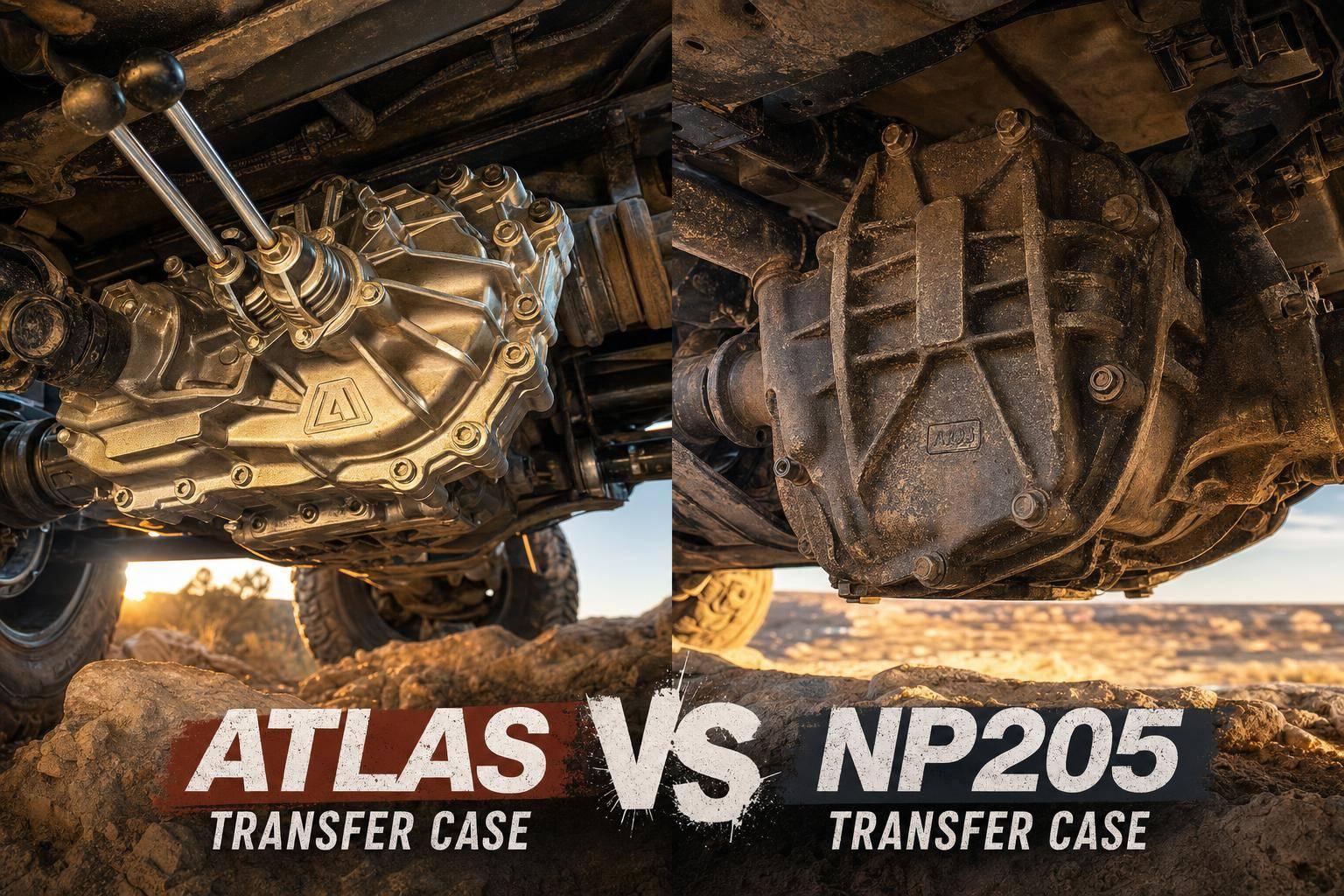
If I want the short answer, it’s this: I’d pick an Atlas for rock crawling, tight packaging, and deep low-range control. I’d pick an NP205 for a lower entry price, cast-iron strength, and full-size truck use.
Here’s the whole article in one quick view:
- Atlas is lighter at about 110 lbs
- NP205 is heavier at about 135–140 lbs
- Atlas offers low range from 2.0:1 to 5.0:1 in 2-speed form, and up to about 10:1+ in 4-speed setups
- NP205 has a fixed 1.96:1 low range
- Atlas comes with twin sticks and can shift between 2WD and 4WD while rolling
- NP205 is simple and tough, but twin-stick control takes mods
- Atlas usually costs about $2,500–$3,000+
- NP205 used units often sell for about $200–$600, though built versions can cost much more
- Atlas often fits better in short-wheelbase rigs
- NP205 is a common fit for GM, Ford, and Dodge heavy-duty truck builds
If I were choosing between them, I’d look at five things first: low-range ratio, shift control, weight, fitment, and price. That’s where the gap shows up fast.
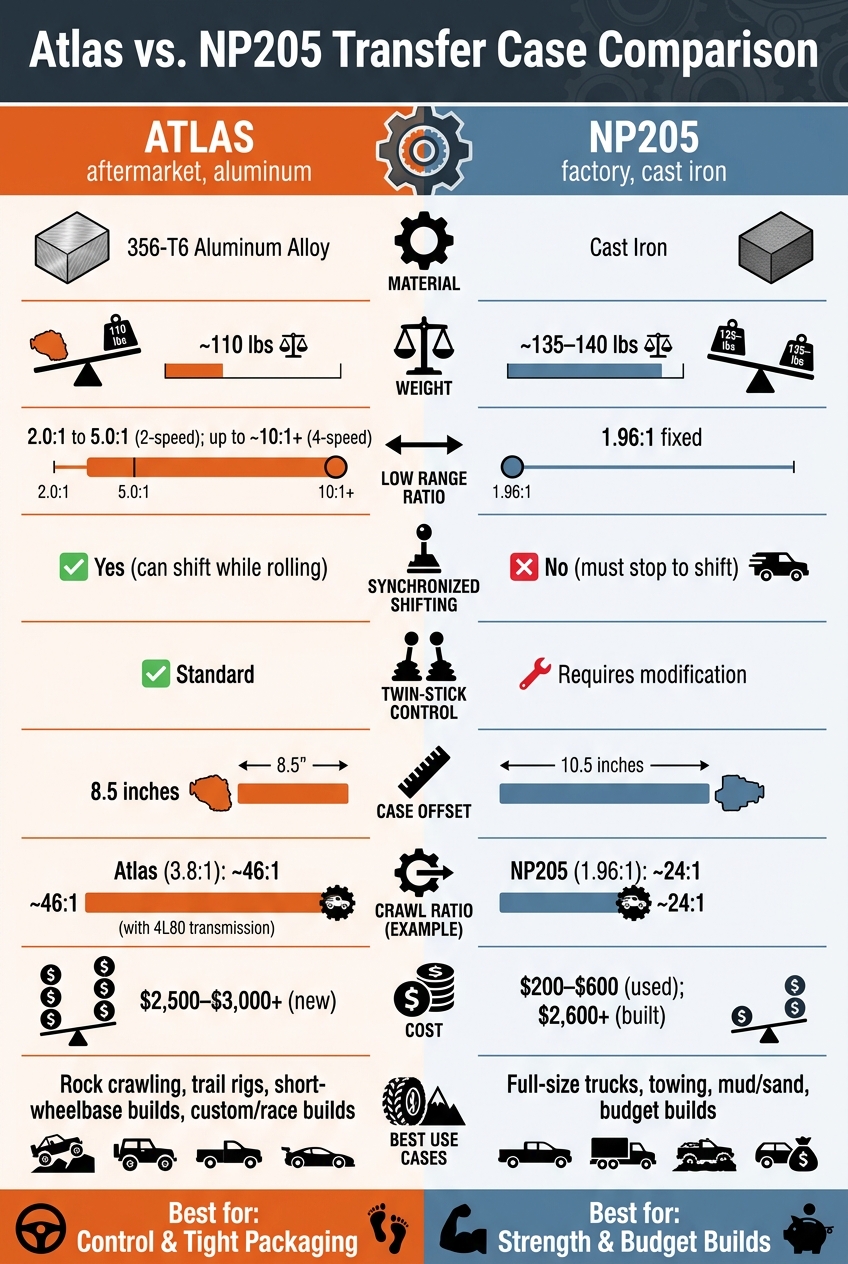
Atlas vs. NP205 Transfer Case: Side-by-Side Specs Comparison
Choosing The Right Transfer Case And How To Modify It – Xtreme 4×4 S4, E4
sbb-itb-afc4690
Quick Comparison
| Criteria | Atlas | NP205 |
|---|---|---|
| Case type | Gear-driven aftermarket case | Gear-driven factory case |
| Housing | 356-T6 aluminum | Cast iron |
| Weight | ~110 lbs | ~135–140 lbs |
| Low range | 2.0:1 to 5.0:1; 4-speed can go past 10:1 | 1.96:1 fixed |
| Shift feel | Synchronized | Non-synchronized |
| Twin-stick control | Standard | Mod required |
| Best use | Rock crawling, trail rigs, custom builds | Full-size trucks, towing, mud, budget builds |
| Cost | About $2,500–$3,000+ | About $200–$600 used; more for rebuilt or built units |
Bottom line: if I need deep gearing and more control, I’d go Atlas. If I want simple, hard-use strength for less money, I’d go NP205.
That’s the core of the comparison, and the rest comes down to how the case fits your rig, tires, transmission, and trail use.
Atlas Transfer Case: Ratios, Design, and Controls
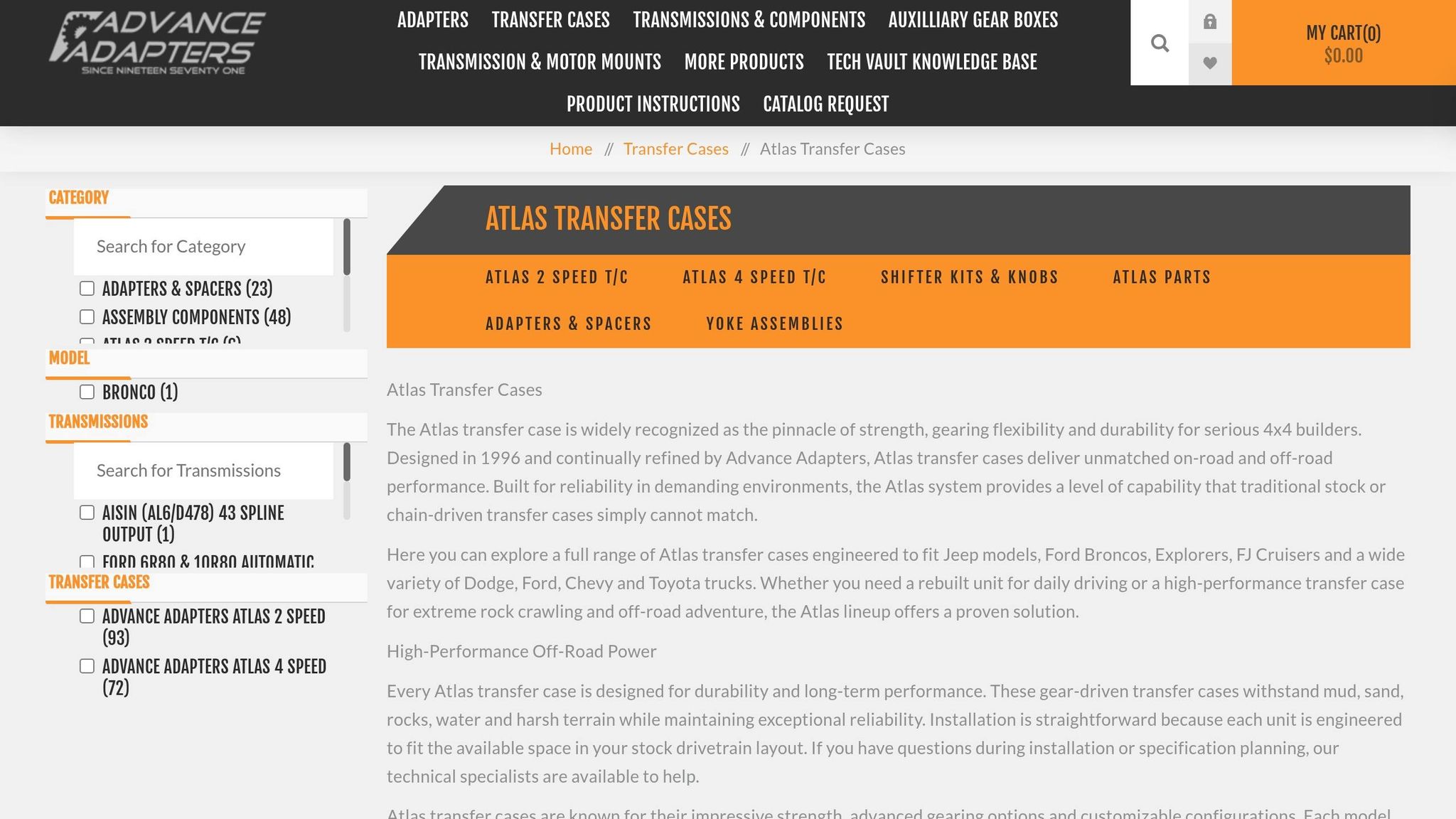
The Atlas is a gear-driven transfer case with a one-piece 356-T6 aluminum housing. That helps keep weight around 110 lbs, which is much lighter than cast iron. Inside, it uses large gears and wide bearing spacing on the front output shaft for added stability when the case is under load.
One of the big draws is the control setup. Twin sticks let you run the front and rear outputs on their own, and synchronized shifting means you can switch between 2WD and 4WD without stopping.
Atlas comes in 2-speed and 4-speed versions. The 4-speed model adds a 2.72:1 planetary unit, which gives you three low-range steps. And because each unit is built to order, you have to choose the full setup before you buy: input spline, output yoke, drop, clocking, shifter, and speedometer type.
Atlas Strengths for Technical Off-Roading
The 2-speed Atlas gives you a broad set of low-range ratios: 1.5:1, 2.0:1, 3.0:1, 3.8:1, 4.3:1, and 5.0:1. That gives you room to match the case to your engine, tire size, and axle gearing.
The 4-speed takes things further. Match the 3.8:1 main gear with the 2.72:1 planetary and you get a 10.34:1 combined low range. Use the 4.3:1 gear with that same planetary and the number jumps to 11.70:1. For slow, technical crawling, that’s a lot of control.
"The Atlas four-speed was built… for the Jeep four-cylinders and the Jeep JKs with the V-6. The problem came in when the customers with the V-8 and the 50-inch-plus tires… Today it is built to handle the increase of power." – Mike Partridge, President, Advance Adapters
Twin sticks also open up a couple of trail tricks. You can use 2WD low, which helps cut binding in tight turns. You can also do a front dig: rear in neutral, front in low, so the front tires help swing the rig around tight obstacles. Despite all of that, the aluminum case stays compact enough to fit under shorter-wheelbase rigs like the Jeep YJ, TJ, and JK.
That extra control also means more setup choices.
Atlas Trade-Offs to Consider
The Atlas sits on the pricey side. A standard 2-speed setup costs about $2,500–$2,750, based on yoke and shifter choices. Since each unit is built to order, you need to nail the specs before purchase. That includes the input spline count, left-hand or right-hand drop, output yoke type (1310, 1350, or flange), clocking angle, and speedometer type (mechanical or electronic VSS).
Fitment can also take some work. The case is taller and wider, so it often needs a 1-inch body lift or some floor clearance work to make room for the shifters.
Those trade-offs set up the NP205’s simpler, lower-cost approach.
NP205 Transfer Case: Factory Strength and Simple Durability
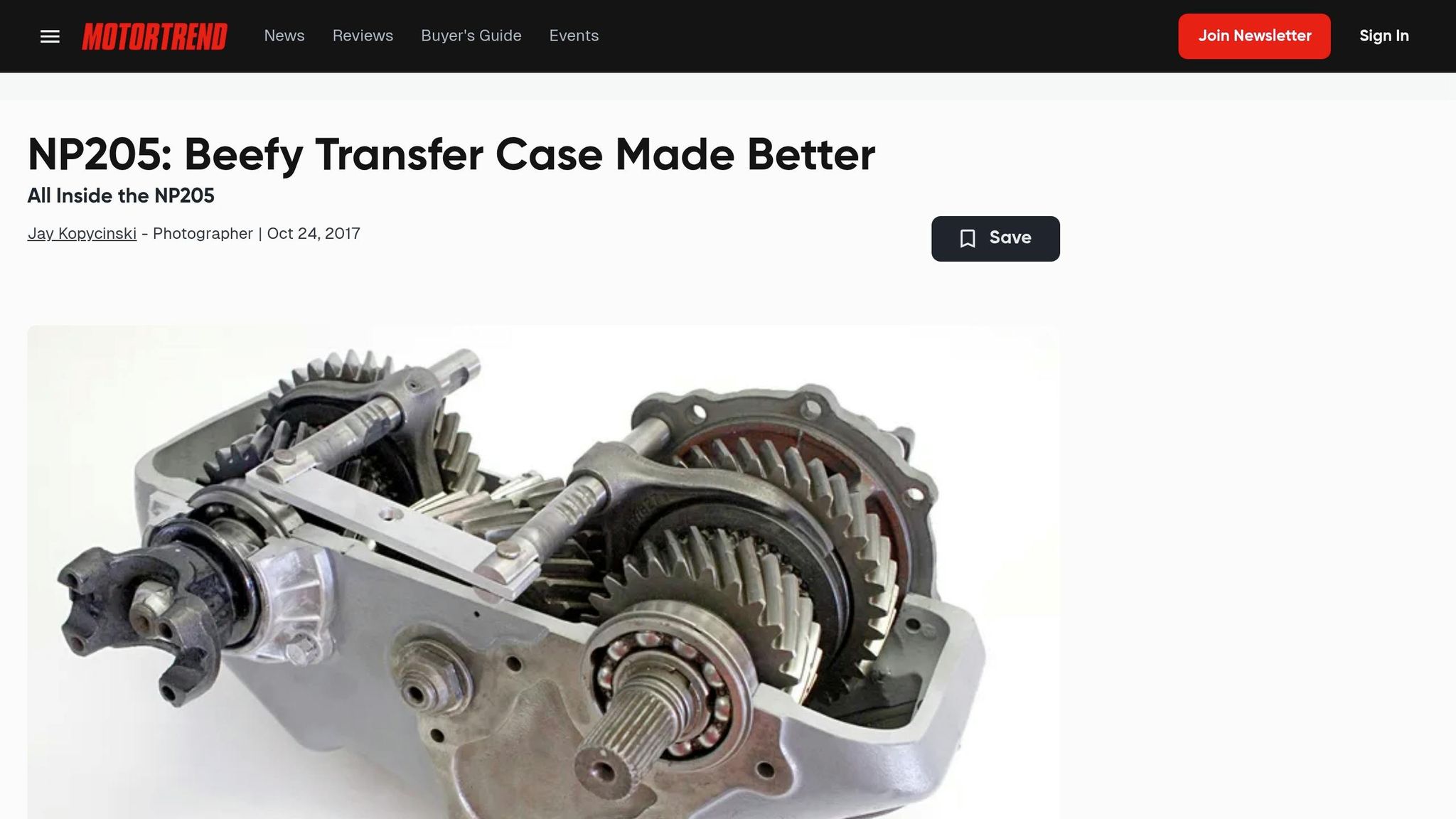
The NP205 is a part-time, gear-driven transfer case with a cast-iron housing. In plain English, it’s built like a tank. That cast-iron case stays rigid and resists flex under load, and the gear-driven layout gets rid of the drive chain found in lighter-duty cases. That matters because the chain is often one of the first parts to give up in hard-use drivetrains. Compared with the Atlas, the NP205 gives up some setup options in exchange for a simpler design.
The gearing is simple: 1:1 high range for highway driving and towing, plus about 1.96:1 low range for off-road use. That direct-drive high range is one reason the NP205 shows up so often in Dodge, Ford, GM, and International 1-ton and heavy-duty truck applications. Dry weight usually falls between 124 and 140 lbs, so it’s heavier than the Atlas, which comes in at about 110 lbs.
Where the NP205 Performs Best
The NP205 works best in builds where strength and long service life matter more than low-range options. It fits full-size trucks, towing rigs, and mud builds especially well. The 1.96:1 low range and cast-iron construction make sense in those setups. In mud and sand, the shallower low range can actually help by keeping tire speed up, which improves self-cleaning.
Used units are often available for $200 to $500, depending on spline count and output setup. That lower buy-in makes the NP205 a good place to start for a budget build. One thing to watch: input splines change by application. GM, Ford, and Dodge versions use 10-, 27-, or 32-spline inputs, respectively. Check that before you buy, or you may end up with a part that doesn’t match the rest of your drivetrain.
NP205 Limitations and Common Modifications
The biggest downside of the NP205 is its 1.96:1 low range. On the trail, and especially in technical rock crawling, that ratio is shallow by itself. So builders usually deal with it in one of two ways.
- A twin-stick conversion gives independent front and rear control, but it requires internal rail modification.
- A doubler setup, often pairing the NP205 with an NP203 range box, adds more low-range choices while keeping the 205’s core strength.
There’s also the aftermarket route. Gear sets like the LoMax 3:1, priced around $1,095, give you more reduction without swapping the whole case. The catch is extra weight and more parts to deal with. An NP203/NP205 doubler, for example, weighs about 242 lbs dry.
That leads straight into the side-by-side look at gearing, weight, fitment, and cost.
Atlas vs. NP205: Specs and Key Differences Side by Side
Atlas and NP205 split apart in four big areas: gearing, shift control, packaging, and cost. That’s what drives most build decisions.
If you want more control and more setup options, Atlas leans your way. If you want a simple, hard-to-kill case and you’re watching your budget, the NP205 has a strong case for itself.
Gearing, Crawl Ratio, and Trail Control
This is the clearest difference between the two.
The NP205 has a fixed 1.96:1 low range. Atlas gives you far more choice. It comes in 2-speed and 4-speed versions, with 2-speed low-range ratios of 2.0:1, 3.0:1, 3.8:1, 4.3:1, and 5.0:1. The 4-speed Atlas can go up to about 10:1.
On slow, technical terrain, that difference matters. A deeper low range gives you more control at low speed, which can make tricky sections feel less like a wrestling match.
Shift behavior is another big divider. Atlas can shift while rolling, while NP205 cannot. Atlas also comes with twin sticks as standard. On an NP205, twin-stick control takes modification.
The specs below focus on the details that tend to shape the build.
| Feature | Atlas | NP205 |
|---|---|---|
| Case Material | 356-T6 heat-treated aluminum alloy | Cast iron |
| Dry Weight | ~110 lbs | ~135–140 lbs |
| Low Range Ratio | 2.0:1 to 5.0:1 (2-speed); up to about 10:1 (4-speed) | 1.96:1 fixed |
| Synchronized Shifting | Yes | No |
| Twin-Stick | Standard | Requires modification |
| Typical Use | Rock crawling, buggies, custom builds | Full-size trucks, towing, mud bogging |
Weight, Fitment, Durability, and Cost
Fitment is another spot where Atlas often gets the nod, especially in tighter builds.
The Atlas case offset is 8.5 inches, versus 10.5 inches for the NP205. In a short-wheelbase rig, those two inches can make packaging a lot less painful.
Weight also plays into the choice. Atlas comes in at about 110 lbs, while the NP205 sits around 135–140 lbs. The NP205’s cast-iron case has a long-standing reputation for toughness, while Atlas trades some of that old-school heft for a lighter aluminum design.
Then there’s cost, which is where many decisions get made.
Because the NP205 is out of production, you’re looking at the used or rebuilt market. Used units can start around $200 to $600, and built versions can hit $2,600+. Atlas sits in a much higher buy-in range from the start, with new units usually landing around $2,500 to $3,000+ depending on setup. Used Atlas cases are uncommon.
| Factor | Atlas | NP205 |
|---|---|---|
| Case Offset | 8.5 inches | 10.5 inches |
| New Purchase Cost | $2,500–$3,000+ | N/A (out of production) |
| Used/Rebuilt Cost | Rare used | $200 (used) to $2,600+ (built) |
Which Transfer Case Fits Your Build
The right transfer case depends on the rest of your drivetrain. Tire size, wheelbase, torque, and suspension all change the equation. A setup that feels perfect in a short-wheelbase crawler can be the wrong call for a long-bed tow rig.
Best Fit for Rock Crawlers, Trail Rigs, and Race Builds
Atlas is the better pick when low-speed control is the main goal. If your rig runs 40-inch tires or more on technical terrain, Atlas gives you the gearing to move slowly and stay in control. Pair a 4L80 with a 3.8:1 Atlas, for example, and you get a crawl ratio of about 46:1. Use that same transmission with an NP205, and you’re looking at roughly 24:1.
That gap matters on the trail. More reduction means you can ease over rocks instead of charging at them.
Atlas also makes more sense for dedicated rock crawling because it gives you more control over gearing and more freedom when space is tight. That smaller, lighter package helps a lot in short-wheelbase rigs, where every inch counts. Its lower weight and synchronized shifting also make it a strong match for race-style builds.
Best Fit for Full-Size Trucks, Towing, and Mixed-Use Builds
NP205 is a better match for heavier trucks and mixed-use builds when brute strength and cost matter more than crawl ratio. Its cast-iron housing suits high-torque, heavy-duty work, and it has a long track record of holding up in mud and sand too.
There’s also the cost side of it. The NP205 is still the lower-cost used option, even after rebuilds.
Conclusion: Key Differences to Remember
Atlas leans toward control and easier packaging. NP205 leans toward simple strength and a lower buy-in cost.
FAQs
Which transfer case is better for daily driving?
For mostly daily driving and street use, the NP205 is usually the smarter pick. It’s a proven, heavy-duty factory transfer case that handles high-torque drivetrains well and fits street-focused builds without much drama.
The Atlas makes more sense for custom, high-performance rock-crawling rigs. But for a truck that spends most of its time on pavement with the occasional mild trail run, the NP205 is often the more cost-effective choice.
Will an Atlas or NP205 fit my transmission?
It depends on the exact setup. This isn’t a simple yes-or-no answer.
Start by checking the input spline count, bolt pattern, and input shaft length to see if the transfer case will match your transmission.
You’ll also want to look at the adapter housing, crossmember clearance, and driveshaft angles. The NP205 often needs a custom adapter or a specific input shaft. An Atlas is usually easier to configure for your drivetrain.
Is upgrading an NP205 cheaper than buying an Atlas?
It can be. But the final price comes down to your build.
A used NP205 is usually cheap to buy up front. The catch? Costs tend to climb once you add adapters, heavy-duty output shafts, bearing housings, rebuild kits, and shift linkage upgrades.
For a lot of builders, those add-ons push the total close to the price of a new Atlas. So the trade-off is pretty simple: the NP205 is a tough, budget-friendly option, while the Atlas gives you a more modern layout, configurable gearing, and easier packaging.
Leave a Reply