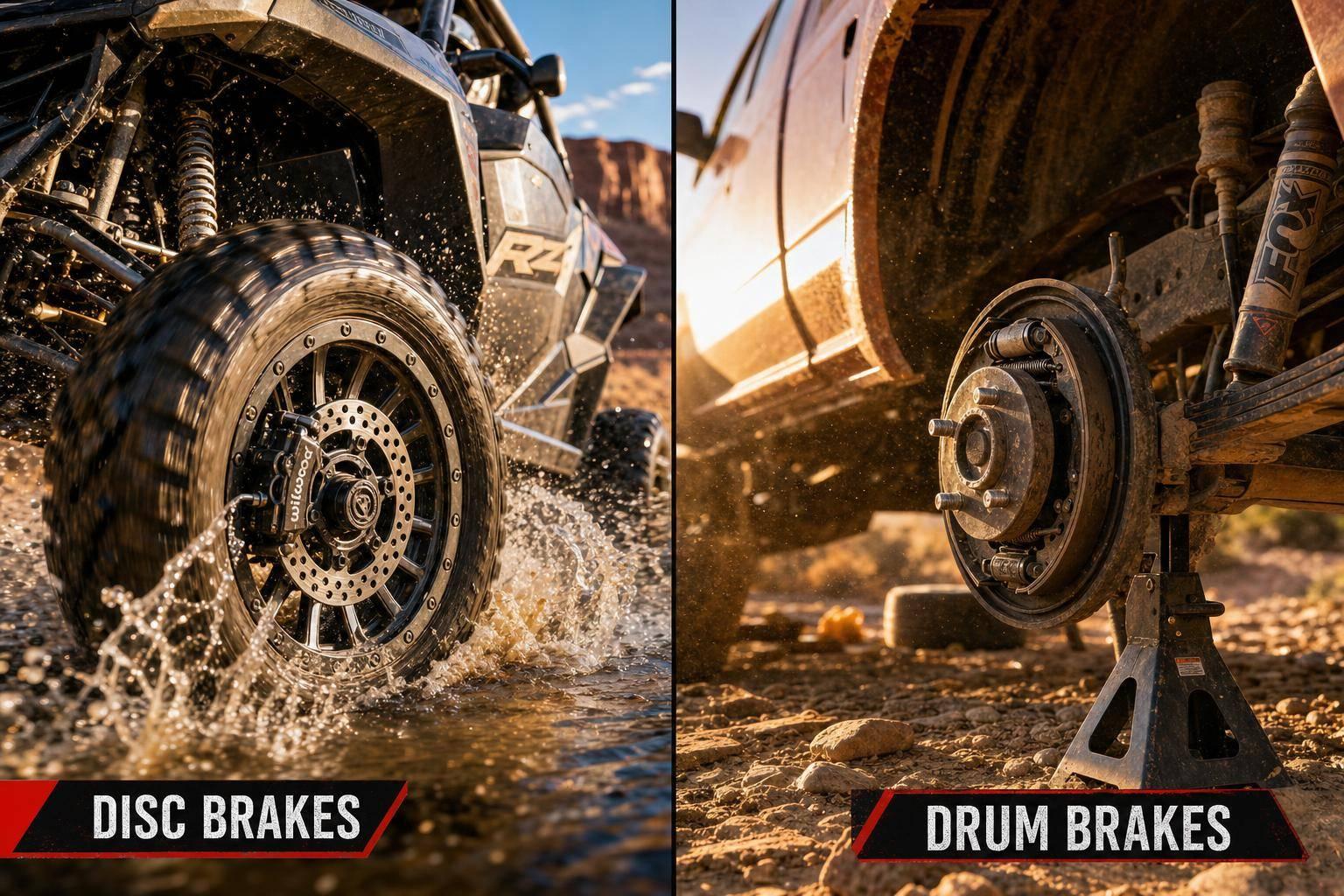
If you drive off-road in mud, water, rocks, or on long descents, disc brakes are the better choice for most builds. They run cooler, come back faster after water crossings, and give you more control on loose ground.
Here’s the short version:
- Disc brakes give you better pedal feel and brake control
- Disc brakes handle heat better on long downhill sections and race runs
- Disc brakes dry off faster after water crossings
- Drum brakes are smaller and can fit tighter wheel setups
- Drum brakes can cost less, but mud and water tend to stay inside longer
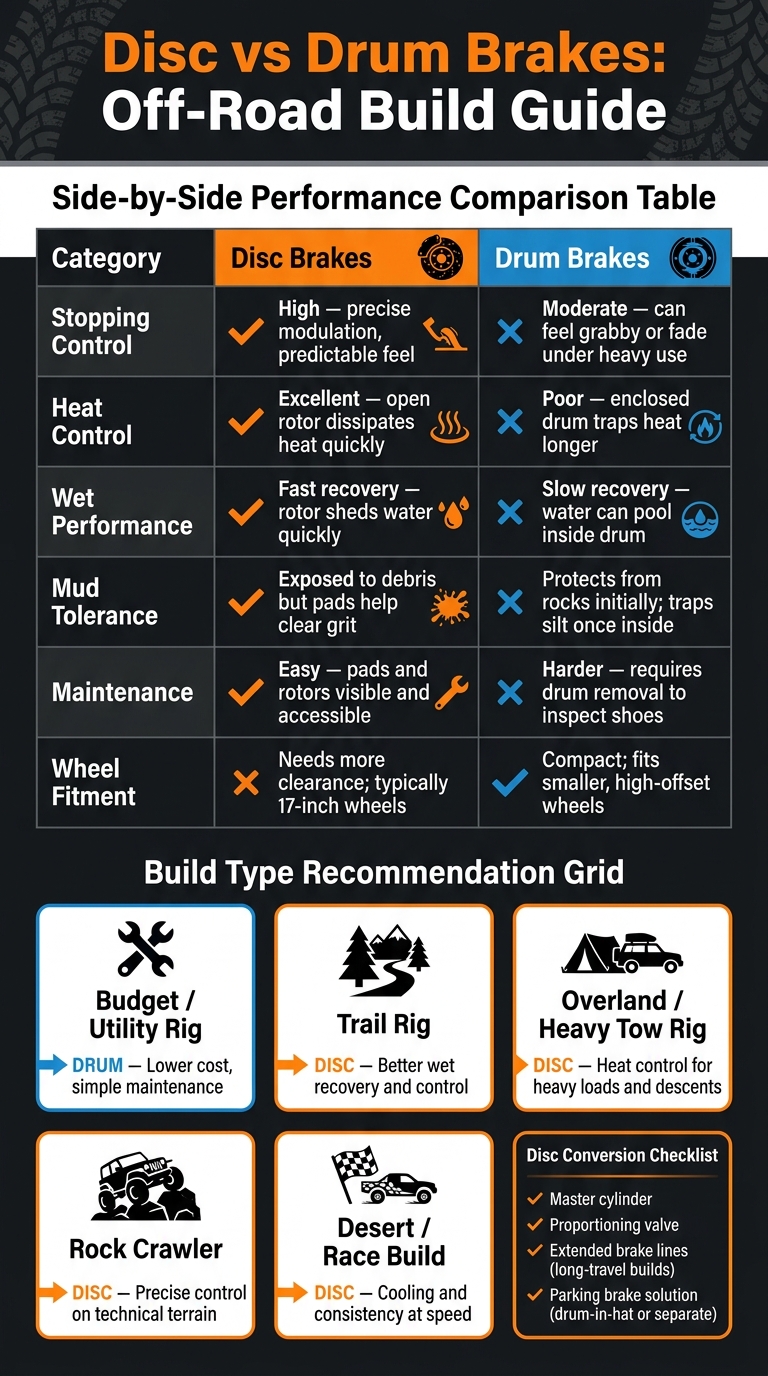
- Disc conversions often need more than rotors and calipers: you may also need a master cylinder, proportioning valve, longer brake lines, and a parking brake setup
For most trail rigs, crawlers, overland trucks, and race trucks, I’d pick disc brakes. If you have a lower-cost utility build that sees light trail use, drum brakes can still do the job.
Disc vs Drum Brakes: Which is Better & how do they work?
sbb-itb-afc4690
Quick Comparison
| Criteria | Disc Brakes | Drum Brakes |
|---|---|---|
| Control on dirt and rocks | Better modulation and steadier feel | Less linear, can feel grabby |
| Heat on long descents | Runs cooler, less fade | Holds heat, fades sooner |
| Water crossing recovery | Dries and clears faster | Water can stay trapped inside |
| Mud and silt | Exposed parts need cleaning | Debris can get trapped once inside |
| Field service | Pads and rotors are easy to inspect | More work to inspect and service |
| Wheel fitment | May need more wheel clearance | Usually fits tighter wheel setups |
| Best fit | Trail, crawl, overland, race | Budget, light-use rigs |
A lot of off-road brake problems show up in the same places: steep descents, repeated stops, and water crossings. That’s why this comparison looks at control, heat, contamination, service access, and swap planning right away.
Off-Road Brake Basics and Side-by-Side Comparison
The main difference comes down to heat and contamination.
Disc brakes use an open rotor and caliper. The rotor spins in open air, and the caliper squeezes brake pads against it to slow the wheel. Drum brakes work the other way. Shoes press outward against the inside of an enclosed drum.
That one design change shapes a lot: how each brake deals with heat, how dirt and water get in, and how easy each system is to check and service.
How Disc Brakes Work in Off-Road Conditions
With disc brakes, the rotor sits out in the open, so heat can escape straight into the air. That helps a lot when you’re braking over and over on a long downhill run. Pads also wipe water and light mud off the rotor surface, which helps the brakes come back faster after creek crossings or wet sections.
That’s why race builds often run large rotors and multi-piston calipers. They’re built to handle more heat without the brake feel going soft.
The trade-off is simple: the open caliper is easier to hit with rocks, grit, and trail junk. So the slides or pins need regular cleaning if you want things to keep moving the way they should.
How Drum Brakes Work in Off-Road Conditions
Drum brakes hide the shoes and hardware inside the drum, which gives them a bit more protection from rocks and direct hits. On rough trails, that can help at first.
But there’s a catch. If mud, silt, or water gets inside, it tends to stay there. That speeds up wear and makes the brakes slower to recover after water crossings. The enclosed drum also holds heat longer, which increases fade risk on long trails.
Put plainly, drum brakes can seem fine until the trail gets wet, steep, or drawn out.
The differences are easier to spot side by side:
| Feature | Disc Brakes | Drum Brakes |
|---|---|---|
| Stopping Control | High; precise modulation and predictable feel | Moderate; can fade or feel grabby under heavy use |
| Heat Control | Excellent; open rotor dissipates heat quickly | Poor; enclosed drum traps heat longer |
| Wet Performance | Fast recovery; rotor sheds water quickly | Slow recovery; water can pool inside the drum |
| Mud Tolerance | Pads help clear water and light grit; exposed to debris | Protects from rocks initially; traps silt once it enters |
| Maintenance | Easy; pads and rotors are visible and accessible | Harder; requires drum removal to inspect shoes |
| Wheel Fitment | Needs specific caliper-to-spoke clearance | More compact; generally easier spoke clearance |
These gaps show up most on steep descents, repeated stops, and water crossings.
Stopping Control, Heat, and Harsh Terrain
Pedal Feel and Brake Modulation on Loose Ground
Those design differences show up fastest when grip falls off and braking has to stay precise. On loose dirt, gravel, and rock, disc brakes tend to give more predictable pedal feel and easier modulation on steep descents. That matters when the surface is already sliding around under you.
Drum brakes are less consistent in those same conditions. Because they rely on internal shoes and hardware, they can feel less linear and harder to fine-tune when traction is already limited.
Precision is a big deal, but repeated downhill braking exposes the larger gap fast: heat control.
Heat Buildup and Brake Fade on Trails and Race Stages
On long descents and race stages, discs stay more consistent because they shed heat faster. Drums trap heat and fade sooner.
That difference gets hard to ignore when the trail keeps dropping and you’re still on the brakes. A setup that manages heat better usually gives you the same response corner after corner instead of changing as things get hotter.
Mud, Dirt, and Water Crossing Performance
Off-road driving doesn’t just beat up brakes with heat. Mud and water are part of the test too. After mud or water, discs recover faster, while drums hold moisture and debris longer.
Discs aren’t perfect, though. If grit gets left between the pad and rotor, they can still suffer.
Service Access, Wheel Fitment, and Conversion Planning
Once performance is sorted out, service access and fitment usually decide what makes sense next. On trail rigs and race trucks, easy maintenance and clean packaging matter just as much as stopping force.
Maintenance Access and Routine Service
Disc brakes are easier to check and clean after a muddy run. You can see the pads and rotor without digging deep into the assembly. That makes routine inspections simpler, especially when a truck gets used hard and serviced often.
Drum brakes take more work. The shoes and hardware sit inside the drum, so inspection, cleanup, and adjustment take longer. And when it’s time for service, pad swaps are much faster than drum shoe work, which means dealing with springs, clips, and tensioners.
Fitment is the next hurdle, especially once larger rotors and calipers enter the mix.
Wheel Clearance and Brake Packaging
Disc brakes usually need more space. Larger rotors and outboard calipers need room around the wheel barrel and spokes, which is why many off-road builds run 17-inch wheels to clear bigger brake parts. Wheel offset matters too. Get that wrong, and spoke-to-caliper contact can become a problem.
Drum setups are more compact, so they fit smaller, high-offset wheels with less trouble. That space-saving edge is real. But for many builds, it starts to matter less when service ease and brake output move to the top of the list.
Clearance is only one piece of the swap. The hydraulic system has to match the new brake setup too.
Key Checks Before a Drum-to-Disc Conversion
If the plan is a drum-to-disc swap, the hydraulic and packaging details matter just as much as the brake parts themselves. A disc conversion also needs the correct master cylinder, proportioning valve, and brake-line length. Long-travel builds often need extended lines at full droop so the lines don’t get stretched or damaged. On long-travel LSK Suspension builds, brake packaging, suspension geometry, and fabricated spindles must work together.
Rear disc conversions also need a parking brake plan. Many builders use drum-in-hat rotors or another separate parking-brake setup.
| Conversion Factor | Stock Drum Setup | Converted Disc Setup |
|---|---|---|
| Wheel Fitment | Fits smaller, high-offset wheels more easily | Often needs 17-inch wheels and careful caliper clearance |
| Brake Line Needs | Standard factory lengths | Extended lines often required on long-travel builds |
| Parking Brake | Built in | Requires drum-in-hat or other separate solution |
Best Use Cases and Final Verdict
Disc vs Drum Brakes for Off-Road: Which Is Right for Your Build?
Once you’ve looked at performance, service, and fitment, the choice comes down to one thing: how you use the truck.
When Drum Brakes Still Work
Drum brakes still have a place on budget utility builds where heat management and pedal feel aren’t top priorities. If you’re putting together a basic trail rig or an entry-level prerunner, sticking with the factory drum setup can be a smart move. It costs less, has fewer parts to deal with, and works fine for occasional street driving and light trail use.
That said, the tradeoff shows up fast once the truck gets heavier, faster, or starts seeing rougher terrain.
When Disc Brakes Are the Better Pick
For most hard-used off-road builds, disc brakes are the better pick. Trail rigs that handle repeated descents, frequent water crossings, or tires 37 inches and up get a clear edge from discs. Race builds and prerunners running at sustained speed in rough terrain need the steady braking disc systems provide. Heavy trucks also benefit from the added heat capacity and stopping cushion that discs bring.
Key Takeaways for U.S. Off-Road Builds
| Build Type | Recommended Brake | Primary Reason |
|---|---|---|
| Budget / Utility Rig | Drum | Lower cost and simple maintenance |
| Trail Rig | Disc | Better wet recovery and control |
| Overland / Heavy Tow Rig | Disc | Heat control for heavy loads and descents |
| Rock Crawler | Disc | Precise control on technical terrain |
| Desert / Race Build | Disc | Cooling and consistency at speed |
For most demanding off-road builds, disc brakes are the safer bet. Drums still fit the picture when cost and simplicity matter more than heat control.
FAQs
Are disc brakes worth it for light trail use?
Usually, no. For light trail use, paying to switch to disc brakes is often tough to justify. Stock drum brakes are usually enough for most off-road driving and towing.
Disc brakes do make maintenance easier. They also shed heat better and hold less water. But those upsides matter most for high-performance driving or heavy towing. If you’re not dealing with brake fade or frequent failures, the payoff is pretty small.
What parts do I need for a drum-to-disc swap?
You’ll need a conversion kit with the main parts that replace the drum setup. That usually includes:
- rotors
- calipers
- caliper mounting brackets
- brake pads
- brake lines
- possibly a new master cylinder
If you’re building out the full axle, you may also need aluminum hats, wheel bearings, and special fittings. Make sure all hardware is torqued to the manufacturer’s specs.
Will disc brakes fit my current wheels?
It comes down to your wheel diameter and offset. Disc brake parts – mainly the calipers and rotors – are often larger than drum brake hardware, so they need more room inside the wheel.
If your wheels are on the smaller side, the kit may rub against the inner rim. In that case, you may need a larger wheel size or a different backspacing setup. Before installation, always compare your brake kit’s clearance requirements with your wheel specs.
Leave a Reply