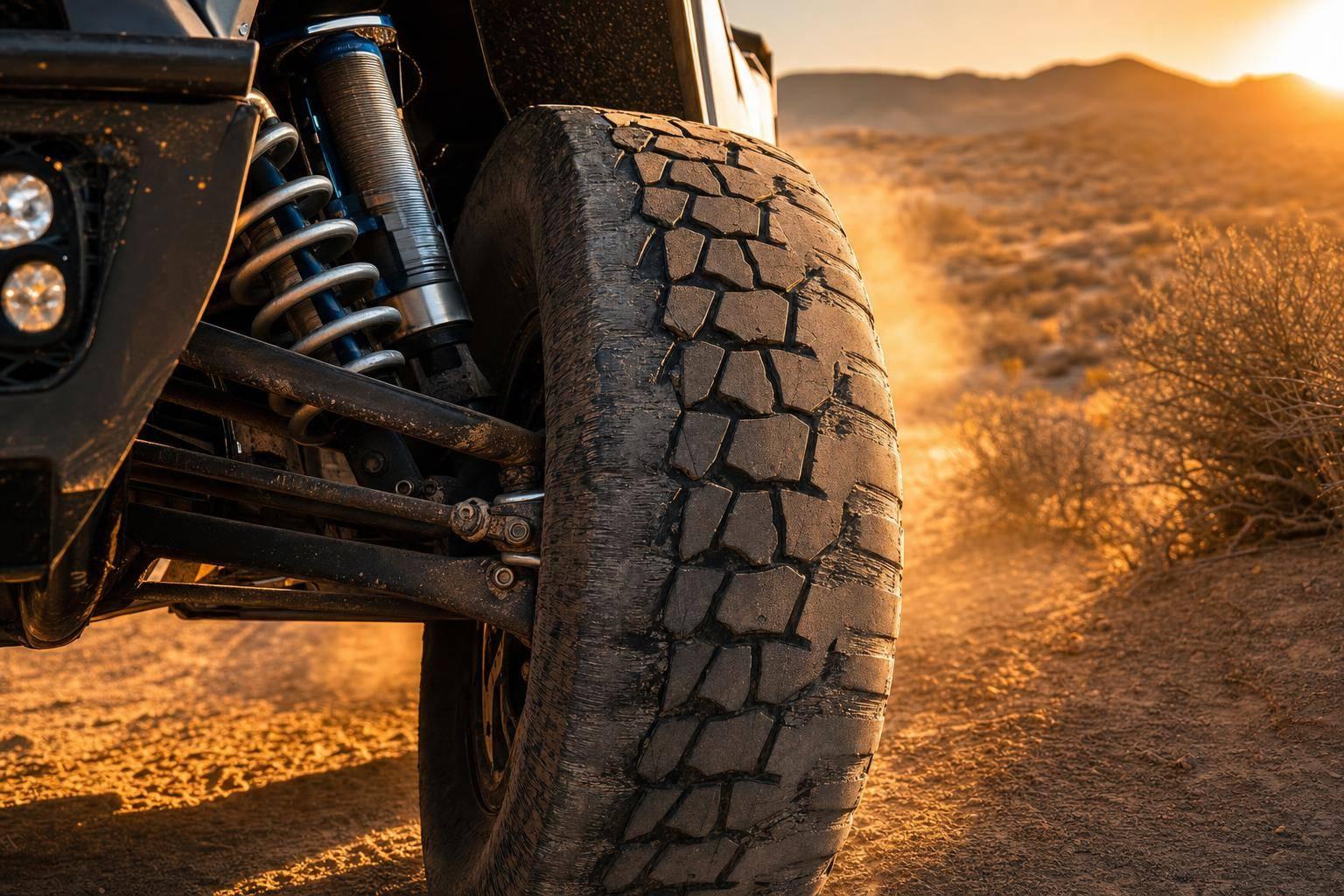
If your truck pulls, wanders, shakes the wheel, or starts wearing the inside or outside edge of a front tire, I’d treat alignment as a top suspect right away. On a long travel setup, small changes in caster, camber, and toe can show up fast on the road and even faster in your tires.
Here’s the short version:
- Pulling or drifting often points to a caster or camber side-to-side problem
- A crooked steering wheel usually means toe is off
- Loose highway feel and weak self-centering often mean low positive caster
- Feathered tread is a common sign of bad toe
- Inside or outside edge wear often points to camber trouble
- Brake pull, clunks, or binding can mean parts shifted after a hard hit, not just that the numbers changed
I’d also keep timing in mind. Alignment should be checked right after installation, then again after about 500 to 1,000 miles as parts settle. After a hard trail hit, a preload change, new control arms, tie rods, or steering parts, I’d check it again. Even if the truck feels fine, a check every 6 to 12 months can help catch tire wear before it gets expensive.
A few fast facts matter here:
- Toe is often the angle that wears tires the fastest
- A truck used for overlanding should be aligned at its normal loaded weight
- One front tire wearing much faster than the other can point to a bent or shifted part
- Steering shake at 40–65 mph may be alignment, but I’d also inspect joints and wheel balance
Put another way: if the steering changed after install or after off-road use, I wouldn’t wait for the tires to prove it. The main things I’d watch are steering feel, tire wear, braking behavior, and signs that a part moved after impact.
Below, I break down the symptoms that matter most and what each one can mean.
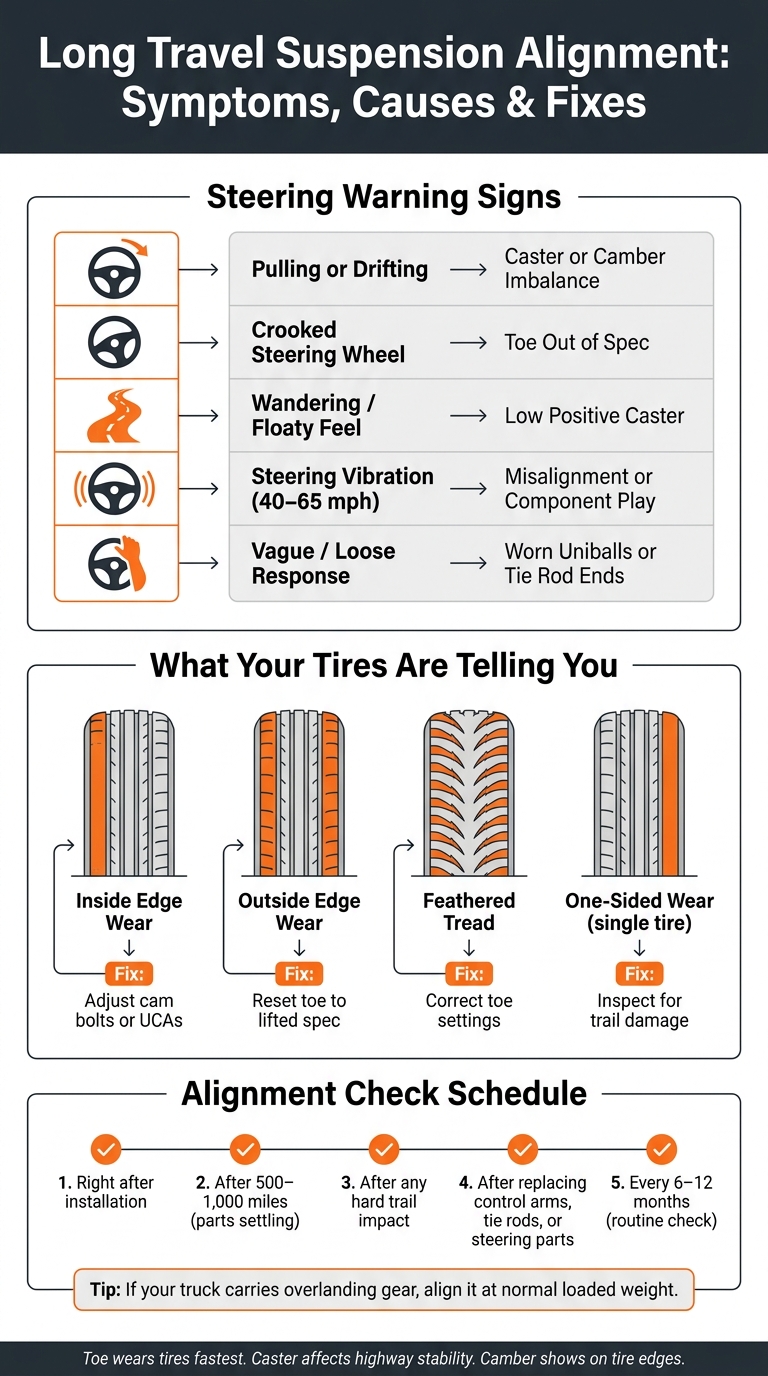
Long Travel Suspension Alignment: Symptoms, Causes & Fixes
Steering Signs Your Suspension Is Out of Alignment
Pulling, Drifting, or a Crooked Steering Wheel
If your truck keeps drifting to one side on a flat, straight road, that’s a strong sign the alignment has moved out of place. When it pulls all the time, the issue often comes from a camber or caster imbalance.
A steering wheel that sits crooked while you’re driving straight is another common clue. In most cases, that means toe is out of spec after a lift or suspension install.
And if the truck feels vague or twitchy at the same time, look at caster and bump steer next. That’s often where the problem starts to show up.
Wandering, Loose Response, or Steering Vibration
A floaty, disconnected feel at highway speed usually points to too little positive caster. When that self-centering force drops off, the truck reacts more to road grooves, ruts, and crosswinds. You feel like you’re making small corrections all the time.
If the steering wheel shakes at speed, inspect the tie rods, ball joints, uniballs, rack mounts, and control arm pivots for play. Wear in any of these parts can feel like an alignment issue, even when alignment isn’t the only problem. Rough-pavement twitch can also point to bump steer caused by changed tie rod angles.
| Symptom | Likely Cause | What to Check |
|---|---|---|
| Wandering / floaty at speed | Low positive caster | Control arm angles, UCA adjustment |
| Pulling to one side | Camber or caster imbalance | Side-to-side geometry, ball joint wear |
| Crooked steering wheel | Toe out of spec | Tie rod adjustment after lift |
| Vague / loose response | Worn uniballs or tie rod ends | Pivot points, steering rack mounts |
| Steering vibration | Misalignment or component play | Tie rods, ball joints, rack |
sbb-itb-afc4690
Total Chaos Long Travel 2016 Tacoma Custom Alignment
Tire Wear Patterns That Point to Bad Alignment
Tire wear often flags alignment problems before the steering wheel does. Sometimes the steering only feels a little off, but the tires are already telling you something is wrong.
Inside Edge, Outside Edge, and Feathered Tread Wear
Inside shoulder wear usually points to too much negative camber. That often happens when long-travel control arms push the factory cam bolts close to their limit. In many cases, the tread shows the issue before anything else feels wrong.
Outside edge wear usually points to positive camber or a toe problem after lift geometry changes.
Feathering is easy to spot once you know what to feel for. The tread feels sharp in one direction and smooth in the other. That usually means toe is out of spec.
If one front tire is wearing much faster than the other, look closely at the knuckle and control arm. A bend or slight shift from a trail hit can cause that kind of uneven wear.
Tire Scrub, Squeal, and Fast Front Tire Wear
Low-speed scrub and squealing in parking lot turns usually mean the front end isn’t tracking the way it should. That’s often tied to scrub radius or Ackermann changes after the track width gets wider or the wheel offset becomes more aggressive.
Front tires can also wear fast when toe changes after ride height moves. Even a small change can make the tire drag a bit with every mile. It doesn’t sound like much, but over time it adds up.
After a hard hit or any ride-height change, check the front tire shoulders. That’s often where the first signs show up.
Tire Wear Diagnostic Table
| Tire Wear Pattern | Likely Alignment Angle | Possible Long Travel Source | Recommended Next Step |
|---|---|---|---|
| Inside edge wear | Excessive negative camber | Steep arm angle; cams at limit | Inspect UCAs; adjust camber via cams or aftermarket arms |
| Outside edge wear | Positive camber or improper toe | Lifted geometry; camber shift | Adjust cam bolts or install corrected-geometry UCAs |
| Feathered tread | Incorrect toe | Tie rod angle mismatch causing bump steer | Reset toe to lifted-spec; verify tie rod ends aren’t binding |
| Cupping or scalloping | Dynamic toe / damping issues | Worn shocks or high-speed oscillation | Check shock valving and bushing integrity |
| One-sided wear (single tire) | Camber/caster split | Bent knuckle or shifted front-end component | Inspect for structural damage from trail impacts |
| Rapid front wear / scrub | Toe-out or scrub radius | Widened track; aggressive wheel offset | Verify KPI and wheel offset compatibility |
Handling and Braking Changes After Installation or Hard Use
If the steering still feels decent, the next clues usually show up in handling and braking. In a lot of cases, the first red flags are highway instability and brake pull. That’s often where caster or toe drift starts to show.
Instability in Lane Changes and Under Braking
After a long travel install or a preload change, a truck can feel twitchy and nervous at highway speed. It may wander, feel vague, or need constant correction just to stay in its lane. In plain terms, that usually points to a toe or caster issue.
When a truck is lifted or preload is increased, the control arms rotate downward and caster drops. Most trucks need positive caster for highway stability. Even a small drop can make the steering feel light, vague, and slow to self-center.
Pulling under braking usually points to unequal caster or camber. Toe and caster that are out of spec can also force you to keep correcting the wheel, which wears on the driver during long trips.
If the truck still feels off after an alignment check, stop there and look for shifted or damaged parts.
Clunks, Binding, or Signs of Shifted Components
If the problem shows up only after a hard hit or full-travel event, the cause may be mechanical, not just alignment geometry. Put another way: not every handling change after an impact comes from alignment alone.
Clunks, knocks, or binding at full steering lock or full travel are signs that something else needs attention first. On a long travel setup, tie rod ends and spherical bearings can bind and make the truck feel unstable, even when the alignment numbers don’t look far off.
Hard impacts can shift lower control arm cam tabs, which changes alignment without any clear visible bend. After a hard hit, inspect:
- Cam tabs
- Tie rods
- Limit straps
Do that before scheduling alignment. If the shocks bottom out before the straps, the next hit can shift alignment again.
New springs, bushings, and hardware can also settle with use, so it’s smart to recheck alignment after 500 to 1,000 miles.
Those symptoms are your sign to check alignment now, not after putting on more miles.
When to Schedule an Alignment and What to Check
Key Times to Check Alignment on a Long Travel Setup
When steering feels off or tire wear starts showing up, don’t wait around. That usually means something has shifted. A set schedule helps you catch problems before they turn into bigger ones.
Check alignment right after installation, then again after 500–700 miles as new parts settle in. You should also check it after any hard impact or any major suspension change. Past that, it’s smart to schedule an alignment after hard off-road use, after replacing control arms, tie rods, ball joints, or steering racks, and every 6–12 months even if nothing feels wrong.
If the truck is set up for overlanding and usually carries extra gear, have the alignment done at its normal loaded weight. That matters more than a lot of people think. A truck that sits one way empty and another way with camping gear, tools, water, and fuel can behave very differently on the road.
When installing long travel kits or control arms – such as those from LSK Suspension – ask for a before-and-after spec sheet. It gives you a baseline you can compare against later.
Symptom-to-Check Summary Table
If something feels off, use the table below to connect the symptom to the most likely thing to inspect:
| Symptom | Likely Geometry Issue | Recommended Check |
|---|---|---|
| Vibration between 40–65 mph | Toe or caster mismatch | Check tie rod ends and wheel/tire balance |
| Steering won’t return to center | Insufficient caster | Verify upper control arm geometry and steering axis inclination |
| Crooked steering wheel | Toe off center | Check tie rod adjustment and center the steering rack |
| Instability under braking | Anti-dive geometry or toe-out | Inspect control arm pivot heights and tie rod angles |
| One-sided tire wear (single tire) | Camber or caster split | Inspect for structural damage from trail impacts |
FAQs
Can bad wheel balance feel like an alignment problem?
Yes. Bad wheel balance can feel a lot like an alignment problem because it can cause vibration or make the steering feel unsettled.
The main difference comes down to how the issue shows up.
Wheel imbalance usually causes speed-dependent vibrations. In plain English, the faster you go, the more noticeable the shaking tends to become.
Alignment issues with a long-travel suspension are different. They’re more likely to cause wandering, poor return-to-center, or uneven tire wear, and those problems can show up regardless of tire balance.
Should I align my truck loaded for overlanding?
Yes. Loading your truck for overlanding can change its ride height and suspension geometry, which can push alignment angles like camber and toe out of spec.
Overlanding also means long highway miles mixed with rough trails. That kind of use puts more stress on tires and suspension parts. A proper alignment helps prevent uneven tire wear and keeps handling steady and predictable.
It’s smart to check alignment from time to time, especially after a major change in load or a long off-road trip.
Can a hard trail hit shift alignment without obvious damage?
Yes. A hard hit on the trail can knock your alignment out of place even if nothing looks damaged at first glance.
When you slam into a rock or another obstacle, parts like tie rods or control arms can bend. That changes your alignment angles and throws the suspension geometry out of spec.
If the steering feels off after a rough trail run, or the steering wheel suddenly sits crooked, there’s a good chance the alignment shifted.
Leave a Reply