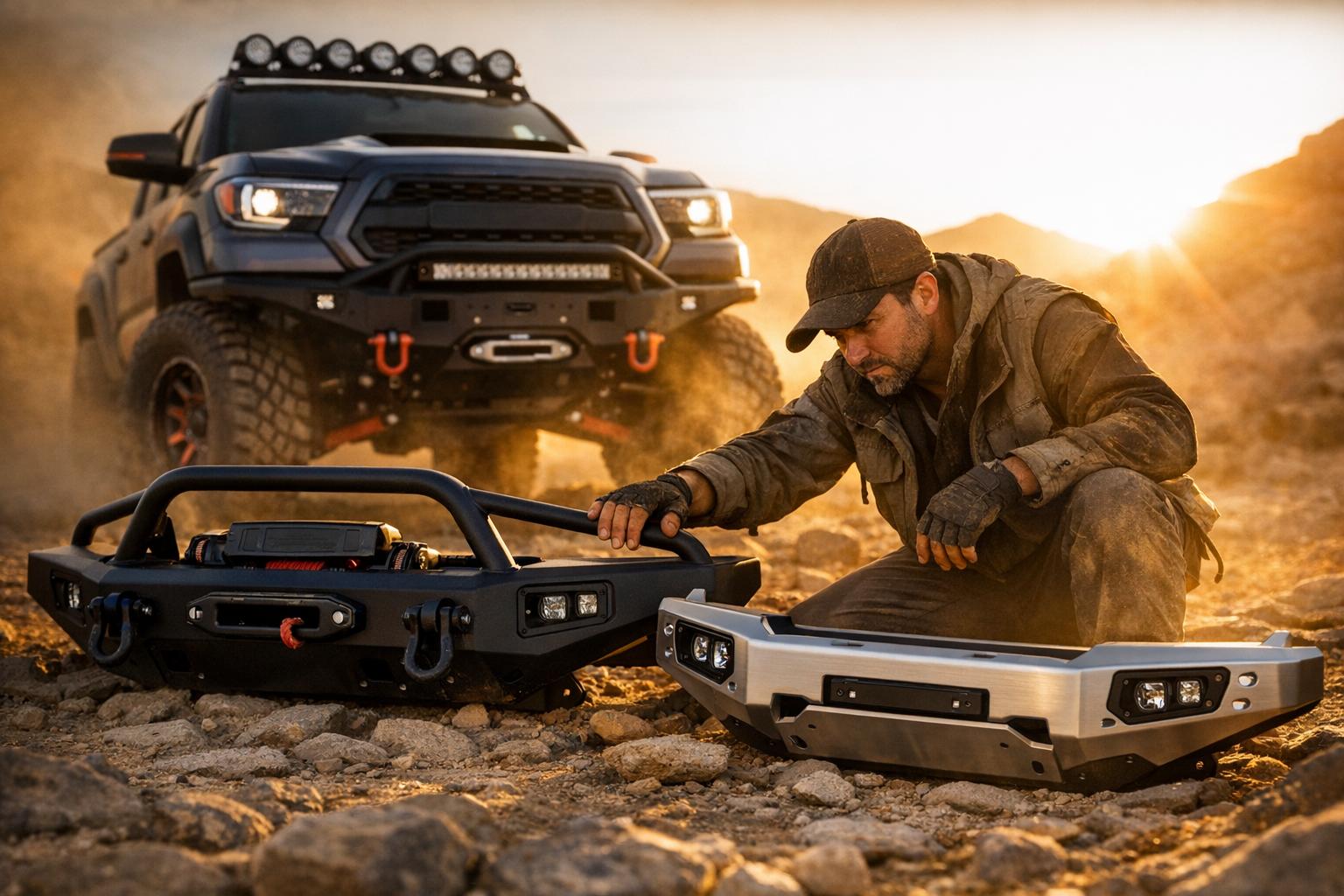
When upgrading your off-road truck’s bumper, the goal is to balance protection, weight, and functionality based on your specific driving needs. A stock bumper won’t cut it for rugged trails or extreme conditions. Here’s how to choose the right one:
- Determine Your Off-Road Activity:
- Rock Crawling: Stubby or high-clearance bumpers improve tire clearance and approach angles.
- Overlanding: Lightweight aluminum bumpers reduce weight and support accessories.
- Desert Racing: Tubular designs improve airflow and reduce weight.
- Rural Driving: Full-width steel bumpers protect against animal strikes and heavy brush.
- Material Matters:
- Steel: Durable, handles heavy impacts, but adds weight (90–160 lbs). Prone to rust if coating chips.
- Aluminum: Lightweight (40–80 lbs), rust-resistant, but less impact-resistant and harder to repair.
- Recovery Gear Compatibility:
- Ensure the bumper supports winches (8,000–17,500 lbs) and has reinforced recovery points.
- Vehicle Fit and Safety:
- Confirm compatibility with safety systems (sensors, airbags) and state regulations on bumper height.
- Weight and Suspension:
- Heavy bumpers may require suspension upgrades to maintain performance and handling.
Choosing the right bumper ensures durability, safety, and optimal off-road performance. Always match your bumper to your truck’s setup and intended use.
Understanding Your Off-Road Needs
Defining Your Off-Road Goals
Start by identifying your primary off-road activity. The right bumper for a weekend of rock crawling might not cut it for long overland adventures.
"A stock bumper works fine for everyday driving. But once your truck starts seeing hunting camps, overlanding trips, rough backroads, or weekend trail rides, you start wanting more protection and more capability up front." – C.G. Racine, Rough Country
Different activities call for different bumper features. For example:
- Rock crawling: A stubby or high-clearance bumper is essential for better approach angles.
- Overlanding: Lightweight aluminum bumpers (40–60% lighter than steel) are ideal for saving weight and mounting accessories.
- High-speed desert runs: Tubular bumpers are a great choice because they’re lightweight and allow better airflow to the radiator.
- Rural driving: Full-width steel bumpers offer the most protection, critical for avoiding damage from animal collisions. In the U.S., animal-vehicle collisions result in over $10 billion in damages annually across 1.9 million incidents.
Once you’ve nailed down your activity, think about how balancing protection and weight might impact your truck’s performance.
Balancing Protection, Weight, and Performance
While extra protection is great, it comes at a cost – added weight. For example, a full-width steel bumper typically weighs between 90 and 160 lbs. Throw in a winch (another 60–85 lbs), lights, and a skid plate, and your front-end weight could increase by 200–280 lbs. This added weight shifts your truck’s center of gravity forward, which can affect steering, braking, and fuel efficiency.
Here’s a breakdown of bumper styles by activity:
| Bumper Style | Best Activity | Weight Range | Key Trade-off |
|---|---|---|---|
| Stubby/High-Clearance | Rock crawling | Lower | Exposes corners and headlights |
| Full-Width Steel | Hunting/rural driving | 90–160 lbs | Reduces approach angle; heavy |
| Pre-Runner/Tubular | Desert racing | Lowest | Less surface protection than plate |
| Mid-Width/Modular | Overlanding | Moderate | Balances protection and mounting options |
| Hybrid | Daily/weekend use | Moderate | Less durable than full steel |
If you’re not into hardcore rock crawling or desert racing, a hybrid bumper – featuring a steel center with lighter outer wings – offers a great mix of durability and manageable weight.
Accounting for Vehicle Constraints
Your off-road goals and weight considerations are just part of the equation. Modern trucks come with built-in crash-absorbing structures and sensor systems, like parking sensors, adaptive cruise control, and forward collision warnings. Installing an aftermarket bumper may require trimming crash bars or relocating sensors with a kit. Skipping these steps could deactivate safety features or trigger annoying warning lights.
Suspension is another critical factor. If your truck has – or will have – a long-travel suspension kit, which increases axle travel and widens your track, you’ll need a high-clearance bumper. This ensures your tires and suspension components have enough room to move without rubbing. A bumper designed for a stock suspension won’t work well with oversized tires (35"+) or lifted setups when you’re tackling trails.
Plan your suspension upgrades before choosing a bumper. Ensuring compatibility with your truck’s safety systems and suspension is just as important as matching the bumper to your off-road goals.
sbb-itb-afc4690
Off-Road Bumper Buying Advice – What makes a bumper good or bad?
Bumper Materials and Construction
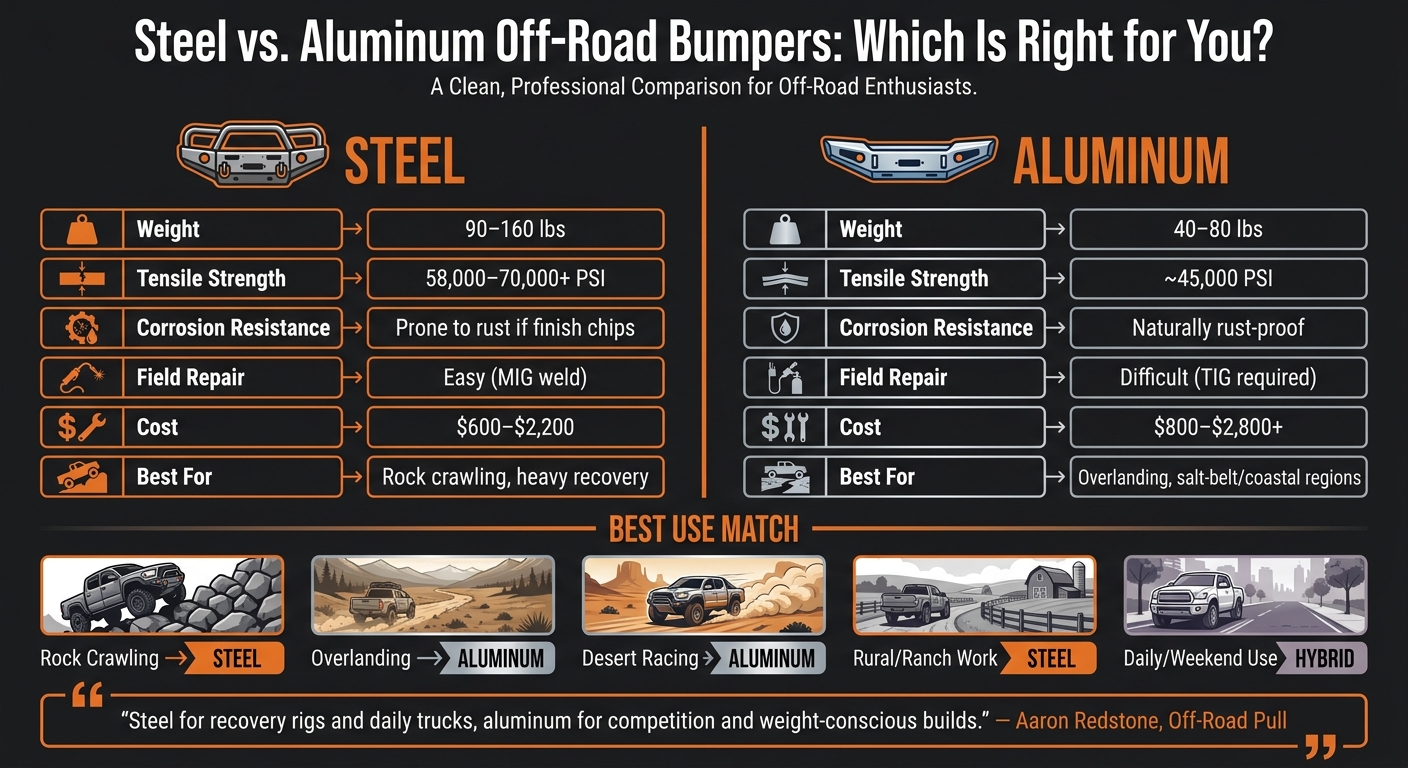
Off-Road Bumper Materials & Styles: Steel vs. Aluminum Comparison Guide
Steel vs. Aluminum: A Direct Comparison
When picking a bumper, the material and how it’s built are just as important as its style and fitment – especially for off-road adventures. The two main contenders? Steel and aluminum.
Steel is the rugged choice for heavy-duty use. Mild steel plates boast a tensile strength of 58,000–65,000 PSI, while High-Strength Low-Alloy (HSLA) steel pushes past 70,000 PSI. This makes steel highly resistant to repeated impacts from rocks or stumps without permanent damage. Plus, repairing steel is relatively simple with a standard MIG welder. However, steel bumpers are heavy – typically 90–160 lbs for a full-width front bumper – and if the powder coat chips, rust can become an issue over time.
On the other hand, aluminum bumpers are much lighter, weighing 40–80 lbs, which is about 40–60% less than their steel counterparts. The most common alloy, 6061-T6, has a tensile strength of around 45,000 PSI, which is roughly 30% less than mild steel. While aluminum is naturally rust-resistant – making it ideal for coastal or salt-heavy regions – it’s more prone to denting and deformation under heavy impacts. Field repairs are also trickier, requiring specialized TIG welding.
"Steel for recovery rigs and daily trucks, aluminum for competition and weight-conscious builds." – Aaron Redstone, Founder of Off-Road Pull
| Feature | Steel | Aluminum |
|---|---|---|
| Weight | 90–160 lbs | 40–80 lbs |
| Tensile Strength | 58,000–70,000+ PSI | ~45,000 PSI |
| Corrosion Resistance | Prone to rust if finish chips | Naturally rust-proof |
| Field Repair | Easy (MIG weld) | Difficult (TIG required) |
| Cost | $600–$2,200 | $800–$2,800+ |
| Best For | Rock crawling, heavy recovery | Overlanding, salt-belt regions |
Some manufacturers offer hybrid designs that combine steel’s durability with aluminum’s weight savings, giving you the best of both worlds.
Next, let’s dive into the construction details that make a bumper truly ready for off-road challenges.
What to Look for in Construction Quality
Material choice is just one piece of the puzzle – construction quality is equally critical. Start by checking plate thickness. High-quality steel bumpers often use 3/16" steel plates for the main body, with 1/4" reinforcements at key stress points like recovery mounts and frame brackets. Thinner materials may look fine at first glance but can fail during a hard recovery pull.
Recovery points are another key feature. Look for fully welded recovery points with internal gusseting to ensure they can handle heavy loads. Recovery points that aren’t directly tied to the frame mounting brackets can fail under pressure, which is the last thing you want when you’re stuck on the trail. If you’re considering a tubular bumper, make sure the ends are capped or welded shut to prevent water from collecting inside, which could lead to internal rust.
A durable finish is also a must. Multi-stage powder coating is the industry standard, with some manufacturers adding a zinc primer layer for added rust protection – especially useful in wet or muddy conditions. Since scratches are inevitable, keeping a can of bedliner spray or touch-up paint handy can help stop rust from spreading when the coating gets damaged.
With these construction tips in mind, you’ll be better prepared to choose a bumper that can handle the demands of your off-road adventures.
Matching Bumper Styles to Off-Road Activities
Common Bumper Styles Explained
Once you’ve decided on the material, the next step is choosing a bumper style that aligns with your off-road needs. Plate bumpers, crafted from flat steel or aluminum, are known for their durability and ability to withstand heavy impacts, making them ideal for challenging terrains. On the other hand, tube (prerunner) bumpers, made from steel tubing, are lighter and improve airflow to the radiator – an essential feature for desert conditions. If you’re looking for a mix of strength and reduced weight, hybrid designs combine a steel winch cradle with an aluminum outer shell, offering a balanced option. Keep in mind that the quality of construction and materials you choose will enhance the effectiveness of these styles.
For those who prefer to maintain the factory look of their vehicle while adding functionality, center mount (semi-hidden) bumpers are a great choice. They provide winch mounts and recovery points without altering your truck’s overall appearance.
The bumper’s width also plays a significant role in its performance. Stubby bumpers stop short of the wheel wells, allowing maximum tire clearance for navigating technical terrain. Mid-width bumpers strike a balance, extending slightly beyond the grille for added protection while maintaining good clearance. Full-width bumpers cover the entire front end, offering comprehensive protection for headlights, fenders, and other components, especially useful in areas with heavy brush or the risk of animal strikes.
Specialized Features for Off-Road Use
Beyond the basic design, certain features can enhance your bumper’s functionality depending on your off-road environment. Stingers are a popular addition for steep descents, as they contact the ground first and help redirect momentum to prevent end-over-end flips. Bull bars not only shield the grille from brush but also provide mounting points for lights and other accessories. Grille guards extend this protection to the headlights and radiator, which is particularly valuable in rural areas where animal-vehicle collisions are a frequent concern – approximately 1.9 million incidents occur annually in the U.S..
If you’re tackling steep or rocky terrain, high-clearance designs taper upward to improve your vehicle’s approach angles. For added protection to underbody components like the steering rack and intercooler, integrated skid plates are a smart choice, shielding these vulnerable parts from damage caused by rocks or debris.
Choosing a Bumper by Activity
Your off-road adventures dictate which bumper style will serve you best. Here’s a breakdown to help match your activities with the right bumper:
| Activity | Recommended Style | Key Feature |
|---|---|---|
| Rock Crawling | Stubby / High-Clearance | Maximum tire clearance and approach angle; stingers for steep descents |
| Overlanding | Hybrid / Aluminum Plate | Lightweight design, accessory mounts, winch compatibility |
| Mudding / Recovery | Full-Width Steel Plate | Heavy-duty recovery points and winch mount |
| Desert Racing | Tubular (Prerunner) | Lightweight construction, improved airflow, and aggressive approach angles |
| Ranch / Rural Work | Full-Width w/ Grille Guard | Protection from animal strikes and brush |
For rock crawling, a stubby or high-clearance bumper is essential to ensure your tires can navigate obstacles without interference. Adding a stinger is wise for extreme descents. If your focus is overlanding, a hybrid or aluminum plate bumper keeps the weight manageable on long journeys while offering the accessory mounts you’ll need. For mudding or heavy recovery, opt for a full-width steel plate bumper – it provides the strength and solid recovery points required when you’re stuck deep in the muck. Desert racing calls for a tubular prerunner bumper to keep the front end light and ensure proper cooling under high-speed, high-temperature conditions.
Lastly, if you’re using your vehicle for ranch or rural work, a full-width bumper with a grille guard offers excellent protection against animal strikes and brush, ensuring your truck stays functional in rugged environments.
Next, we’ll dive into how to equip your bumper with recovery gear and accessories for top-notch performance.
Recovery Gear and Accessory Integration
Winch Compatibility and Recovery Points
A bumper’s value often lies in the gear it supports. If you’re planning to use a winch, the bumper must include a dedicated winch cradle. This means a reinforced mounting plate integrated into the bumper’s internal frame – not just welded to the outer shell. Most off-road bumpers follow a universal 10″ x 4.5″ mounting pattern, accommodating winches rated between 8,000 and 17,500 lbs. To ensure safe recovery operations, the winch capacity should be at least 1.5 times your vehicle’s gross weight.
Recovery points are equally important. D-ring or shackle mounts need to be welded directly to the bumper’s internal frame brackets, not just attached to the outer layer. This construction ensures they can handle heavy recovery loads without twisting or breaking. For instance, Warn Elite series bumpers include shackle mounts rated for a 9,500-lb capacity.
Another key detail is fairlead compatibility. Hawse fairleads are ideal for synthetic ropes and offer a more compact profile, while roller fairleads are better suited for steel cables to prevent wear and fraying. Be sure the bumper’s mounting holes match your chosen fairlead type and confirm that the design keeps winch mounts accessible during recovery. Opting for a winch-ready bumper upfront can save you the hassle of retrofitting later.
Mounting Lights and Accessories
Modern bumpers often make accessory installations easier by including features like pre-drilled holes, integrated cutouts, and welded tabs for LED light bars, cube lights, or fog lights. Avoid drilling into the bumper post-installation, as this can compromise the powder coating and lead to rust.
When setting up lights, think about airflow. Large light bars mounted low on the bumper can block air from reaching the radiator or intercooler, which is especially problematic for turbocharged vehicles in hot conditions. Use integrated wiring channels to protect cables from debris and maintain a clean, organized look.
"Integrated options make setup easier, keep wiring clean, and eliminate the need for extra brackets." – Lil B’s Fabrication
Most bumpers don’t come with a wiring harness, so plan to purchase a relay, fuse block, and switch panels separately. If you expect to add more accessories later, look for bumpers with extra mounting points to avoid needing custom brackets.
Clearance for Suspension and Chassis Upgrades
The weight of a bumper can significantly impact your vehicle’s suspension and chassis. A full-steel bumper with a winch can add up to 245 lbs to the front end. This extra weight can strain the suspension, potentially causing front-end sag, altered handling, and faster wear on components if not addressed.
If you’re upgrading to long-travel suspension systems – like LSK Suspension kits or enhanced control arms – bumper clearance becomes even more critical. Oversized tires need enough space to move freely at full articulation without hitting the bumper wings. In such cases, a stubby or high-clearance bumper is a better choice. As C.G. Racine from Rough Country explains:
"High-clearance bumpers trim down the bulk and improve approach angles for trail performance… You gain: Better tire clearance, Improved articulation space, Less front-end drag on obstacles."
After installing a heavy bumper, it’s essential to get a professional alignment. The added weight can shift caster and camber angles, affecting handling. If you’re making suspension changes, ensure that bumper cutouts and sensor relocation brackets are properly adjusted so your truck’s safety systems remain functional. Managing these factors will help maintain your vehicle’s off-road performance and durability.
Fitment, Safety, and Legal Compliance
Vehicle-Specific Fitment
Choosing the right bumper for your truck isn’t just about looks – it’s about function and safety. A poorly matched bumper can compromise both. That’s why it’s crucial to pick one designed specifically for your truck’s year, make, and model. Each truck has unique frame horn patterns and mounting points, so a proper fit ensures the frame and body can move independently without issues.
"A poorly fitted bumper harms performance, alignment, and safety." – Lil B’s Fabrication
To make sure you’re getting the right fit, use your vehicle’s VIN during the selection process. When installing, leave a small gap between the bumper and the truck body to allow for natural frame flex. Also, check if the bumper is a true bolt-on design or if it requires permanent modifications like cutting the factory grille or welding reinforcements.
Safety Systems and US Legal Requirements
Upgrading your bumper isn’t just about fit – it also needs to work seamlessly with your truck’s safety systems and meet legal standards. Many modern trucks are equipped with advanced features like parking sensors, adaptive cruise control, and collision warning cameras. Aftermarket bumpers should include pre-cut sensor pockets or relocation brackets to keep these systems functional.
Airbag compatibility is another critical factor. Since aftermarket bumpers are often thicker and more rigid than factory ones, they can affect how airbags deploy during a crash.
"The aftermarket front bumper is thicker and can therefore make the airbag deploy sooner." – Royal Truck Accessories
Always confirm that the bumper you’re considering is compatible with your vehicle’s SRS (Supplemental Restraint System).
On the legal side, federal NHTSA regulations under FMVSS 581 generally exempt trucks and SUVs with a GVWR over 6,000 lbs. However, state laws still apply, and these can vary widely. For instance:
| State | Max Bumper Height | Notes |
|---|---|---|
| California | 27 inches | For trucks/SUVs over 4,500 lbs GVWR |
| Florida | 30 inches | For trucks over 3,500 lbs |
| Texas | No set maximum | Must have front and rear bumpers; aftermarket allowed |
Before you buy, check your state’s DMV or motor vehicle laws – especially if your truck is lifted. Make sure headlights, turn signals, and license plates remain visible and at compliant heights after installation.
Lastly, don’t forget about insurance. A steel bumper costing $1,500–$2,200 may not be covered under a standard comprehensive policy unless declared as a modification. Adding an equipment rider, which typically costs $5–$15 per month, ensures full coverage for replacement value.
Paying attention to these details ensures your bumper upgrade not only enhances your truck’s protection but also aligns with safety standards and legal requirements.
Bumper Selection Checklist
When choosing a bumper, keep these points in mind:
- Define your use case: Whether it’s rock crawling, overlanding, or daily driving, your activities will guide the right choice.
- Confirm vehicle fitment: Use your VIN to ensure compatibility with your truck’s year, make, and model.
- Check sensor and camera compatibility: Look for bumpers with cutouts or relocation kits for your truck’s safety systems.
- Verify airbag compatibility: Make sure the bumper works with your vehicle’s SRS.
- Review state laws: Check for height limits and edge requirements before buying.
- Account for weight: If the bumper is heavy, factor in potential suspension upgrades.
- Plan for accessories: Confirm winch cradle dimensions, light mounts, and fairlead compatibility.
- Update insurance: Declare the modification and add coverage to protect your investment.
Conclusion and Key Takeaways
When selecting a bumper, think about how you plan to use your vehicle. A weekend rock crawler will need something entirely different from someone who spends their days cruising rural highways or tackling long overland routes. Every choice – whether it’s material, style, recovery features, or finish – should align with your specific needs.
Steel bumpers boast a tensile strength of 58,000–65,000 PSI and add about 90–160 lbs to your vehicle. On the other hand, aluminum provides similar functionality at roughly half the weight, while also resisting rust – making it an ideal pick for coastal environments or weight-sensitive builds. The "better" material depends entirely on your terrain and priorities, as each option impacts durability and vehicle performance differently.
"The key is matching the bumper to your actual needs rather than choosing the heaviest or most aggressive option available." – Sean Witherspoon
Keep in mind that adding a heavy steel bumper and a winch could increase your front axle weight by 150–250 lbs. This often means upgrading your suspension to maintain proper handling. Companies like LSK Suspension offer high-quality components to handle this additional load, ensuring your truck performs well on both rugged trails and paved roads. Additionally, think about how your build might evolve over time.
Planning ahead can save you money and hassle. For instance, opting for a winch-ready bumper now can prevent the need for costly replacements down the road. Don’t forget to confirm VIN fitment, check your state’s bumper height regulations, and update your insurance to reflect the modification. With steel bumpers typically priced between $600 and $2,200, they’re a solid investment for long-term performance and adaptability.
FAQs
Do I need new springs after a heavy bumper and winch?
Adding a heavy-duty bumper and winch to your vehicle puts extra weight on the front end. For many vehicles, this added load can lead to sagging, which impacts both ride height and overall performance. To keep your vehicle balanced and maintain its off-road capabilities, it’s a good idea to upgrade your front springs. This ensures they can handle the added weight effectively, especially if your truck wasn’t originally built for heavy-duty use.
Will an aftermarket bumper mess with my airbags or sensors?
Aftermarket bumpers can affect your vehicle’s safety systems in ways you might not expect. While some are built to accommodate factory fog lights and sensors, they may not always align with airbags or advanced sensor systems. These safety features rely heavily on the original bumper’s design and geometry. To avoid any issues, check with the manufacturer to ensure the bumper won’t disrupt your vehicle’s electronic safety features or compromise crash performance.
How do I pick the right winch size for my truck?
Before picking a winch, make sure your bumper is designed to work with one and includes an integrated winch plate. Some bumpers are only compatible with specific winch types, like low-profile models or those with removable control boxes. To avoid any fitting problems, measure the available space or check with the manufacturer for exact specifications.
Also, remember that installing a heavy-duty bumper and winch will add significant weight to the front of your vehicle. This extra weight might affect handling, so you may need to upgrade your suspension to maintain proper performance.
Leave a Reply