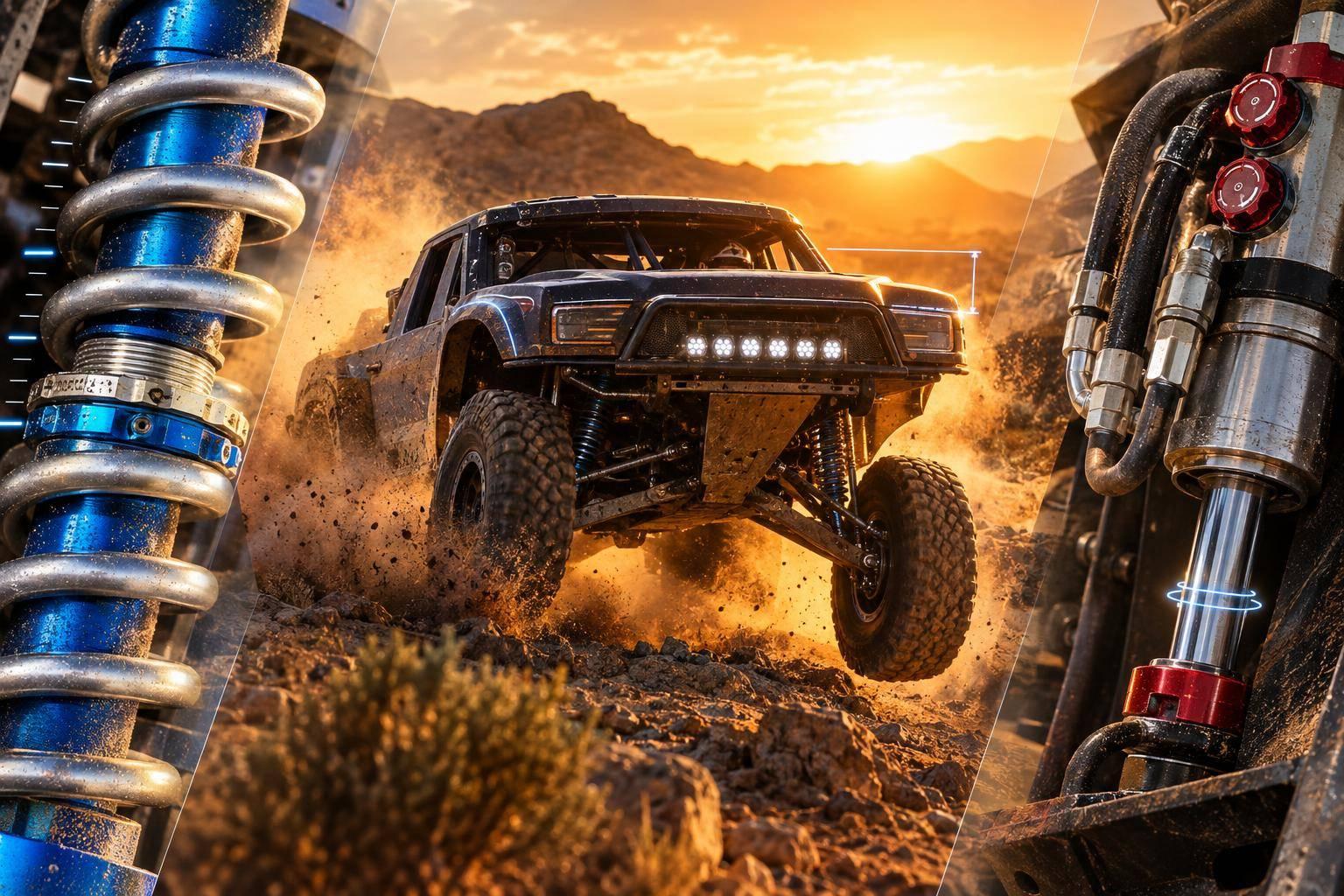
I’d choose coilovers for street use and moderate dirt, then add bypass damping when hard desert driving calls for more control through the stroke. Before buying, match the springs and valving to your truck’s loaded weight – not just its curb weight.
Here’s how I’d narrow the choices:
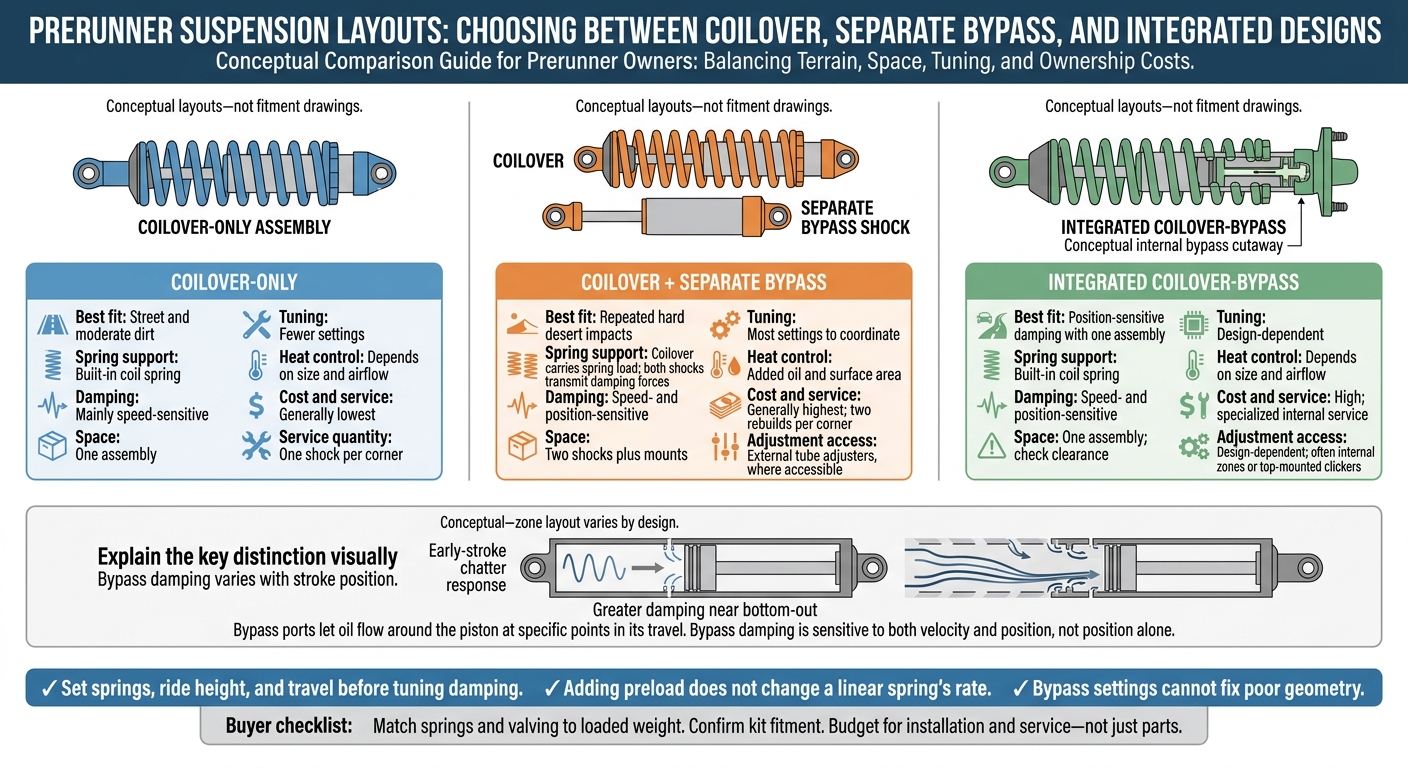
- Coilover-only: Spring support and damping in one shock per corner, with fewer settings and generally lower installation and service costs.
- Coilover plus separate bypass: Two shocks per corner share damping work, adding stroke-specific control and heat capacity – but also mounting space, fabrication, tuning, and rebuild work.
- Integrated coilover-bypass: Spring support and position-sensitive damping in one assembly, with adjustment access and service needs that depend on the design.
My starting rule: <u>set springs, ride height, and travel before tuning damping</u>. Adding preload does not change a linear spring’s rate, and bypass settings cannot fix poor geometry. I’d confirm kit fitment, test one adjustment at a time, and budget for installation and service – not just parts.
Quick Comparison
| Factor | Coilover-only | Coilover + bypass | Integrated coilover-bypass |
|---|---|---|---|
| Best fit | Street and moderate dirt | Repeated hard desert impacts | Position-sensitive damping with one assembly |
| Damping | Mainly speed-sensitive | Speed- and position-sensitive | Speed- and position-sensitive |
| Space | One assembly | Two shocks plus mounts | One assembly; check clearance |
| Tuning | Fewer settings | Most settings to coordinate | Design-dependent |
| Heat control | Depends on size and airflow | Added oil and surface area | Depends on size and airflow |
| Cost and service | Generally lowest | Generally highest; two rebuilds per corner | High; specialized internal service |
More adjustment isn’t automatically a better match. I’d choose the layout your terrain demands – and your truck has room to fit.
Prerunner Coilovers vs Bypasses: Choose Your Layout
Shock Tuning The Ranger – Reckless Wrench Garage
sbb-itb-afc4690
Coilovers vs Bypasses: How They Work
The difference comes down to how each shock controls suspension movement: coilovers provide spring support and set ride height, while bypasses vary damping by stroke position.
| Feature | Conventional coilover | Separate bypass shock | Integrated coilover-bypass |
|---|---|---|---|
| Spring support | Built-in coil spring | Requires a separate spring source | Built-in coil spring |
| Adjustment methods | Preload perches, internal valving, optional external adjusters | External bypass circuits and internal valving | Preload, internal valving, and top-mounted clickers on some designs |
| Damping behavior | Primarily velocity-sensitive | Position- and velocity-sensitive | Combines velocity- and position-sensitive damping |
Coilovers: Springs, Ride Height, and Damping
Spring rate determines support, while preload changes ride height. Adding preload does not change a linear spring’s rate. Dual-rate setups start with a softer combined rate, then transition to the firmer main-spring rate.
Conventional coilover damping responds mainly to piston speed. Internal valving controls compression and rebound, while optional external adjusters let you fine-tune the available circuits. A larger shock body holds more oil, but vehicle weight, motion ratio, and intended use matter more than diameter alone.
Speed-based damping is simpler to tune, but it offers less control over individual parts of the stroke.
Bypasses: Damping Zones Through the Stroke
Bypass ports let oil flow around the piston at specific points in its travel. This softens the response to chatter early in the stroke and firms up damping near bottom-out.
| Bypass configuration | Circuit arrangement | Adjustment complexity |
|---|---|---|
| 3-tube | Typically 2 compression, 1 rebound | Moderate |
| 4-tube | Typically 3 compression, 1 rebound | High |
| Internal bypass | Internal passages | Design-dependent; external adjustment may be limited |
More tubes don’t guarantee more zones or better performance. Tube placement and passage overlap vary, so check the circuit layout before choosing a configuration.
That added control also takes more room and makes mounting more complex – a concern when your truck has limited space for hardware.
Separate Bypass Shocks vs Integrated Coilover-Bypass Shocks
Bypass damping works on the same principle whether the shock is separate or built into the coilover. The layout determines how much space you need and how easily you can reach the adjustments.
A separate bypass adds damping control to the truck’s existing spring system. An integrated coilover-bypass puts spring support and position-sensitive damping in one assembly. It’s a packaging tradeoff, not a separate tuning approach: you need fewer mounting locations, but often give up direct access to zone adjustments.
| Installation factor | Separate coilover + bypass | Integrated coilover-bypass |
|---|---|---|
| Force path | Coilover carries spring load; both shocks transmit damping forces | Spring and damping forces pass through the same mounts |
| Adjustment access | External tube adjusters, where accessible | Design-dependent; often internal zones or top-mounted clickers |
The next tradeoff is how much tuning time each layout demands.
Tuning Options and Setup Time
More adjustment options mean more tuning time. Coilovers usually need fewer changes. Bypasses take longer because each zone controls a different part of the stroke. For either layout, set springs and geometry before tuning damping.
| Tuning factor | Conventional coilover layout | Bypass layout |
|---|---|---|
| Primary adjustments | Ride height through the spring perch; external damping adjusters, if equipped | External bypass tubes for compression and rebound zones |
| Baseline setup effort | Lower; fewer settings to coordinate | Higher; multiple zones must work together |
| Required skill | Moderate; understanding springs, ride height, and damping | Advanced; understanding zone transitions and bypass flow |
| Revalving needs | When the adjustment range cannot cover the truck’s weight, load, or geometry | When zone transitions or total damping force need correction |
Set Springs and Geometry Before Tuning Damping
Get the mechanical setup right before changing damping. Set the load, tire pressure, spring rates, and ride height. Then check compression and droop travel, motion ratio, shock travel, bump stops, limit straps, and brake-line length through the full range of travel.
For an LSK Suspension kit, confirm starting spring rates and valving with the kit manufacturer before testing. Bypass settings cannot fix unsuitable springs, poor geometry, or incorrect shock travel.
Record the starting adjuster positions according to the shock manufacturer’s instructions. Keep that baseline handy so you can return to it if a change doesn’t help.
Test Chatter, Body Control, Bottoming, and Rebound
Use the same off-road test route at conservative speeds. Change one setting at a time and log the result. Coilovers have fewer settings to coordinate. With bypasses, check how each zone adjustment affects the rest of the stroke.
Establish chassis control before testing larger impacts, then assess chatter, bottoming resistance, and rebound. Judge suspension movement – not road speed. Watch for rebound packing, when the suspension doesn’t recover between hits, or excessive kick. Stop testing immediately if you notice leaks, damage, or unsafe behavior.
Once the baseline tune is close, repeated hard runs can show whether heat management is the next limit.
Heat Control, Installed Cost, and Service
Compare complete layouts – not just shock prices. Once tuning is close, focus on ownership cost, heat control, fitment, and service needs. A separate bypass adds damping capacity, but it also adds mounts, hoses, tuning work, and service points.
| Factor | Coilover-only | Coilover + separate bypass | Integrated coilover-bypass |
|---|---|---|---|
| Oil capacity | One shock body and reservoir | More total oil across two shock bodies and reservoirs | One assembly with moderate capacity |
| Damping workload | One shock handles damping and spring support | Shocks share damping; the coilover mainly supports vehicle weight | One assembly handles damping and spring support |
| Heat control | Depends on body size, reservoir, and airflow | More oil slows temperature rise; more exposed surface area sheds heat faster | Depends on body size, reservoir, and airflow; internal bypass improves heat rejection over a standard coilover |
| Parts and fabrication | Coilover, mounts, and reservoir hardware as equipped | Adds bypass shocks, hoops, and reservoir hardware | One shock assembly; mounting and clearance depend on the application |
| Tuning labor | Set up springs and adjust damping | Match coilover valving to bypass zones | Tune spring support and internal bypass damping together |
| Inspection points | Seals, shafts, bearings, bushings, and hoses/fittings as equipped | All coilover checks, plus bypass fittings, adjusters, and rod ends | Standard shock checks, plus inspection of internal bypass parts during service |
| Rebuild complexity | One shock per corner | Two shocks per corner, plus bypass components | One assembly with added internal bypass components |
Managing Heat During Repeated Impacts
Once tuning is close, heat can become the limiting factor. Damping turns suspension motion into heat. More oil slows temperature rise, while more exposed surface area helps shed that heat. Bypass layouts add both, helping control temperatures through repeated impacts.
Watch for fade or leaks as the shocks warm up. Follow the manufacturer’s service guidance instead of relying on a fixed mileage interval.
Mounting Space and Fabrication Costs
After heat control, check mounting space. Treat a separate bypass as a fabrication job, not just another bolt-on part. Have the installer cycle the suspension and steering through their full travel to check tire, tube, reservoir, and hose clearance. Bypass shocks often need custom hoops or frame mounts.
Inspections, Rebuilds, and Revalving
Check for leaks, scratched or pitted shafts, play in bearings and bushings, hose abrasion, and leaking bypass fittings. Nitrogen pressure also needs checking. Inspect adjusters for damage or seizure, but don’t force them.
Reassess tuning when vehicle weight, spring rates, tire size, suspension geometry, or terrain changes. Leave nitrogen charging and internal service to qualified technicians.
Conclusion: Match the Shock Layout to Your Build
Weigh tuning range, setup time, heat control, cost, and service needs. Choose coilovers when their damping range fits your build. Add bypass damping only when stroke-specific control is worth the added cost and setup time. Ride height comes from the spring package – not bypass settings.
| Layout | Intended use | Packaging | Tuning effort | Installed cost | Service |
|---|---|---|---|---|---|
| Coilover | Street and moderate dirt | One assembly; fit depends on the kit | Springs and conventional valving | Generally lowest | Standard rebuilds |
| Coilover + bypass | Demanding desert use and repeated hard impacts | Room for two shocks and supporting mounts | Highest; both shocks and damping zones need coordinated tuning | Generally highest | Two shocks per corner |
| Integrated coilover-bypass | Performance builds needing position-sensitive damping in one assembly | Single assembly; check clearance | Moderate to high; internal tuning can be involved | High | Specialized internal service |
Use this comparison to narrow your options based on how you drive and the space available.
Choosing Shocks for Street, Desert, Front, and Rear Use
Choose shocks based on packaging and travel demands – not axle location alone.
Check Kit and Shock Fit With LSK Suspension
Before ordering, check fitment details with the kit supplier. Ask LSK Suspension about vehicle-specific race kits, long-travel kits, mounts, and weld-it-yourself parts.
Confirm kit contents, shock body dimensions, stroke, extended and compressed lengths, mounts, and fabrication needs. Don’t assume shocks or secondary bypass mounts are included.
FAQs
How do I know when I’ve outgrown coilovers?
A coilover-only setup may no longer meet your needs if it feels harsh over small bumps yet bottoms out too easily on bigger hits during high-speed desert driving. Bypass shocks provide position-sensitive damping: the initial stroke stays plush, while resistance increases to help prevent bottoming out.
If you’re moving to a long-travel kit for tougher terrain, adding bypass shocks is the usual route to the performance, stability, and control you need.
How can I tell shock fade from poor tuning?
Shock fade is a heat-related loss of damping. After sustained driving over rough terrain, your suspension may feel soft or inconsistent. Poor tuning, on the other hand, causes persistent harshness or unsettled handling, no matter how long you’ve been driving.
LSK Suspension components are precision-tuned for your vehicle’s weight and terrain. Contact us for a revalve so your shocks deliver the correct damping curves from the start.
Can I add bypass shocks without replacing my coilovers?
Yes. Bypass shocks typically work alongside your existing coilovers, but they need a secondary mounting location, such as a shock hoop or tower. Their position-sensitive damping complements the coilovers.
LSK Suspension long travel kits are designed around matching coilovers and optional bypass shocks. Contact us to confirm whether your specific platform and kit geometry support a dual-shock configuration.
Leave a Reply