I’d choose spherical bearings for alignment control, rubber bushings for comfort, and polyurethane for a firmer ride. Before buying, I’d check the joint’s travel limits, load rating, and fit – not just whether it fits your vehicle.
The tradeoff? Less flex usually means more noise and impact reaching the cabin. Dirt exposure, lubrication needs, and replacement access matter, too.
Quick Comparison
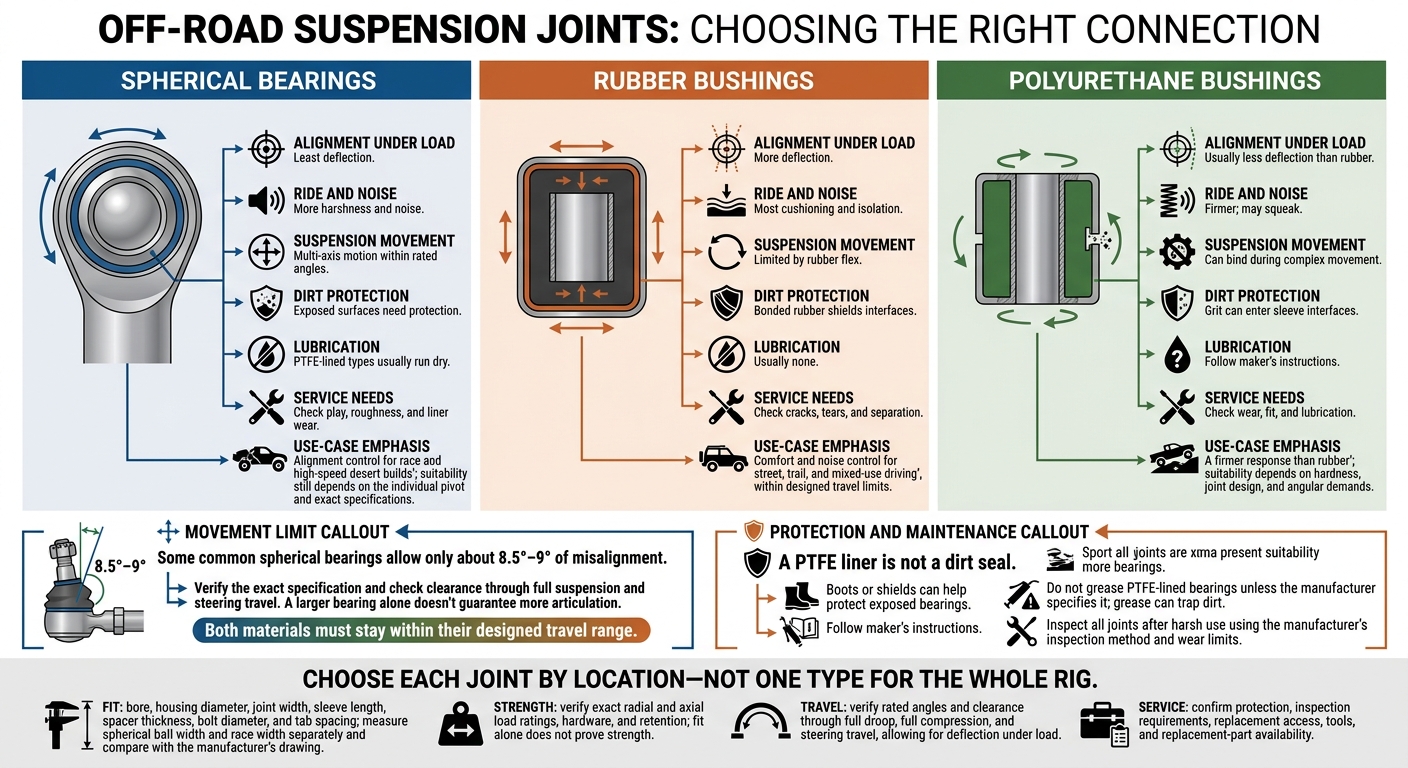
| What matters | Spherical bearings | Rubber bushings | Polyurethane bushings |
|---|---|---|---|
| Alignment under load | Least deflection | More deflection | Usually less deflection than rubber |
| Ride and noise | More harshness and noise | Most cushioning and isolation | Firmer; may squeak |
| Suspension movement | Multi-axis motion within rated angles | Limited by rubber flex | Can bind during complex movement |
| Dirt protection | Exposed surfaces need protection | Bonded rubber shields interfaces | Grit can enter sleeve interfaces |
| Lubrication | PTFE-lined types usually run dry | Usually none | Follow maker’s instructions |
| Service needs | Check play, roughness, and liner wear | Check cracks, tears, and separation | Check wear, fit, and lubrication |
My rule: <u>choose each joint by location</u>, not one type for the whole rig. Some common spherical bearings allow only about 8.5°–9° of misalignment, so I’d verify the exact specification and check clearance through full suspension and steering travel. Then I’d confirm mounting dimensions, hardware, protection, and how the joint comes out when it wears.
Spherical Bearings vs Bushings: Off-Road Joint Guide
CC31: Poly Bushings vs Rubber vs Spherical
sbb-itb-afc4690
How Spherical Bearings Control Suspension Movement
A spherical plain bearing (uniball/monoball) has a hardened ball inside a matching race. The ball pivots with minimal deflection rather than relying on material flex. Off-road suspensions use these bearings in control arms, shock mounts, trailing arms, and links.
Angular Travel and Alignment Control
These joints help hold alignment under braking and cornering loads. Their multi-axis movement reduces binding as the suspension travels – as long as the bearing and mount have enough angular clearance.
Angular travel has limits. Many common bearings allow about 8.5° to 9° of misalignment. Match the angle specification, load rating, spacer size, and mount geometry to the application. A larger bearing alone doesn’t guarantee more articulation.
Spacers, Retainers, and Seals
The right spacer stack and mount geometry help the joint move as intended. Misalignment spacers provide clearance for tilt, while the bearing must stay securely retained in its housing.
Many bearings have a bonded PTFE liner that provides self-lubrication and reduces friction. These bearings typically run dry. Don’t add grease unless the manufacturer calls for it: grease can trap dirt and shorten joint life.
That precision improves control, but it comes at the cost of the cushioning bushings provide.
How Bushings Cushion Suspension Movement
Spherical bearings favor precision. Bushings favor comfort and isolation.
Bushings flex or rotate around a sleeve to absorb impacts. This movement reduces noise and load transfer, but it also lets suspension alignment shift more under load.
Rubber vs. Polyurethane Bushings
Rubber blocks more noise and vibration, making it a quieter choice for mixed street-and-trail driving. Polyurethane flexes less, giving the suspension a firmer response under trail loads.
| Characteristic | Rubber bushings | Polyurethane bushings |
|---|---|---|
| Noise and vibration isolation | Generally greater | Typically lower |
| Compliance | Usually more flex | Usually less flex; depends on hardness |
| Alignment deflection | Generally greater under load | Typically reduced |
| Lubrication | Usually not needed | Often required; follow the design |
Both materials have a limit: they must stay within their designed travel range.
Articulation Limits and Installation
Even a firm bushing can bind when suspension travel goes beyond its design limits. Binding can speed up wear, cause squeaking, and shorten service life.
Grease can trap grit during dusty off-road driving, so follow the manufacturer’s lubrication instructions exactly.
Ride, Wear, and Maintenance Compared
Ride Feel, Noise, and Articulation
At the same suspension point, spherical bearings deliver the sharpest response with the least deflection. The tradeoff is more impact, noise, and vibration reaching the vehicle.
| Characteristic | Spherical bearings | Rubber bushings | Polyurethane bushings |
|---|---|---|---|
| Response and alignment | Sharp response; minimal deflection | Softer response; more deflection | Firmer response; less deflection than rubber |
| Ride harshness | Transmit more impact | Provide the most cushioning | Provide less cushioning than rubber |
| Noise and vibration | More mechanical noise | Best noise and vibration isolation | Can squeak when dry |
| Angular articulation | Accommodate misalignment within rated limits | Can tear or bind at extreme angles | Limited suitability for complex movement |
Race drivers may want that extra feedback; trail rigs usually don’t. Dirt exposure and service intervals add another layer to that choice.
Dirt Exposure and Service Life
Exposed spherical bearings favor precision over shielding. Bushings give up some precision in return for isolation and protection.
| Exposure or factor | Spherical bearings | Rubber bushings | Polyurethane bushings |
|---|---|---|---|
| Dust | Exposed surfaces are vulnerable to grit | Bonded construction shields working surfaces | Grit can collect at sleeve interfaces |
| Mud and water | Can reach bearing surfaces | Bonded construction limits entry | Can enter moving interfaces |
| Protective features | Optional boots or shields | Bonded rubber shields interfaces | Protection depends on seals and design |
| Wear factors | Load, liner condition, alignment, exposure | Ozone, oil, salt, installation | Fit, angular demands, lubrication |
Grit speeds up wear on exposed bearings. Boots or shields can help, but a PTFE liner is not a dirt seal. Inspection and replacement needs are a practical difference between bearing and bushing setups.
Inspection, Lubrication, and Replacement
The maintenance tradeoff comes down to what you check, whether lubrication is needed, and which parts you replace.
| Service item | Spherical bearings | Rubber bushings | Polyurethane bushings |
|---|---|---|---|
| Inspection cues | Play, roughness, liner damage | Cracking, tearing, sleeve separation | Squeaks, gaps, deformation |
| Lubrication | PTFE-lined bearings run dry; grease only if specified. | Usually none required | Follow specified lubrication instructions |
| Replacement indicators | Excessive play, roughness, liner failure | Tearing or sleeve separation | Worn bore or excessive wear |
| Replacement method | Press-in bearing where supported | Bushing or complete arm, as designed | Replaceable insert where supported |
Inspect all joints after harsh use, paying extra attention to exposed bearings. Check for looseness, abnormal movement, and visible damage using the manufacturer’s inspection method and wear limits.
Choose Joints for Your Driving Needs
With the wear and ride tradeoffs clear, match each joint to how you drive and where it pivots. Base your choice on required movement, loads, dirt exposure, and how much maintenance you’re willing to do.
Race and High-Speed Desert Builds
Use spherical bearings where alignment control and low deflection matter most – under braking, cornering, whoops, and landing loads. Match the misalignment angle and spacer stack to the pivot. Inspect the joints after every race or hard run, and keep replacement bearings, spacers, retaining hardware, and installation tools on hand.
Before ordering LSK Suspension race kits, long-travel kits, control arms, or other suspension parts, confirm the exact joint design, vehicle fitment, included hardware, and replacement-part availability.
Street, Trail, and Mixed-Use Builds
For daily drivers and recreational trail rigs, comfort, noise control, and lower maintenance can take priority over maximum precision. Rubber favors isolation; polyurethane favors a firmer response. Keep either type within its intended angle range, especially when a lift changes the arm’s operating position.
For mixed-use builds, use bearings where geometry control matters and bushings where comfort and isolation matter – but check compatibility across the whole vehicle. Bearings can transfer more force into nearby brackets, welds, and remaining bushings. Before final assembly, check load paths, pivot angles, and full suspension travel.
Fitment details determine whether the joint works as intended.
Fitment and Service Checklist
Dimensions, Load Ratings, and Mounting
Once you choose bearings or bushings, check fitment before ordering. The joint must match the arm, mount, and travel range.
Measure the full assembly in inches: bore, housing diameter, joint width, sleeve length, spacer thickness, bolt diameter, and tab spacing. For spherical bearings, measure ball width and race width separately. Compare those measurements with the manufacturer’s drawing and dimensional tables. Check press fit or slip fit, along with any weld-in or bolt-in dimensions. Don’t rely on the vehicle fitment listing alone.
Fit alone does not prove strength. Check radial and axial (thrust) load ratings for the exact part. Then verify bolt grade, thread engagement, torque, and retention hardware, including which sleeve or spacers the bolt must clamp. Inspect mounts for cracks, distorted tabs, and elongated holes. Welded assemblies need a manufacturer-approved design and qualified weld execution.
Next, check that the joint moves freely throughout suspension travel. Safely support the suspension and disconnect springs or shocks as needed. Cycle it from full droop to full compression and through steering travel. Compare the joint’s maximum operating angle with its published articulation limit. Check clearance around spacers, seals, brake lines, steering links, and the chassis throughout the motion – not just at the endpoints. Include full droop, full compression, and steering lock, and allow for deflection under load.
Protection and Replacement Access
Check clearance for seals, boots, or shields. Make sure you can reach retaining rings, grease fittings, and fasteners, with enough room for removal tools. Find out whether replacement requires a press, specific adapters, or a complete control arm replacement. Save the exact replacement part numbers.
Read the service instructions before buying. Verify installation orientation, pressing procedure, torque values, and removal method. Apply pressing force only to the specified surfaces – never through the spherical sliding interface. Choose a joint with inspection and removal steps that fit your maintenance routine.
Conclusion: Match the Joint to Your Build
The choice comes down to control versus isolation. Race and long-travel builds suit joints with less flex and multi-axis articulation, but those joints pass along more noise and need regular inspection. Dusty or muddy conditions also mean more cleaning and inspection for exposed joints.
Rubber favors daily comfort when alignment control is less important. Polyurethane feels firmer, but it can squeak and wear faster when forced to handle large alignment changes.
Choose each joint by location – not by an all-or-nothing rule. Weigh race precision against street and trail comfort, along with dirt exposure and service needs. Match the setup to your driving without taking on more maintenance than you can handle.
FAQs
Which joints should I upgrade first on a mixed-use rig?
Start with spherical bearings in your control arms, like those in LSK Suspension lower control arms. Swapping factory rubber or plastic bushings for stainless spherical bearings increases strength and eliminates bushing deflection. It also allows precise alignment adjustments, including negative caster to clear larger tires.
Under these loads, bushings can wear out early and squeak. Spherical bearings provide durable pivots you can service with press-in replacement wear parts.
Will switching to spherical bearings require an alignment?
Yes, you’ll need an alignment after installing spherical bearings in your suspension. These parts affect steering and handling geometry. An alignment ensures your vehicle’s settings are within specification.
How can I tell joint wear from suspension binding?
Check for play versus resistance. Worn spherical bearings or uniballs usually develop looseness. You may feel play or a clunk when moving suspension components by hand.
Binding feels different: the joint is too stiff or won’t move freely through its intended range. Misalignment or components that can’t move freely often cause it.
Squeaking or resistance can point to a bushing or joint that’s struggling to move. Noticeable play or “slop” points to bearing wear.
Leave a Reply