I’d choose PTFE-lined bearings for low friction without routine greasing – and consider metal-to-metal bearings when grease access and regular service are practical. Neither type wins on load or heat alone: check the exact part’s ratings, seals, and fit before choosing.
Some PTFE liner systems report friction coefficients of 0.02–0.10, but results depend on load, temperature, and construction. My rule for either type: match the bearing to the joint, not just its size.
Quick Comparison
| What I’d check | PTFE-lined | Metal-to-metal |
|---|---|---|
| Friction and noise | Usually lower friction and less sliding noise | Depends on grease and clearance; may transmit more noise |
| Lubrication and access | Normally needs no routine grease | Usually needs grease and accessible fittings |
| Dirt and wear | Grit can damage the liner and ball | Contaminated grease can damage contact surfaces |
| Loads and articulation | Verify liner limits, radial and axial ratings, and movement | Verify impact duty, radial and axial ratings, and movement |
| Heat | Check liner and full assembly limits | Check metal, grease, and seal limits |
| Materials and fit | Check ball finish, liner construction, housing, and spacers | Check metal pairing, hardness, housing, and spacers |
| Inspection and replacement | Watch for play, binding, and liner damage | Watch for clearance, roughness, and surface damage |
<u>No routine greasing does not mean no inspections.</u> I’d check both types after mud, water, or hard impacts, follow the manufacturer’s wear limits, and confirm the approved replacement and spacer stack. Grease cannot repair wear – and rebuilding is an option only when the design allows it.
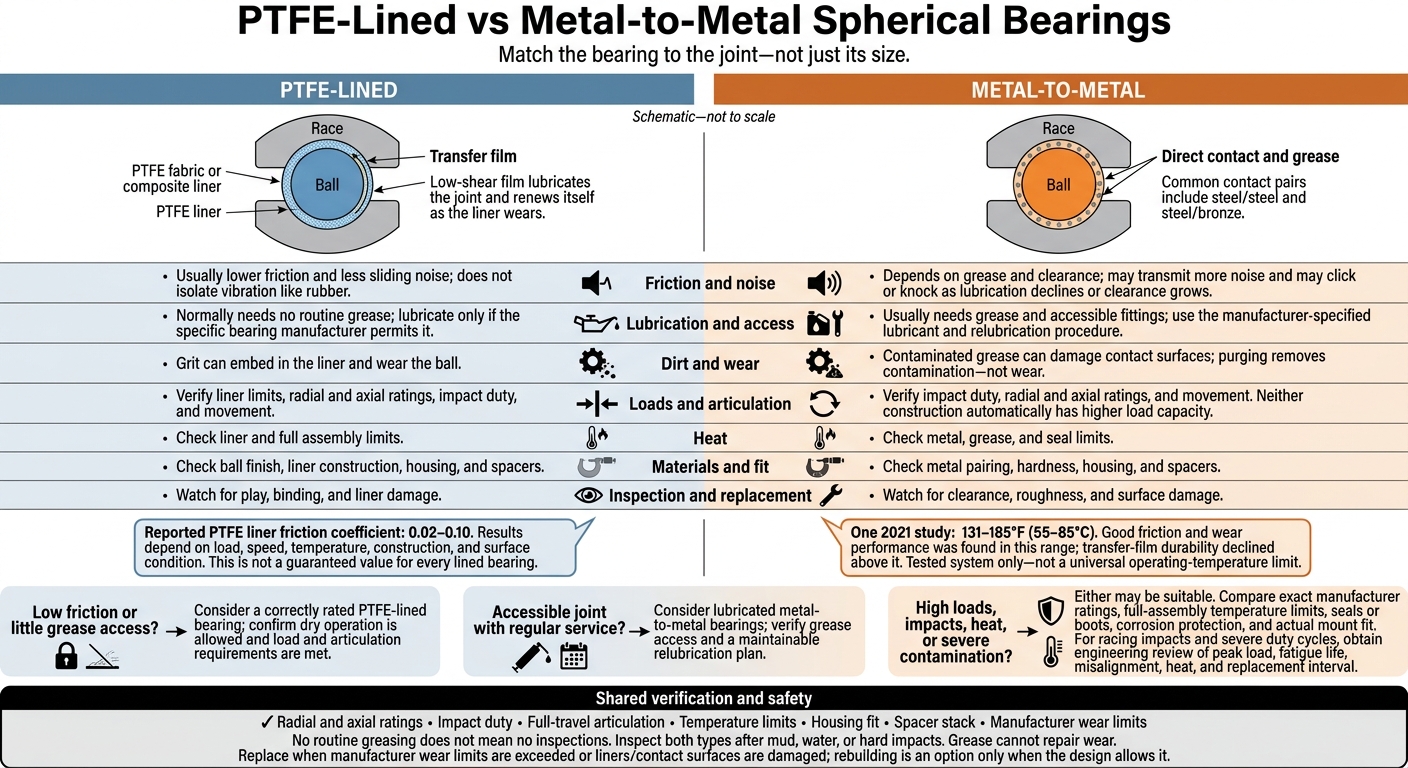
PTFE-Lined vs Metal-to-Metal Spherical Bearings
How PTFE-Lined Spherical Bearings Work
A bonded PTFE fabric or composite liner sits between the race and ball. As the ball moves, it deposits PTFE on its surface, creating a transfer film. This low-shear film lubricates the joint and renews itself as the liner wears. Metal-to-metal bearings, by contrast, depend on grease to control friction, heat, and wear.
Liner Friction, Noise, and Lubrication
The film reduces friction during small suspension movements. Some liner systems report friction coefficients of about 0.02–0.10, depending on load, speed, temperature, and surface condition. They also reduce noise, though the rigid ball and housing still transmit vibration. Extra grease usually isn’t needed; use it only if the specific bearing manufacturer permits it.
Dirt Exposure and Liner Wear
Without exposed grease, there’s less buildup. But grit can still embed in the liner and wear the ball. Use seals or boots that allow full articulation, and keep pressure-washer spray out of the joint.
After exposure to mud, water, or impacts, check for play, notchy movement, and liner cracking or displacement. Grease cannot restore worn PTFE or a failed bond. Replace the bearing or liner assembly when damage appears.
Liner Load and Temperature Limits
Check radial and axial ratings separately, along with impact duty, articulation angle, speed, and operating temperature. The radial rating alone doesn’t account for suspension side loads or repeated impacts.
Liner composition, bond quality, contact pressure, and the ball’s hardness and finish all affect performance. A corroded or rough ball can abrade an otherwise suitable liner.
One 2021 study found good friction and wear performance at 131–185°F (55–85°C), but transfer-film durability declined above that range. These results apply to the tested system – not every PTFE-lined bearing. Follow the bearing’s published specs, and check for full-travel clearance and binding before service. These limits matter when comparing PTFE-lined bearings with metal-to-metal designs.
sbb-itb-afc4690
How Metal-to-Metal Spherical Bearings Work
PTFE liners use a transfer film. Metal-to-metal joints instead rely on direct contact and grease. In suspension pivots and shock mounts, the inner ball pivots against the outer race while carrying load. Common contact pairs include steel/steel and steel/bronze. Performance depends on the material pair, hardness, surface finish, clearance, and geometry.
Metal Contact, Noise, and Grease Access
Too little lubricant increases friction, heat, and wear. Excessive clearance can cause rattling and impact wear.
Use the manufacturer-specified lubricant, and make sure grease reaches the contact surfaces. Keep fittings accessible after installation and follow the specified relubrication procedure. Base relubrication intervals on load, temperature, and contamination, rather than a fixed schedule.
Dirt Exposure and Metal Surface Wear
Grease protects metal surfaces, but it can also trap grit. A joint that lets you purge contaminated grease can be serviced, but that doesn’t mean it’s sealed against contamination.
Clean the fitting before greasing, then remove any expelled grease. Inspect the seals and grease, and check for rust, pitting, scoring, galling, roughness, and looseness.
Purging removes contamination – not wear. It cannot restore worn surfaces or correct clearance. Wear limits matter most when the joint faces repeated impacts or heat.
Metal Bearing Shock Loads and Temperature Limits
Steel/steel designs can suit alternating loads and impacts. Still, check the bearing’s static and dynamic ratings, load direction, and permitted misalignment. Repeated suspension impacts call for more than a static load rating.
Metal-to-metal bearings don’t automatically have a higher load capacity than PTFE-lined bearings. Construction, lubrication, and installation determine whether a bearing suits the application.
Temperature limits apply to the full assembly, including grease and seals. Verify the exact bearing and lubricant specifications before placing the joint near brake or exhaust heat.
PTFE-Lined vs Metal-to-Metal Bearings
Comparison for Suspension Pivots and Shock Mounts
Typical behavior is a starting point, not a guarantee. PTFE-lined bearings often have friction coefficients of 0.02–0.10, but load, construction, and operating conditions affect the result.
Use the comparison below to narrow your options. Then check the exact part’s rating and housing fit.
| Decision factor | PTFE-lined spherical bearings | Metal-to-metal spherical bearings | Suspension implication |
|---|---|---|---|
| Friction and articulation | Generally lower starting torque. | Typically higher friction, depending on the grease film. | Compare articulation under the intended load. |
| Contact noise | Reduces sliding noise but does not isolate like rubber. | May click or knock as lubrication declines or clearance grows. | Noise alone does not prove wear. |
| Lubrication burden | Normally dry-running; lubricate only if permitted. | Usually requires grease. | Choose a service schedule you can maintain. |
| Abrasive contamination | Grit speeds up liner wear. | Grit in grease speeds up surface wear. | Protect and inspect exposed pivots and shock mounts. |
| Peak and shock loads | Liner limits depend on the application. | Some designs suit severe impacts. | Choose for impact duty, not static rating alone. Verify load reversals and misalignment at shock mounts. |
| Temperature | Limits depend on the liner. | Limits depend on materials, lubricant, and seals. | Check the full assembly’s temperature limit near brake or exhaust heat. |
| Maintenance access | Normally needs no routine grease access. | Grease ports must remain accessible. | Buried pivots that articulate frequently may favor a correctly rated lined bearing. |
| Inspection and replacement timing | Watch for increasing play or liner damage. | Watch for growing clearance or contact-surface wear. | Follow manufacturer wear limits, not a universal mileage interval. |
PTFE describes the liner, not the whole bearing. The ball, race, hardness, corrosion protection, and liner construction also guide selection. Compare radial, axial, and oscillating ratings separately: a liner’s psi rating is not the bearing’s full load rating. Material choice narrows the options; wear limits and fit determine whether the joint remains serviceable.
When to Inspect, Replace, or Rebuild
Follow the vehicle’s service procedure to inspect safely. Check PTFE bearings for liner damage and metal-to-metal bearings for growing clearance and surface wear. Check both types for play, binding, seal damage, and corrosion.
Inspect sooner after contamination or hard impacts. After an impact, check the mounts and surrounding suspension hardware, too. Record play and condition so you can track wear over time.
Relubrication, replacement, and rebuilding are separate jobs. Relubricate only serviceable bearings whose instructions permit it. Replace bearings that exceed specified clearance limits or have damaged liners or contact surfaces. If a bearing binds, rule out hardware, fit, and alignment problems before replacing it.
Rebuild the surrounding assembly when spacers, sleeves, seals, bushings, or hardware also need attention. Don’t assume the bearing itself is rebuildable. Match the replacement’s materials, ratings, and fit to the suspension hardware, and use the exact replacement specification – not outside diameter alone.
Choosing Bearing Materials, Ratings, and Fit
Once friction, dirt exposure, and service needs are clear, the material pairing, ratings, and fit determine whether a bearing will hold up in the mount.
Ball, Race, and Liner Materials
Match the sliding surfaces, not just the material labels. Assess the inner ball, race or housing, liner construction, load, and service conditions as one system.
A PTFE-lined bearing needs a hard, smooth ball surface to limit liner abrasion. A metal-to-metal bearing needs compatible ball and race materials, suitable hardness, and an effective lubricant film to prevent galling. Check the required surface finish and liner construction. Stainless steel isn’t automatically stronger or more wear-resistant than hardened alloy steel, and a coating helps only while it remains intact.
The material pairing sets the wear behavior. Ratings and fit determine whether that pairing holds up in service.
Load Ratings, Misalignment, and Installation
Check radial, axial, and static ratings separately, using the manufacturer’s required safety factor. Factor in suspension leverage, impact loads, oscillation angle, and cycle rate. Also account for temperature-related load reductions – not just the published temperature range.
Measure actual articulation through full travel. Spacers, shoulders, and mounting tabs can limit movement below the bearing’s rated misalignment range.
Before installation, verify the bore, outside diameter, width, shoulder or snap-ring dimensions, and allowable housing fit. Spacer length and tab spacing must allow the hardware to clamp the inner ball without side-loading the liner or race edge.
When pressing a bearing into a housing, apply force only to the race being fitted. Keep weld heat and press loads out of the ball and liner. After installation, cycle the joint through full travel and check for binding or looseness.
Suspension Fitment and Replacement Parts
After checking materials and ratings, verify the exact chassis fit before ordering or pressing in the bearing. The bearing must also match the suspension mount, spacer stack, and articulation range.
For LSK Suspension components, check the vehicle, model year, suspension position, and approved replacement part against the current instructions. Verify that the bearing and spacer stack match the mounting geometry.
Before ordering, confirm the replacement’s liner type, material pairing, lubrication rules, load rating, misalignment, temperature range, and installation procedure. If switching to metal-to-metal construction, check that the assembly has suitable grease access and a relubrication plan.
Record the part number, spacer arrangement, torque requirements, and inspection criteria so future rebuilds use the same approved parts and procedure.
Conclusion: Match Bearings to Operating Conditions
Compare friction, dirt exposure, heat, and service access, then choose a bearing for the suspension pivot’s or shock mount’s actual duty.
Match the bearing to the joint’s friction, load, heat, and service needs. PTFE-lined bearings typically allow smooth articulation without routine greasing. Lubricated metal-to-metal designs can handle demanding applications when their ratings are verified and regular greasing is practical.
Selection by Maintenance and Load Needs
Use these guidelines to narrow your options.
| Operating priority | Bearing direction to consider | Qualifying constraint |
|---|---|---|
| Low friction and reduced contact noise | PTFE-lined | Check suitability for the joint’s load and articulation. |
| Little or no grease access | PTFE-lined | Confirm the bearing allows dry operation. |
| Accessible joint with scheduled service | Lubricated metal-to-metal | Check grease access and service intervals. |
| High static or impact loading | Either | Compare exact manufacturer ratings. |
| Severe sand, mud, or water exposure | Sealed or booted design matched to the application | Check contamination protection and corrosion resistance. |
| High shock-mount temperature | Either, based on the full assembly’s temperature limit | Check grease, liner, seal, and hardware ratings to determine suitability. |
| Racing impacts and severe duty cycles | Either, after engineering review | Verify peak load, fatigue life, misalignment, heat, and replacement interval. |
Inspect both types during regular service and after unusual impacts. Increasing play, rough movement, damaged seals, liner debris, exposed metal, or grease loss call for a closer check against the manufacturer’s replacement criteria.
Check the bearing’s material pair, lubrication system, size, seals, clearances, load and temperature ratings, and installation fit against the vehicle and complete mount assembly – not dimensions alone.
FAQs
Can I switch bearing types without changing my suspension mounts?
Generally, no. LSK Suspension kits are designed for specific bearing and component setups. They often require permanent frame changes, such as replacing the factory shock and upper control arm mounts with custom shock towers.
These systems depend on precise geometry and load distribution, so you can’t simply swap bearing types within the existing factory mounts. Before making changes, check your vehicle’s kit requirements and the fabrication work involved.
How can I distinguish bearing wear from spacer problems?
Check for play or physical damage. Bearing wear typically creates extra movement or looseness in the spherical joint, often due to friction or debris. Excessive play usually means it’s time to replace the bearing.
Spacer misalignment or a poor fit can cause binding, uneven wear, or noise – even when the bearing is tight. If noise persists or the joint’s movement is restricted despite a tight bearing, check for spacer or alignment problems.
How does ball material affect PTFE liner life?
The available documentation does not explain how ball material affects PTFE liner life in spherical bearings. LSK Suspension uses high-quality components in its race kits, but its documentation does not link ball material to liner longevity.
Leave a Reply