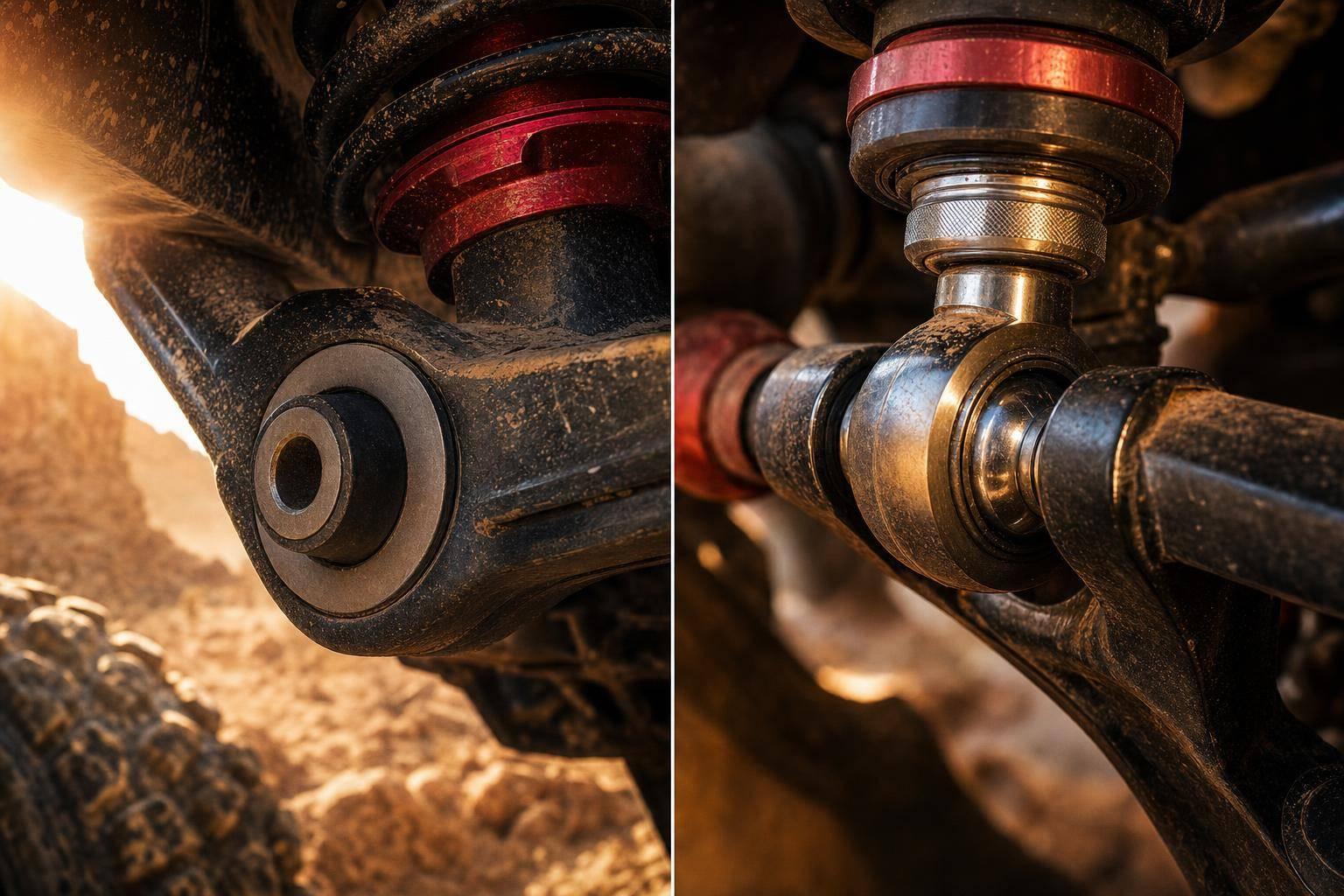
If you want less service and less noise, I’d pick bushings. If you want tighter steering and more suspension angle, I’d pick bearings.
That’s the short answer. In most long-travel setups, bushings work better at frame-side pivots because they soak up vibration and keep dirt out better. Bearings like uniballs and heim joints fit wheel-end and steering points better because they move through more angles with less flex. The tradeoff is simple: bearings need more frequent cleaning and checks, while bushings usually last longer between service.
Here’s what matters most to me when I compare them:
- Bushings
- Usually rubber, polyurethane, or Delrin
- Better for ride comfort and lower noise
- Less exposed to mud, dust, and salt
- Common wear signs: squeaks, cracks, torn material, sleeve wear
- Bearings
- Usually uniballs or heim joints
- Better for steering feel and articulation
- More exposed to grit and moisture
- Common wear signs: play, rough movement, contamination
- Service difference
- Bushings: grease and inspect on a set schedule
- Bearings: clean after off-road use, relube with PTFE oil, and check for play by hand
A few hard facts stand out in the article. It calls out two main bearing types in these systems: uniballs and heim joints. It also lists common sizes such as a 1.50-inch FK uniball at the lower control arm, a 1.00-inch FK uniball at the spindle, and 7/8"-14 rod ends at the upper control arm. Those details make one thing clear: these parts are built for different jobs, not as direct swaps.
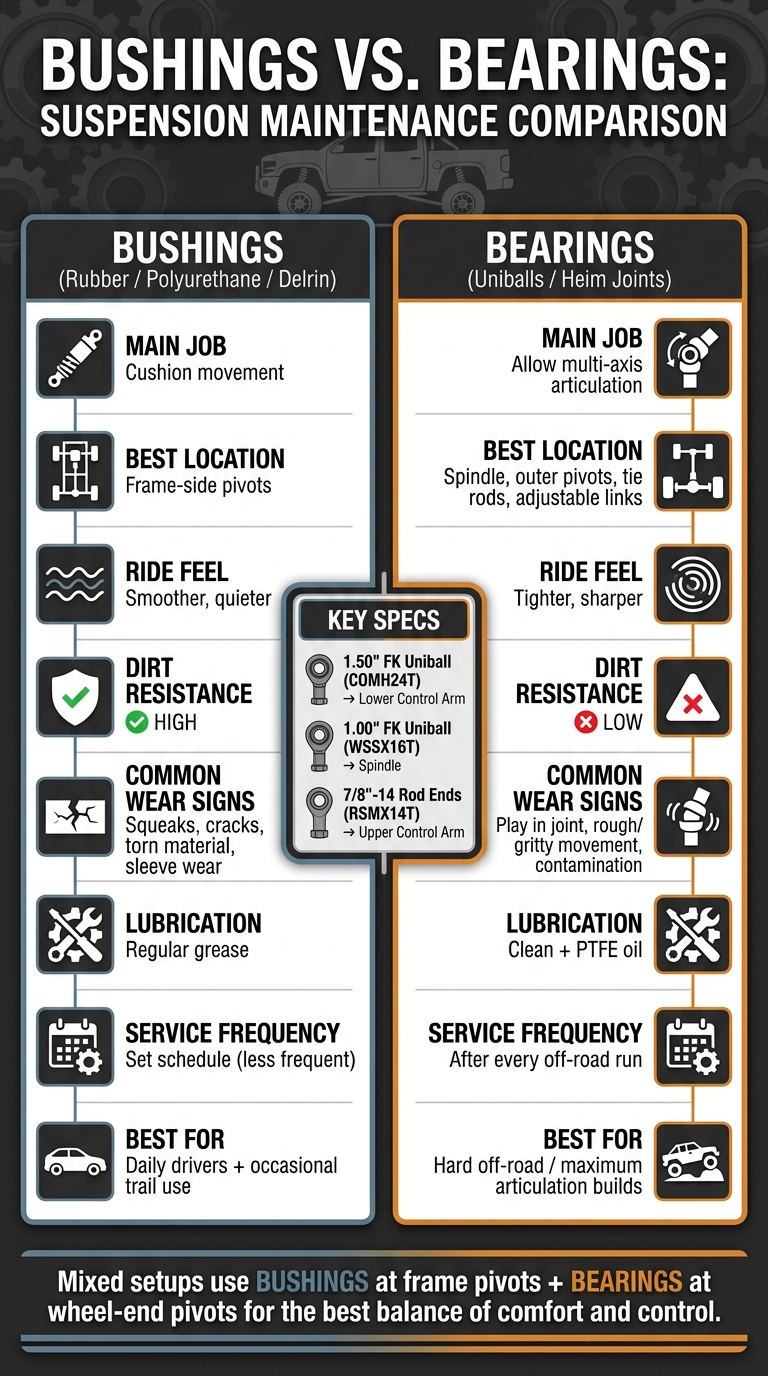
Bushings vs. Bearings: Suspension Maintenance Comparison
Bushings vs. Bearings – What are the Differences?
sbb-itb-afc4690
Quick Comparison
| Part | Main Job | Best Location | Ride Feel | Dirt Resistance | Main Wear Sign | Service Need |
|---|---|---|---|---|---|---|
| Bushings | Cushion movement | Frame-side pivots | Smoother, quieter | Higher | Squeaks, cracks, sleeve wear | Grease and inspect |
| Bearings | Allow multi-angle movement | Spindle, outer pivots, tie rods, adjustable links | Tighter, sharper | Lower | Play, grit, rough feel | Clean often, PTFE oil, inspect after runs |
My takeaway: if you daily-drive your truck and hit trails now and then, bushings usually mean less work. If you push hard off-road and need every bit of suspension movement, bearings make more sense – but you need to stay on top of service.
That’s the full comparison in plain terms, and it sets up the rest of the article.
Bushings: How They Work and What They Need
In long-travel setups, bushings are usually found at the frame-side pivots. That puts them on the comfort side of this comparison.
Rubber vs. Polyurethane Bushings
Rubber bushings are what most stock vehicles use when ride comfort comes first. They’re compliant, quiet, and don’t ask for much attention until they wear out. The downside is simple: rubber can deform under repeated hard loads. On a rig that spends a lot of time off-road, that can let alignment drift over time.
Polyurethane and Delrin bushings are stiffer and resist deflection under load. Long-travel kits often use Delrin or polyurethane at the frame-side pivots to resist deflection and hold alignment. That added stiffness helps keep things in place, but it also brings more noise and vibration into the cabin.
How to Spot Worn Bushings and Replace Them
Worn bushings usually make themselves known with squeaks and clunks during suspension travel. A visual check can help too. Look for torn material or a sleeve that’s worn out and no longer round.
When it’s time to replace bushings in fabricated control arms, match the new part to the exact size and material spec from the original kit manufacturer. Long-travel kits usually use replaceable bushings, so in many cases you’re just swapping the worn insert instead of replacing the whole arm.
Bearings do the same job, but they allow more articulation and need service more often.
Bearings: How They Work and What They Need
Bearings move with much less deflection than bushings. On a long-travel suspension, that means tighter steering feel and more articulation. The flip side is simple: these joints are more exposed to dirt, moisture, and wear. That tradeoff is a big part of deciding where each joint should live in the suspension.
Where Spherical Bearings and Heim Joints Are Used
Two common bearing types in off-road suspension are uniballs and heim joints (also called rod ends). They do different jobs based on load and adjustability.
Uniballs are pressed into cups on spindles and lower control arms, where loads are highest. A typical lower control arm connection uses a 1.50" FK uniball (COMH24T), while the spindle connection uses a 1.00" FK uniball (WSSX16T).
Heim joints are threaded, which makes them a good fit for adjustable links. That’s why you’ll usually see them at upper control arm frame pivots and tie rods, where alignment changes matter. LSK Suspension‘s race kits use 7/8"-14 rod ends (RSMX12T) at the upper control arm and extended heimed tie rods to improve on- and off-road ride quality.
So the basic rule is pretty straightforward:
- Use uniballs at high-load spindle and lower control-arm pivots
- Use heim joints on adjustable links, tie rods, and upper arm pivots
Once the layout makes sense, the next thing to watch is wear.
How to Spot Worn Bearings and Replace Them
The clearest sign of wear is play between the ball and race. You may also feel rough or gritty movement when you articulate the joint by hand. In most cases, that points to sand or mud getting inside and scoring the bearing surface.
Since most uniballs and heim joints in long-travel setups are exposed, they collect abrasive grit fast. Clean, inspect, and relube them with PTFE oil after every off-road run.
When a bearing is worn out, replace it with the correct size and spacer stack. For rod ends, use 17-4 stainless steel misalignment spacers so the joint keeps its intended articulation range. Then follow the manufacturer’s install and torque guidance.
Next, compare comfort, precision, and service intervals side by side.
Bushings vs. Bearings: Side-by-Side Maintenance Differences
Bushings and bearings don’t wear the same way. And because of that, they shouldn’t be checked or serviced the same way either.
Here’s how the day-to-day upkeep changes depending on which one you’re dealing with:
| Feature | Bushings (Delrin/Poly) | Bearings (Uniballs/Heim Joints) |
|---|---|---|
| Motion Type | Compliant pivot | Multi-axis articulation |
| Steering Precision | Moderate (some deflection) | High (minimal deflection) |
| Contamination Resistance | High – debris doesn’t easily penetrate | Low – exposed to grit, mud, and salt |
| Primary Wear Sign | Persistent squeaking | Play in the joint or visible contamination |
| Lubrication Needed | Regular grease | Cleaning plus PTFE oil |
| Best Application | Frame-side pivots | Wheel-end pivots and steering links |
Comfort, Precision, and Service Interval Tradeoffs
The biggest difference tends to show up in service timing.
Bushings are usually quieter and better shielded from dirt and grime. Bearings, on the other hand, give you tighter control and more exact movement, but they ask for more upkeep. Exposed uniballs and rod ends can pick up abrasive grit in a hurry, especially after runs through mud, dust, or salty conditions. That’s why service intervals are often easier to track by trail days or race miles instead of odometer miles.
Which Option Fits Different Long Travel Suspension Setups
LSK Suspension’s long-travel layouts use each part where it makes the most sense. Bushings go in spots where a little compliance helps. Bearings go where tighter control matters most.
That mixed setup helps keep service work reasonable. Bushings need regular greasing, while bearings need cleaning and PTFE oil after every off-road run.
Conclusion: Picking the Right Part and Keeping It in Good Shape
Choose bushings if you want a quieter ride on the street. Go with bearings if your rig is built for maximum articulation and serious long-travel off-road use. That one choice also shapes the service schedule.
After that, upkeep is pretty simple. Grease Delrin bushings on a regular basis. Clean exposed uniballs after trail runs, add PTFE oil again, and check for play or noise. Bushings tend to stay quiet and ask for less attention. Bearings give you tighter, more precise articulation, but they need steadier care.
FAQs
How do I know if my suspension uses bushings or bearings?
Check the pivot points where the control arms connect to the chassis. Bushings are usually cylindrical inserts made from materials like Delrin or polyurethane, and they cushion the metal parts. Bearings, or uniballs, are spherical metal joints built for precise, low-friction movement.
You can also confirm your setup by checking your vehicle’s service documentation or by inspecting the control arms for these distinct connection points.
Can I mix bushings and bearings in the same suspension setup?
Yes. It’s common to use both bushings and bearings in the same suspension setup because different pivots need different load handling and movement traits.
For example, LSK Suspension may use spherical bearings on outer pivots for travel and strength, while Delrin bushings are used on inner pivots to help manage load and keep alignment in check.
How often should I service suspension bearings after off-road use?
Service intervals depend on how and where you drive. If your vehicle sees a lot of off-road use, check things more often. A regular inspection schedule goes a long way here.
Many LSK Suspension upgraded control arms use sealed assemblies, including sealed uniball cups, to help keep dirt and debris out and help parts last longer. Even so, you should inspect FK Uniballs, rod ends, and Delrin bushings from time to time for wear and buildup, especially after hard off-road trips.
Leave a Reply