If you want the short answer: digressive pistons give you more control at low shaft speeds, while progressive pistons stay softer at first and add more damping as hits get harder.
That means:
- Digressive usually feels more planted in braking, cornering, and weight transfer
- Progressive usually feels smoother over chatter and adds more resistance on hard hits
- The split happens at the knee in the damping curve, where the shock moves from bleed flow to shim deflection
- Low-speed shaft motion is often around 2–5 in./sec., while sharp impacts can push past 200 in./sec.
- Your best choice depends on terrain, spring rate, vehicle weight, and suspension geometry
If I were picking between the two, I’d keep it simple: choose digressive for platform control, and choose progressive for bump compliance and bottom-out control. Neither is “better” on its own. The shock has to match how and where you drive.
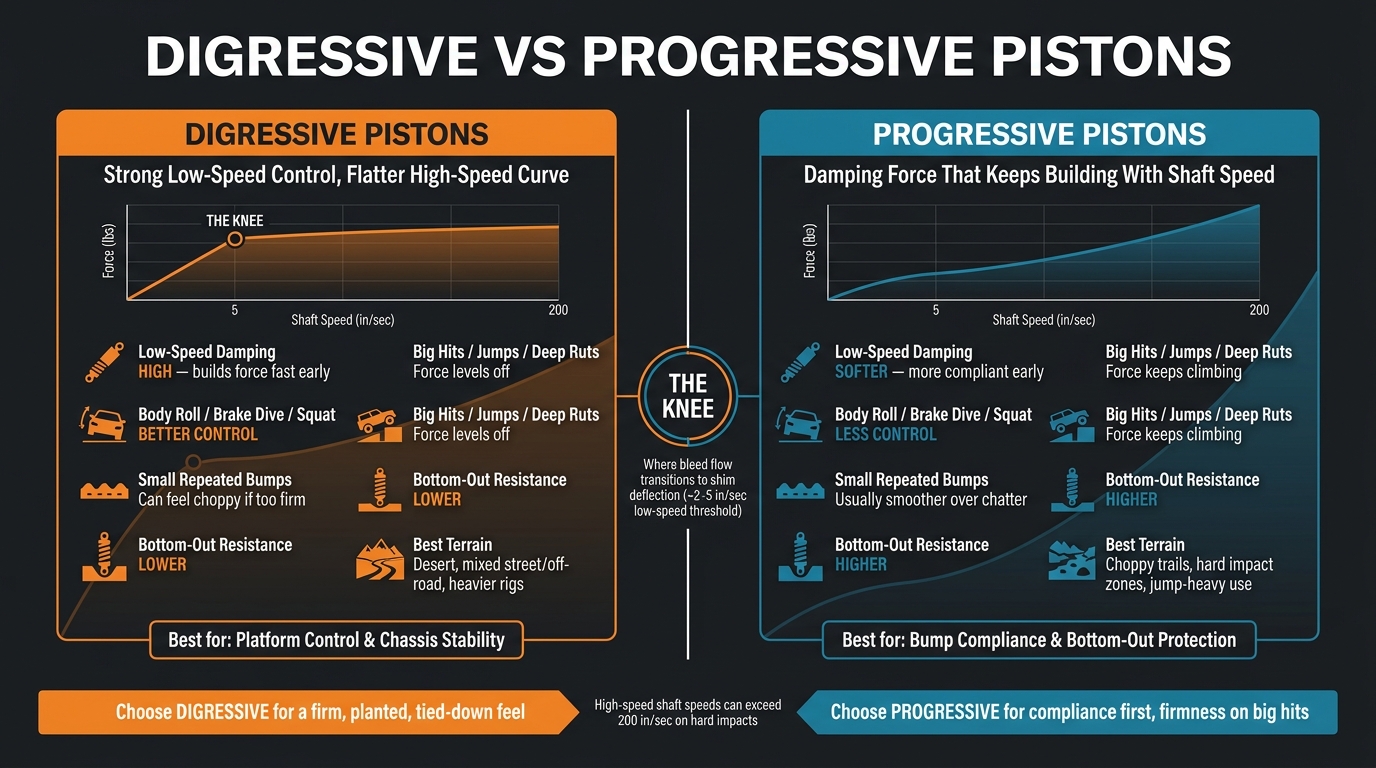
Digressive vs Progressive Pistons: Off-Road Shock Comparison
Piston Design, which is best and why?
sbb-itb-afc4690
Quick Comparison
| Criteria | Digressive | Progressive |
|---|---|---|
| Low-speed damping | Higher early force | Softer early force |
| Body roll / brake dive / squat | Better control | Less control |
| Small repeated bumps | Can feel choppy if too firm | Usually smoother |
| Big hits / jumps / deep ruts | Force levels off more | Force keeps climbing |
| Bottom-out resistance | Lower | Higher |
| Best fit | Desert, mixed street/off-road, heavier rigs | Choppy trails, hard impact zones, jump-heavy use |
Bottom line: I’d use digressive when I want a firmer, more tied-down feel, and progressive when I want the wheel to move more freely at first, then firm up as shaft speed climbs.
Digressive Pistons: Strong Low-Speed Control With a Flatter High-Speed Curve
A digressive piston builds damping force fast at low shaft speeds, then tapers off. The result is strong chassis control without making hard hits feel overly sharp. Through transitions, the chassis stays settled, and the vehicle feels planted instead of loose or wallowy.
How Digressive Valving Is Built
The shims rest against a raised lip on the piston face, so oil doesn’t move freely right away. Pressure has to build before the shims crack open. At low shaft speeds, oil is forced through small bleed passages, which makes damping force climb steeply.
Then comes the knee. Once pressure reaches the opening point, the shims deflect and let more oil pass. After that, force no longer climbs as sharply and starts to flatten out. Even small shim stack changes can move the knee point and change the shape of the high-speed plateau.
That setup puts control first. That’s why digressive pistons are common in vehicles that need steady braking, turning, and weight transfer.
Where Digressive Pistons Work Well Off-Road
Because the firmest damping happens at low shaft speeds, digressive valving works well for body roll, brake dive, and acceleration squat. Those are all slow-velocity events, and this style of valving is built to keep them in check.
For desert running, that matters a lot. Cornering stability and braking control can make the vehicle feel much more settled.
The tradeoff tends to show up on small, repeated bumps like washboard. If low-speed damping is too high, the shock doesn’t have much room to soften before it reaches the knee. Those quick, shallow hits can start to feel choppy.
If washboard feels harsh, open the bleed slightly. That softens the lowest-speed damping without giving up too much chassis control. On repeated chatter, digressive tuning takes careful bleed control, while progressive valving deals with that impact buildup in a different way.
Progressive Pistons: Damping Force That Keeps Building With Shaft Speed
A progressive piston keeps adding damping force as shaft speed goes up. At lower speeds, it stays more compliant. Then, when the hit gets bigger and faster, it firms up. That rising force curve is what sets it apart when you’re looking at comfort, control, and bottoming resistance.
How Progressive Valving Creates a Rising Force Curve
A progressive stack uses shims set up to resist opening more as pressure builds. As shaft speed increases, those shims get tougher to push open, so damping force continues to climb. On a dyno, the curve keeps rising and becomes steeper as speed goes up.
That shape matters. It gives up some early firmness, but pays you back with more protection later in the stroke.
Where Progressive Pistons Work Well Off-Road
Progressive valving works best in terrain with repeated hard impacts. In high-speed compression events, shaft speeds can exceed 200 inches per second, and a progressive piston keeps building resistance across that whole range. The result is strong bottoming resistance on jumps and deep ruts.
Because high-speed shaft movement pushes the curve harder, progressive pistons tend to suit terrain where impact absorption matters more than chassis platform control. The tradeoff is softer low-speed control in exchange for a more compliant stroke on bigger hits.
Those tradeoffs stand out even more when you compare them side by side with digressive valving.
Digressive vs Progressive Pistons: Side-by-Side Off-Road Comparison
Now that both piston types are on the table, the day-to-day difference comes down to control vs. compliance.
Digressive pistons lean toward chassis control.
Progressive pistons lean toward compliance and impact absorption.
Low-Speed Control, High-Speed Bump Response, and Ride Feel
Digressive valving gives you more damping right away at lower shaft speeds. That usually makes the chassis feel firm and planted during body roll, brake dive, and acceleration squat.
Progressive valving does the opposite. It starts softer, then builds damping force as shaft speed goes up. In plain English, that means it tends to feel smoother over small bumps, then gets firmer when you hit bigger impacts.
| Criterion | Digressive Piston | Progressive Piston |
|---|---|---|
| Low-Speed Control (Roll/Pitch) | More initial damping; stable chassis platform. | Less low-speed control; can feel unsettled during slow maneuvers. |
| High-Speed Bump Response | Force flattens; allows the wheel to move quickly to soak up sharp ledges. | Force ramps up; strong bottoming resistance on jumps and ruts. |
| Small Bump Compliance | Can feel stiff or chattery over high-frequency ripples. | Absorbs small trail chatter without transmitting harshness. |
| Overall Ride Feel | Firm and connected; prioritizes chassis stability. | More compliant at low speeds; firms up hard on high-velocity impacts. |
A simple way to picture it: digressive curves hit hard early, then level off. Progressive curves keep climbing as shaft speed increases.
That difference shows up fast on the trail. A digressive setup can feel more tied down in corners and under braking, while a progressive setup often feels less busy when the terrain gets choppy.
Tuning Tradeoffs for Desert, Trail, Crawling, and Mixed-Use Builds
The best piston style depends on where your suspension spends most of its time. Is your rig dealing with slow chassis movement, hard hits at speed, or a bit of both? That’s where the tradeoffs become clear.
| Use Case | Digressive Strengths | Progressive Strengths | Likely Compromise |
|---|---|---|---|
| Desert Racing | High-speed stability and chassis control over whoops. | Superior bottoming resistance for massive G-outs and jumps. | Digressive may feel too harsh on chatter; progressive may feel less settled at speed. |
| Technical Trail | Precise steering response and predictable handling in tight sections. | Soaks up unpredictable trail chatter and hidden potholes comfortably. | Digressive might transmit too much vibration; progressive might feel loose. |
| Rock Crawling | Stable platform; reduces body roll during slow maneuvering. | High compliance and tire wrap over small rocks. | Digressive can feel too stiff for slow-speed comfort; progressive may lack body control on steep inclines. |
| Mixed-Use/Daily | Sharp steering and reduced body roll on pavement. | Comfortable ride over expansion joints and city potholes. | Digressive can be fatiguing on long trips; progressive can feel less stable during quick transitions. |
There’s one more layer here. Piston style doesn’t act alone. Spring rates, shock size, and overall valving all shape how these curves feel on the vehicle.
So the same progressive piston can act one way on a lightly built rig and another way on a heavily sprung truck. That’s why copying someone else’s setup doesn’t always work. On paper, the parts may match. On the trail, the feel can be completely different.
That tradeoff leads straight into how to pick the right piston style for your build.
Choosing the Right Piston Style for Your Suspension Goals
Piston style is only one piece of the puzzle. You still need to match valving to vehicle mass, suspension geometry, spring rates, and how the vehicle is used. Once that part is clear, picking the right curve gets a lot easier.
There isn’t one piston style that works best for every build. The right pick depends on the terrain, the vehicle’s weight, and the kind of control you want from the suspension.
When the use case is clear, the rest of the suspension package shapes the final feel. Heavier builds with gear mounted up high often do well with digressive valving because the strong initial damping helps fight body roll, pitch, and squat right away. For desert running and other high-speed off-road use, progressive valving can make more sense because it starts softer for compliance, then adds damping force as shaft speed climbs, which helps resist bottoming on bigger hits. And in any suspension package – whether that’s a long travel kit, a race kit, or upgraded control arms – the internal shock valving needs to match the geometry and leverage ratios those parts create.
Define the terrain first, then choose the piston style.
FAQs
How do I know which piston style fits my driving?
Choose based on where you drive and how you like the vehicle to feel.
A digressive piston fits drivers who want sharp handling, steady cornering, and a more planted feel. It gives firmer low-speed damping, which helps with control, but it softens up over sharp bumps so the ride doesn’t feel harsh every time the road gets choppy.
A progressive piston makes more sense for rough, uneven terrain and bigger hits. It stays softer at low speeds, then adds more resistance as shaft speed goes up. That can help when the ground is unpredictable and the suspension needs to deal with harder impacts.
Vehicle weight, tire size, and the type of terrain you drive on also play a big part in the right choice.
Can spring rate change how digressive or progressive valving feels?
Yes. Spring rate changes how digressive or progressive valving feels because the spring and the damping curve work as a pair.
Here’s the simple version: stiffer springs usually need more damping to keep the suspension in check, while softer springs can often work with a flatter damping curve.
If those two parts don’t match, the result is easy to feel on the road or track. The suspension can seem loose and undercontrolled on one end, or harsh and slow to react on the other.
What does the knee in the damping curve actually do?
The knee is the point where a shock absorber changes the rate at which damping force builds.
With digressive valving, that point marks the move from firm low-speed damping – which helps keep the car settled during cornering, braking, and acceleration – to a flatter, softer response when the suspension hits high-speed impacts.
That transition mostly comes from how the main shim stack seals against the piston’s digressive lip. Change the shim thickness, and you can make the knee stand out more clearly, which gives you finer control when tuning the chassis.
Leave a Reply