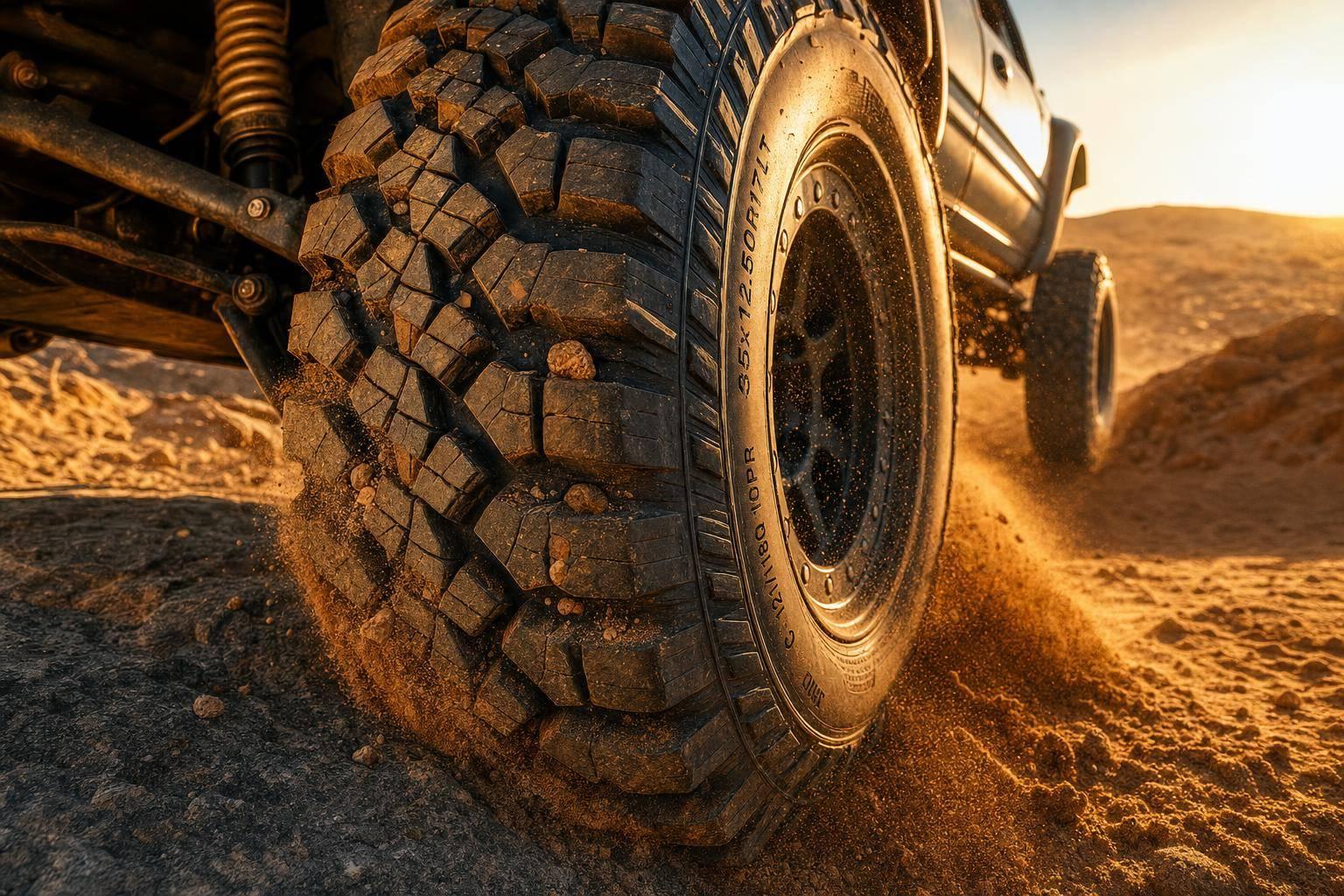
Most off-road tire picks come down to one simple rule: buy for the ground you drive most, not the most aggressive tread you can find.
If I spend 70% to 90% of my time on pavement, a harsh mud tire is often the wrong call. If I drive in deep mud, tight tread blocks can pack up fast and lose grip. And before I pick any tread at all, I need to check load rating, tire size, wheel offset, backspacing, and suspension clearance so the tire does not rub.
Here’s the short version:
- Mud: wide voids and spaced lugs help clear mud
- Sand: tread should help the tire float instead of dig
- Rocks: tighter, stable blocks and strong construction help on hard surfaces
- Gravel: chip resistance matters
- Mixed trails: balanced tread is usually the better fit
- More aggressive tread: more off-road bite, but more road noise and faster pavement wear
- Less aggressive tread: better street manners, but less grip in deep mud or rough trail use
Quick comparison
| Tread type | Best for | Main upside | Main downside |
|---|---|---|---|
| All-terrain (A/T) | Daily driving, dirt, gravel, light mud | Good road comfort and balanced grip | Falls short in deep mud and hard rock use |
| Mud-terrain (M/T) | Mud, loose trails | Strong self-cleaning traction | Loud on pavement, rougher ride |
| Hybrid | Split road and trail use | More off-road grip than A/T, less noise than M/T | Still a middle-ground pick |
| Rock-oriented | Rock crawling | Strong carcass and low-pressure stability | Poor street behavior |
If I want the short answer, it’s this: match tread to terrain first, then make sure the tire fits the vehicle and the weight it carries.
Watch This Before Buying Off-Road Tires! A/T vs M/T vs R/T
sbb-itb-afc4690
Tread Pattern Basics
With fitment out of the way, the next step is the tread itself. This is where off-road grip starts to make sense.
Off-road traction mostly comes down to four things: blocks, grooves, void ratio, and siping. Those four features work together to shape traction, self-cleaning, braking, and wear.
Blocks, Grooves, Voids, and Siping
Tread blocks are the raised rubber lugs that touch the ground. In off-road driving, they do most of the work. They create the traction edges that help a tire bite into loose, rough, or uneven terrain.
Grooves are the channels between those blocks. Their job is simple: give mud, dirt, and debris somewhere to go. If the tread can clear itself, it can keep digging instead of packing up.
Void ratio is the amount of open space between the tread blocks compared with how much rubber stays in contact with the ground. A higher void ratio helps clear mud and sand faster. A lower void ratio puts more rubber on the surface, which usually makes the tire behave better on pavement.
Siping refers to the thin cuts molded into the tread blocks. Those cuts add extra biting edges, which can help grip on hard-packed surfaces.
How Tread Aggression Changes Performance
Tread aggression is the mix of block size, block spacing, and voids. More aggressive tread patterns bite harder in loose terrain and do a better job of shedding mud. Less aggressive patterns are often a better match for daily street driving, and they usually wear more evenly on pavement.
That trade-off matters. Aggressive tread helps in loose terrain, but it often rides rougher and wears faster on pavement. So the right choice depends on where the tire will spend most of its time.
These basics lead straight into the terrain comparison next.
Match Tread to Terrain
Those tread traits start to matter in different ways once the tire meets mud, sand, rock, or gravel.
Mud and Sand
Mud calls for wide voids so the tire can clean itself as it turns. If the gaps are too tight, mud packs in and grip drops fast.
Sand is a different animal. You want a tread that spreads the tire’s load and helps it float, not dig. The goal is to stay on top of soft ground instead of burying the vehicle.
Rocks, Gravel, and Mixed Trails
Rocks and hardpack do better with tight, stable tread blocks and strong construction. That setup helps with grip, steering control, and impact resistance when the surface is hard and uneven.
Gravel brings its own problem: it can chip tread blocks. So chip resistance should be high on your list. Mixed trails ask for balance. You need a tread that stays planted on the road but can still shed dirt once you head off-road.
Terrain-to-Tread Comparison Table
| Terrain | Key Tread Traits | Benefit | Tradeoff |
|---|---|---|---|
| Mud | Wide voids, large spaced lugs | Strong self-cleaning and sustained grip | Best when mud is the priority |
| Sand | Tread that spreads load and resists digging | Helps the tire stay on top of soft ground | Less ideal in deep mud |
| Rocks | Tight, stable tread blocks, durable construction | Better grip on hard, irregular surfaces | Less open for clearing mud |
| Gravel | Chip-resistant compound, balanced spacing | Better resistance to sharp stones | Less aggressive bite in loose terrain |
| Mixed Trails | Balanced void ratio, moderate lug size | Handles varied conditions with steering stability | A compromise by design |
These terrain demands narrow your options before you even look at tread categories. From there, the next step is to match those needs to the most common tread designs.
Common Off-Road Tread Types Compared
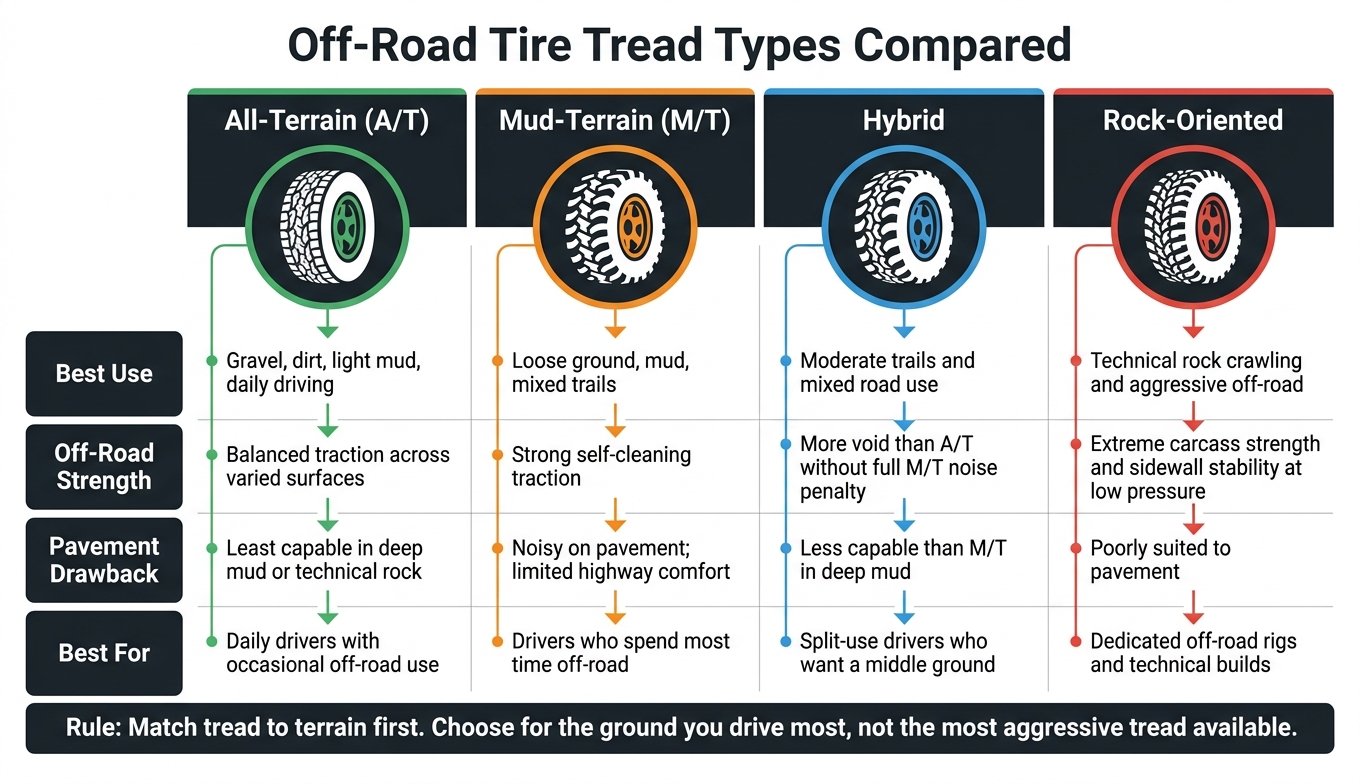
Off-Road Tire Tread Types Compared: A/T vs M/T vs Hybrid vs Rock
Once you know the terrain, the next step is simpler: pick the tread family built for that surface.
All-Terrain, Mud-Terrain, Hybrid, and Rock-Oriented Designs
Each tread type is built with a different goal in mind. The key is to match that goal to the ground you drive on most.
All-terrain (A/T) tires aim for a middle ground between street use and trail use. They handle gravel, dirt, and light mud well, and they stay quiet and comfortable enough for daily driving. The downside? They don’t do as well in deep mud or technical rock terrain.
Mud-terrain (M/T) tires are made for loose ground and tread that clears itself as it rolls. If you’re driving muddy or loose trails, this is the tread family that keeps digging and shedding buildup. They can handle some highway use, but road noise goes up fast.
Hybrid tires land between A/T and M/T designs. They have more void than a standard all-terrain, but without all the noise that usually comes with a mud-terrain. They’re a good fit for drivers who split time between moderate trails and normal road use.
Rock-oriented tires focus on carcass strength and stability, not self-cleaning. They fit technical rock crawling and hard off-road driving, where sidewall support and low-pressure stability matter more than clearing mud. On pavement, though, they’re a poor match.
On-Road Tradeoffs: Noise, Comfort, and Wear
Here’s the plain truth: the more aggressive the tread, the rougher it feels on the road.
M/T tires are noisy on pavement, and rock-focused tires are even less friendly for street driving. As tread gets more aggressive, road noise goes up and ride comfort drops.
Tread Type Comparison Table
Pick the tread family that fits your main terrain, then live with the pavement tradeoffs that come with it.
| Tread Type | Best Use Case | Off-Road Strengths | Pavement Drawbacks | Best For |
|---|---|---|---|---|
| All-Terrain (A/T) | Gravel, dirt, light mud, and daily driving | Balanced traction across varied surfaces | Least capable in deep mud or technical rock | Drivers who prioritize daily comfort with occasional off-road use |
| Mud-Terrain (M/T) | Loose ground, mud, and mixed trails | Strong self-cleaning traction | Noisy on pavement; limited highway comfort | Drivers who spend most time off-road |
| Hybrid | Moderate trails and mixed road use | More void than A/T without full M/T noise penalty | Less capable than M/T in deep mud | Split-use drivers who want a middle ground |
| Rock-Oriented | Technical rock crawling and aggressive off-road driving | Extreme carcass strength and sidewall stability at low pressure | Poorly suited to pavement | Dedicated off-road rigs and technical builds |
Next, use vehicle weight, load, and suspension clearance to rule out sizes that match the terrain but not the truck.
Vehicle Weight, Load Capacity, and Suspension Clearance
Load changes how a tire flexes, wears, and grips. Put a heavy load in the bed or hook up a trailer, and the tread has to work harder. That extra stress can wear an aggressive tire faster than you’d like. So yes, weight matters. But it isn’t the whole story. Tire size and suspension clearance can knock out an option before tread pattern even enters the picture.
Bigger tires also need verified clearance through full suspension travel. That means checking wheel offset, backspacing, and fender space. A tire can look perfect on paper and still be the wrong pick if it rubs under compression or during turns.
Once load and clearance are sorted out, use this process to narrow things down.
A Step-by-Step Process for Picking the Right Tread
- Identify your primary terrain. Not the trail you drive once a year. Think about the ground you see most weeks.
- Estimate your highway percentage. If a big chunk of your miles happens on pavement, noise and wear matter more than max off-road bite.
- Decide what you can live with. Be honest about how much road noise and pavement wear you’re willing to put up with.
- Confirm load rating and clearance. Match the load rating first, then check clearance, offset, backspacing, and fender space.
- Choose for primary use, not edge cases. A tire that works well 90% of the time beats one that shines on one rare trip and feels like a chore everywhere else.
After those checks, the answer is usually pretty clear.
Conclusion: Buy for the Terrain You Drive Most
The right tread comes down to four things: knowing what tread elements actually do, matching the pattern to the terrain you drive on most, being honest about the pavement tradeoffs you can accept, and making sure the tire fits your vehicle’s load capacity and suspension setup. Get those four pieces right, and the choice gets much easier.
For larger, vehicle-specific setups, LSK Suspension offers race kits, long travel kits, and control arms designed to match suspension geometry.
FAQs
How do I know if I need A/T, M/T, or hybrid tires?
It comes down to where and how you drive.
A/T tires strike a middle ground. They aim to keep everyday on-road comfort while still giving you enough traction for the occasional trail, dirt road, or light off-road trip.
M/T tires lean much harder into off-road driving. They use an aggressive tread pattern built for rough ground, loose surfaces, and deep mud.
Hybrid tires sit in the middle. They give you more off-road grip than A/Ts, but they’re usually easier to live with on pavement than full mud tires.
Will bigger off-road tires rub my suspension or fenders?
It depends on your vehicle’s setup and suspension geometry. Larger tires, including 37-inch models, can improve off-road performance, but they often need extra work to keep proper clearance.
LSK Suspension race and long travel kits are built to help fit larger tires by moving the wheelbase forward and increasing track width. For the best fit, check your tire choice and wheel backspacing with the sales team before you buy.
What tread works best if I drive mostly on-road but hit trails on weekends?
If you spend most of your time on pavement but head off-road on weekends, mud-terrain tires can be a smart pick. Their tread pattern is made to give you the grip you need on dirt, mud, and rough trails, while still working well enough for day-to-day road driving.
That mix makes them a solid fit for weekend trips without making your daily commute a pain.
Leave a Reply