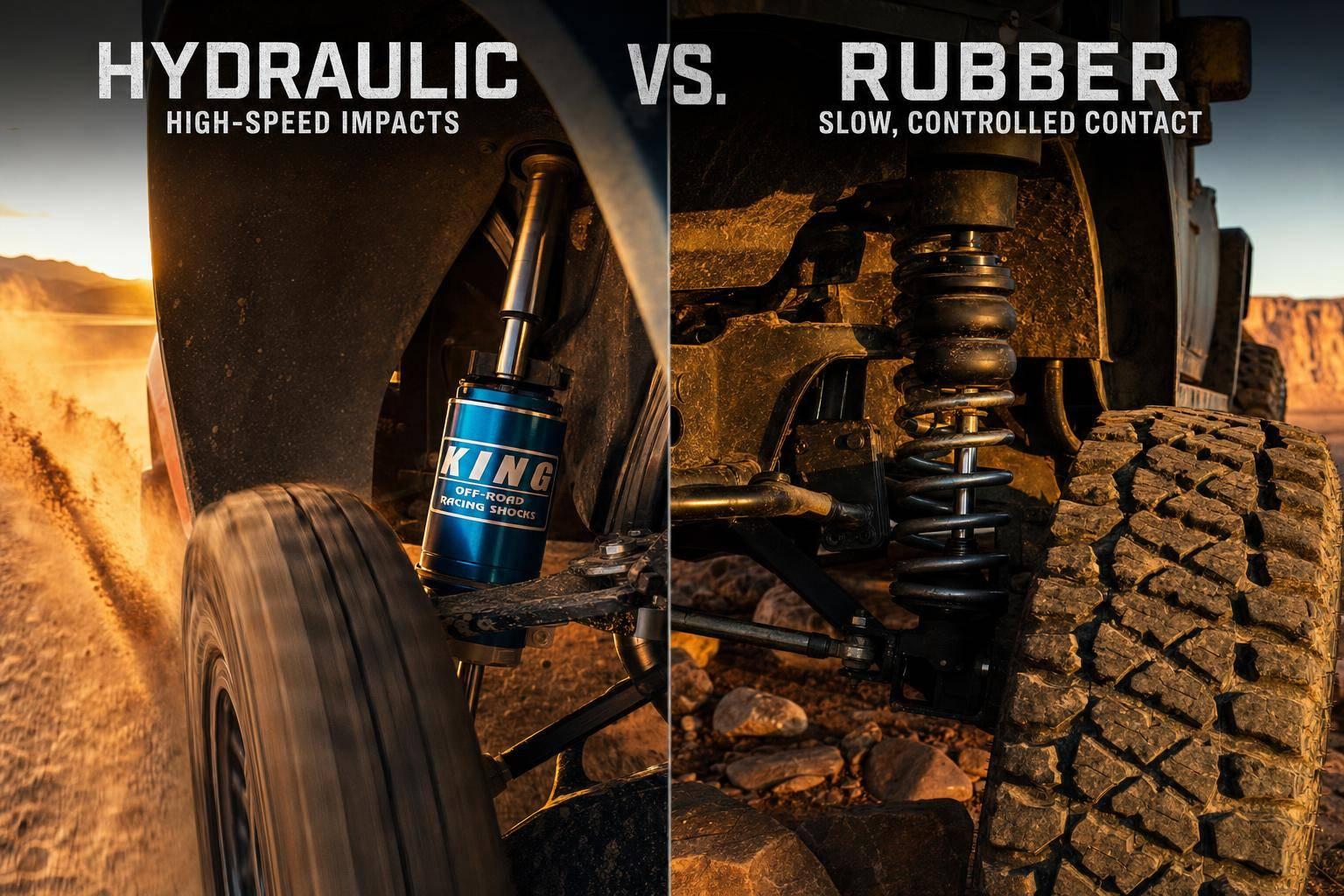
If you hit your suspension hard, hydraulic bump stops are the better pick. If you want low cost, simple install, and low upkeep, rubber bump stops usually make more sense.
I’d boil the whole choice down to this:
- Hydraulic bump stops use oil and nitrogen, often around 350–400 psi, to slow the last part of suspension travel
- Rubber bump stops use compressed rubber or polyurethane to cushion bottom-out
- Hydraulic units cost about $700–$1,000 per pair and often need cutting and welding
- Rubber units cost about $150–$400 per pair and are often bolt-on
- Hydraulic works best for high-speed hits, jumps, whoops, and heavy repeated impacts
- Rubber works best for daily driving, overlanding, towing, and moderate trail use
If I were choosing, I’d look at just five things first:
- Vehicle weight
- Suspension travel
- Driving speed
- Terrain
- Budget
Quick comparison:
| Type | How it works | Best for | Install | Upkeep | Price per pair |
|---|---|---|---|---|---|
| Hydraulic | Oil + nitrogen damping with a progressive end-stroke feel | Desert driving, race builds, repeated hard hits | More work; often welding/fab | Pressure checks and rebuilds | $700–$1,000 |
| Rubber | Material compression with a fixed feel | Street, trail, overland, tow rigs | Usually simple bolt-on | Low | $150–$400 |
So if you want more control at full bump, hydraulic is the move. If you want simple parts that do the job without extra setup, rubber is the better fit.
Bump Stop Tech. & Hydraulic Bump Stop Install – Reckless Wrench Garage
sbb-itb-afc4690
Hydraulic Bump Stops: How They Work, Strengths, and Limits
A hydraulic bump stop uses a piston, oil, and a nitrogen charge to build progressive resistance as the suspension gets close to full compression. That extra control is why these stops matter most when a vehicle takes hard, repeated hits.
Here’s the basic idea: as the bump stop compresses, the nitrogen adds spring force. As it moves deeper into the stroke, oil damping helps soak up the impact. Rebound control also helps limit kickback after the hit.
This is where hydraulic bump stops shine: fast, repeated, high-force impacts. Think high-speed desert driving, whoops, jumps, and hard ledge drops. They’re often built into long-travel kits from LSK Suspension to help control the last few inches of suspension travel in aggressive prerunner and race setups. For sizing, use 2.0-inch units for vehicles under 5,000 lb and 2.5-inch units for heavier rigs or higher-leverage setups like A-arms and trailing arms.
Where Hydraulic Bump Stops Perform Best
Hydraulic bump stops do their best work when the suspension is moving fast and hitting hard over and over. In those conditions, a simple rubber stop can feel like a blunt tool. A hydraulic unit gives you a more controlled ramp-up near the end of travel, which can make a big difference when the terrain keeps punching back.
Tradeoffs: More Control, More Setup
The downside is pretty simple: you get more control, but you also get more setup work. A good pair usually costs about $700 to $1,000. Installation often means cutting, welding, and placing the stops with care so they engage at the right point in the suspension cycle. If they’re set wrong, the vehicle can end up sitting on the bump stop at ride height, which is exactly what you don’t want.
Nitrogen pressure is usually set in the 350–400 psi range, then adjusted based on testing. There’s also some upkeep involved, including seal checks and nitrogen recharges from time to time. Rubber stops don’t need that kind of attention.
Rubber bump stops take a simpler path, with less control and far less setup.
Rubber Bump Stops: How They Work, Strengths, and Limits
Rubber bump stops handle the same end-of-travel issue with a simpler, fixed-rate setup. You’ll also hear them called jounce bumpers or axle snubbers. They’re molded rubber or polyurethane blocks that sit between the frame and axle, and they compress at full bump to soften the impact.
Their progressive feel comes from the shape of the stop and its durometer, not from valving. That’s a big difference. There are no moving parts, so there are no seals to wear out or leak. Many aftermarket versions use polyurethane because it tends to last longer and can be molded to create a more gradual compression curve.
Where Rubber Bump Stops Make the Most Sense
Rubber and polyurethane stops make a lot of sense for daily-driven trucks, overland rigs, tow setups, and moderate trail use. In many cases, they bolt into factory mounting points or existing suspension holes, so installation stays simple and costs stay down. No cutting. No welding. No big fabrication project.
That makes them a good match for builds where dependability and low upkeep matter more than high-speed suspension control. For most street-to-trail trucks, that simpler setup is enough to get the job done without adding extra parts or extra headaches.
Tradeoffs: Simpler and Cheaper, but Less Tunable
The downside is control. Or more accurately, the lack of it. Rubber stops don’t have velocity-sensitive damping. If the suspension slams into them hard and fast, they compress and that’s it. You can’t fine-tune how they react the way you can with a hydraulic setup. Your main tuning options are limited to changing the stop’s height, shape, or durometer.
That limit becomes more obvious on repeated high-energy impacts. The result can be a harsher bottom-out feel. The stop can absorb part of the hit through compression, but it can’t control end-stroke energy the way a hydraulic unit can. Over time, rubber can also dry out and crack from heat and UV exposure, so it’s smart to inspect them now and then.
Those differences stand out most when you compare the two side by side.
Hydraulic vs. Rubber Bump Stops: Side-by-Side Comparison
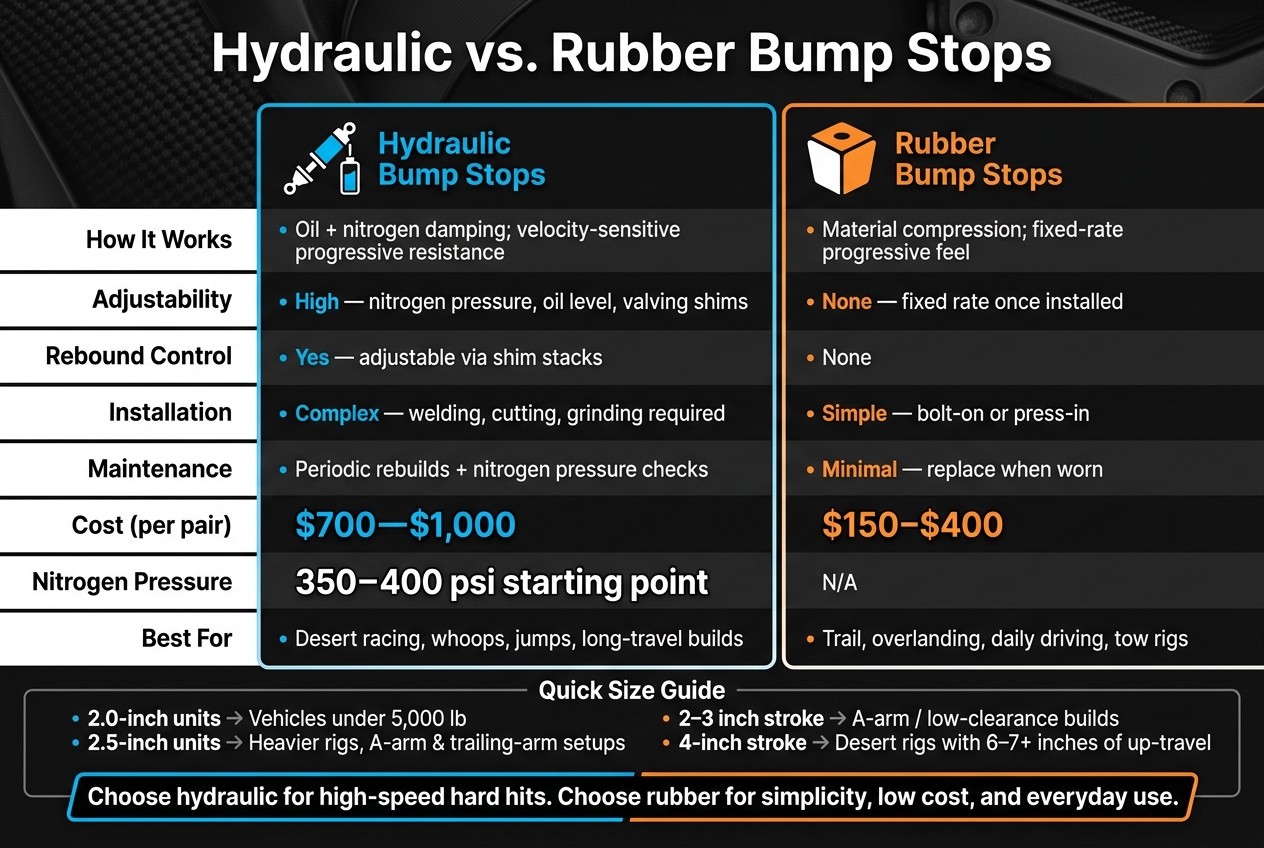
Hydraulic vs. Rubber Bump Stops: Full Comparison Chart
Here’s the quick side-by-side view:
| Feature | Hydraulic Bump Stops | Rubber Bump Stops |
|---|---|---|
| Construction | Steel/aluminum body, piston, shims, shock oil, nitrogen | Rubber or polyurethane block, often hollow-core |
| Working Principle | Velocity-sensitive damping + gas spring | Progressive material compression |
| Adjustability | High – nitrogen pressure, oil level, valving shims | None – fixed rate once installed |
| Available Stroke | 2, 3, or 4 in. stroke options | Fixed height, vehicle-specific |
| Rebound Control | Adjustable via shim stacks or internal springs | None |
| Installation | Complex – welding, cutting, grinding required | Simple – bolt-on or press-in |
| Maintenance | Periodic rebuilds and nitrogen pressure checks | Minimal maintenance; replace when worn |
| Cost (per pair) | $700–$1,000 | $150–$400 |
| Ideal Use Case | Desert racing, high-speed whoops, jumps, heavy builds | Trail running, overlanding, rock crawling, budget builds |
That table lays out the big tradeoff. The next part is what it feels like once the truck hits the trail or starts moving fast.
Performance, Ride Quality, and Repeated Impacts
The main difference shows up after the impact. A hydraulic bump stop doesn’t only soften the hit – it also controls the rebound. Internal shim stacks manage how fast the suspension gives that energy back, which helps keep the vehicle settled through repeated impacts and cuts down on hard chassis unload after a big hit.
Rubber bump stops work in a much simpler way. They absorb force by compressing, but they don’t manage rebound. That can make the suspension feel less consistent when hits come one after another. Hydraulic units also deal with heat better under repeated abuse, while rubber tends to soften and wear out faster.
That extra control matters most when the suspension is cycling again and again, which is where setup and upkeep start to matter more.
Installation, Tuning, and Maintenance
Hydraulic units take more work to install. You’ll need to weld mounting cans or sleeves in place, so expect cutting, grinding, and painting as part of the job. Stroke choice matters too. A 4 in. stroke is a good match for desert builds with lots of suspension travel, while 2 in. or 3 in. strokes fit A-arm setups or low-clearance builds better.
For setup, use an O-ring on the shaft to check how much stroke you’re using, and leave about 1/4 inch of travel in reserve. Nitrogen pressure is usually the first tuning step, with most setups starting around 350–400 psi. From there, internal shim stacks let you tune compression and rebound on their own.
Once you know what installation and tuning involve, price and build level usually make the choice much easier.
Cost and Fit for Different Build Levels
Rubber bump stops usually cost about $150–$400 per pair, while hydraulic bump stops land around $700–$1,000 per pair. If the build is aimed at trail use, overlanding, or keeping costs down, rubber makes sense. If the rig is built for high-speed driving and hard impacts, hydraulic is the better fit.
That price gap is usually what makes the decision pretty clear.
Choosing the Right Bump Stop for Your Build
Pick your bump stop based on speed, terrain, suspension travel, vehicle weight, and budget. That gives you a much better result than shopping by price alone.
If your rig mostly sees trail riding, overlanding, or low-speed rock crawling, rubber bump stops usually make sense. They work well, cost less, and keep things simple. But if you’re charging through whoops or putting together a long-travel desert setup, hydraulic bump stops are usually worth the added cost and setup time. After that, the next step is sizing the stop to fit your rig’s weight and the amount of up-travel you have.
Use 2.5-inch units for heavier rigs and for high-leverage A-arm or trailing-arm setups. A 2-inch or 3-inch stroke fits most A-arm and low-clearance builds. A 4-inch stroke is the better fit for desert rigs with 6–7+ inches of up-travel.
On long-travel builds, control arms, and race setups, it helps to size bump stops early. That way, they work with the rest of the suspension package instead of getting treated like an afterthought.
For a quick match by build type, use this guide:
| Build Type | Bump Stop Type | Notes |
|---|---|---|
| High-speed desert / racing | Hydraulic, 4" stroke, 2.5-inch diameter | Velocity-sensitive damping handles repeated hard hits |
| Technical rock crawling | Rubber or polyurethane | Low-speed use; simple bolt-on; progressive compression |
| Mixed-use trail rig | Rubber or polyurethane | Good balance of comfort and cost |
| Overlanding / daily driver | Rubber or polyurethane | Budget-friendly; minimal maintenance |
| Long-travel A-arm build | Hydraulic, 2.5-inch diameter | High-leverage geometry calls for more damping capacity |
In practice, the right bump stop matches how you drive, how much your rig weighs, and how much travel you have – not just what you want to spend.
FAQs
Do I need hydraulic bump stops for my build?
It comes down to two things: what you want the suspension to do and how much you want to spend.
Hydraulic bump stops make the most sense for high-travel suspension, heavy loads, and hard off-road use where top-end protection and fine-tuning matter. They do a good job soaking up hard hits, but they cost more – about $700 to $1,000 per pair – and they usually need custom installation and tuning.
If your build is less extreme, or you’re trying to keep costs in check, rubber bump stops can be enough. They offer basic protection and are much easier to install.
How do I know what bump stop size to choose?
Measure your suspension at full flex. Articulate the vehicle until the tire tucks into the fender or touches the body, then measure the gap between the bump stop mount on the frame and the bump stop pad on the axle.
From there, subtract any tire-to-body clearance that’s still left. That gives you the extension length you need. Go with the shortest bump stop that still stops contact, because a longer one can cut into up travel and articulation.
Can rubber bump stops handle off-road abuse?
Rubber bump stops are good at dealing with small hits and helping prevent metal-to-metal contact. Most of the time, though, they’re built for normal on-road driving.
Once you get into harsh off-road terrain with repeated, hard bottom-outs, plain rubber bump stops can run out of cushion. They can get overwhelmed when the suspension is taking hit after hit. For tougher off-road use, hydraulic bump stops or rubber bump stops made for off-road driving usually give you better control, more cushioning, and longer service life.
Leave a Reply