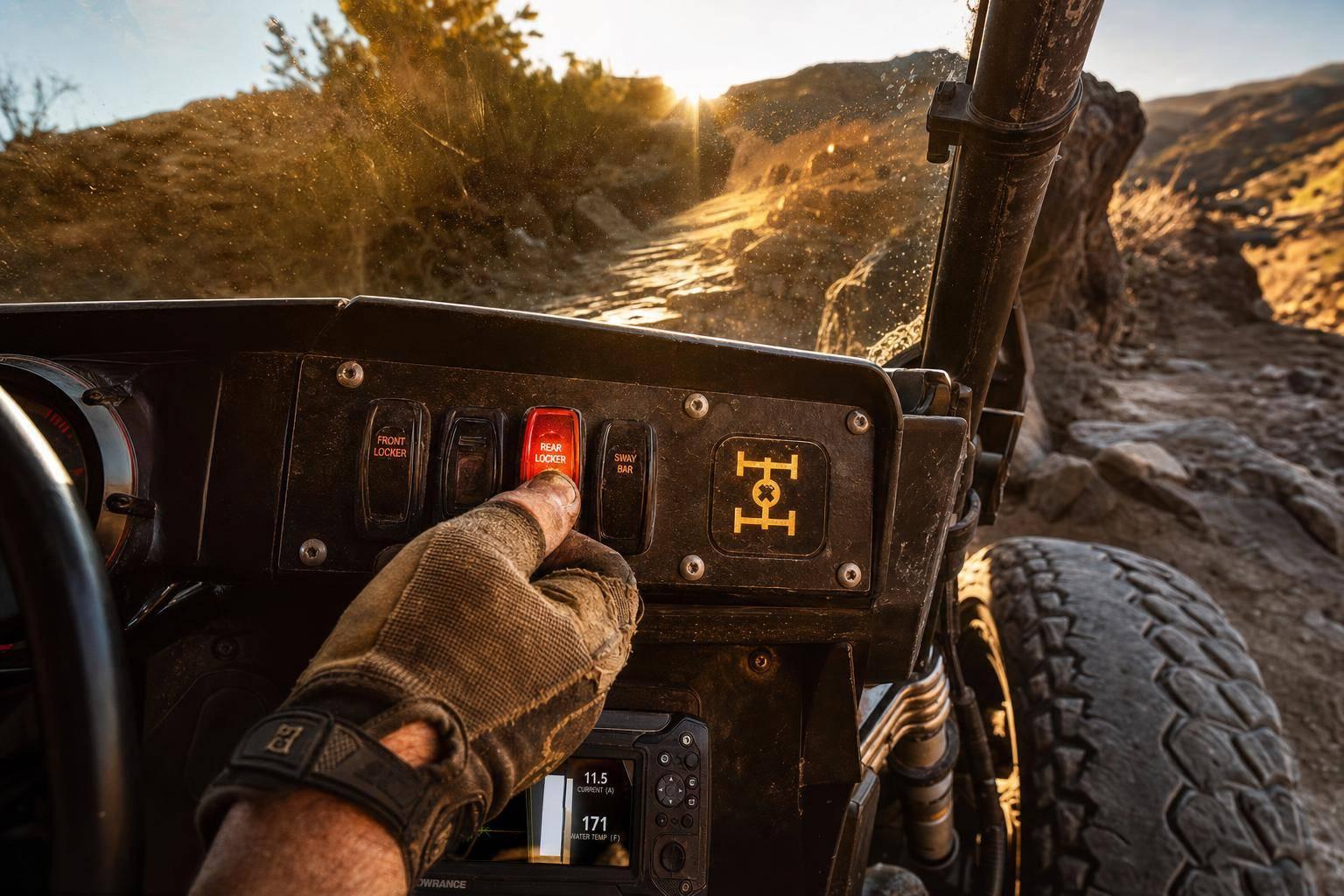
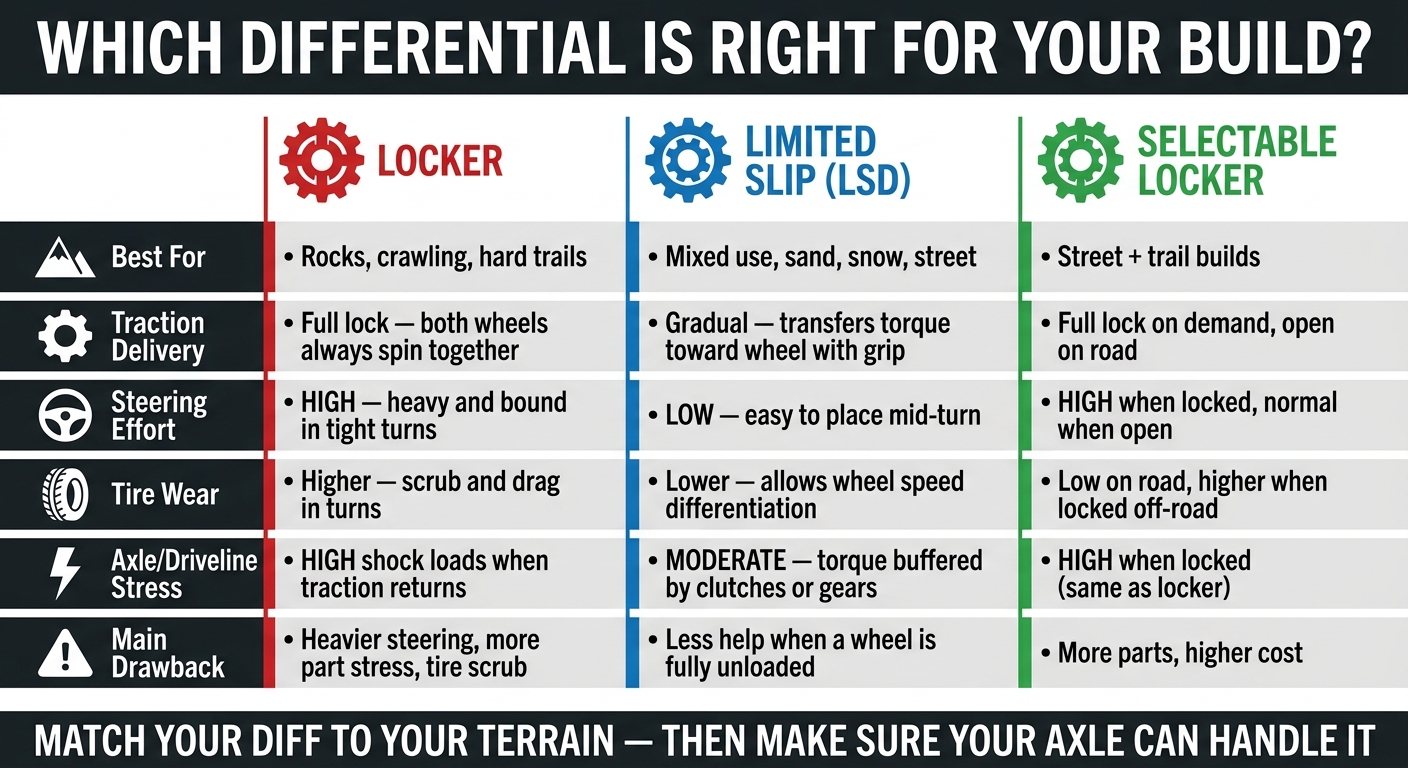
If I want the short answer: lockers win for max traction, LSDs win for street manners, and selectable lockers sit in the middle.
If my rig spends most of its time on rocks, a locker is usually the right call because it keeps both wheels pulling even if one tire lifts. If I drive mixed trails, snow, mud, sand, and pavement, an LSD is often easier to live with because it turns smoother, scrubs tires less, and puts less shock into axle parts. If I want both, a selectable locker is often the best fit because I can leave it open on the street and lock it on the trail.
Here’s what matters most:
- Locker: best traction, more steering push, more tire scrub, more axle shock
- Limited slip: smoother turning, lower tire wear, less driveline hit, less help with a lifted tire
- Selectable locker: strongest mix for many trail trucks and mixed-use builds
- Front lockers: can load steering parts hard, especially with 37-inch tires
- Big tires: often mean stronger shafts, U-joints, and steering parts need to be part of the plan
Bottom line: I’d pick the diff based on where the truck spends more than 50% of its time. Trail-only crawler? Locker. Daily-driven trail truck? LSD or selectable. High-speed dirt rig? Usually LSD or selectable rear.
Locker vs Limited Slip vs Selectable Locker: Off-Road Differential Comparison
Air Locker vs LSD vs Traction Control Part 1
sbb-itb-afc4690
Quick Comparison
| Setup | Best for | Main upside | Main drawback |
|---|---|---|---|
| Locker | Rocks, crawling, hard trails | Full traction to both wheels | Heavier steering and more part stress |
| Limited Slip (LSD) | Mixed use, sand, snow, street | Smoother control and lower tire scrub | Less help when a wheel is unloaded |
| Selectable Locker | Street + trail builds | Open on-road, locked off-road | More parts, more cost |
That’s the whole decision in plain English: pick traction first, then make sure the axle, steering, and tire size can handle it.
How Each Differential Works
How a Locker Works
A locker mechanically locks both axle shafts, so both wheels spin at the same speed. It doesn’t matter which wheel has traction or which one is hanging in the air – both shafts turn together.
There are two main types of lockers:
- Selectable lockers lock when you want them to, usually with air or electric actuation
- Automatic lockers engage on their own, without driver input
That full lockup gives you maximum traction. But there’s a catch. Since both wheels are forced to turn at the same speed, the vehicle resists smooth cornering. On pavement and tight technical turns, steering can feel heavier and more bound up.
How a Limited Slip Works
A limited slip sends more torque to the wheel with grip while still allowing some difference in wheel speed. That partial slip helps the vehicle turn more smoothly and keeps it easier to control on mixed surfaces and during daily driving.
That tradeoff is what changes the feel of each system when traction starts to come and go.
| Feature | Locker | Limited Slip (LSD) |
|---|---|---|
| Engagement Method | Selectable on demand or automatic | Always active; reacts to wheel slip |
| Driveline Stress | High; shock load transfers directly through locked shafts | Moderate; allowed slip softens shock load |
| Best Trail Fit | Rocks, technical crawling, and competition | Mixed trails, loose terrain, sand, and snow |
Those differences show up fast once the truck leaves pavement and the ground starts changing.
Locker vs Limited Slip by Terrain
Rocks and Technical Crawling
For rocks and slow, technical crawling, a locker is the top pick. It keeps power going to both wheels even when grip is uneven or one tire is completely unloaded. That matters when a wheel comes off the ground. Instead of spinning the free tire and losing momentum, the truck keeps pulling.
The catch is steering effort. With the axle locked, turning takes more work. That’s something to think through, especially when setting up the front end. You get more drive, but you also get a truck that wants to push straight when the terrain gets tight. The same tradeoff can show up in sand, mud, and snow too, where extra traction can come with sharper steering behavior.
Sand, Mud, and Snow
In sand, mud, and snow, the decision is less about maximum grip and more about keeping the vehicle smooth and easy to place. A locker still gives the most forward drive when one tire gets light or lifts. If all you care about is bite, it does the job.
But there’s a downside. A locked axle can feel tougher to steer cleanly because both wheels want to turn at the same speed. That can make the truck feel less natural in loose terrain. A limited slip often works better here because it lets the wheels turn at slightly different speeds. That usually means better steering feel and a more predictable response across sand, mud, and snow.
Mixed Trails and Street Use
The chart below keeps things simple by showing how each setup acts when the surface changes in a hurry.
| System | Rocks | Sand, Mud, and Snow | Mixed Trails |
|---|---|---|---|
| Selectable Locker | Excellent; engage on demand | Strong when engaged | Best flexibility; open when not needed |
| Automatic Locker | Very good; always ready | Good, but can be harder to turn smoothly | More steering compromise |
| Limited Slip (LSD) | Limited with wheel lift | Smooth and stable | Better for sand, fire roads, and mixed use |
For a rig that sees both pavement and dirt, selectable lockers usually make the most sense. You can leave them open on the street, then lock them when the trail calls for it. That difference in terrain behavior feeds straight into the day-to-day tradeoffs around steering feel, tire wear, and axle load.
Traction, Steering, Tire Wear, and Axle Load Tradeoffs
Steering Feel and Vehicle Control
The extra traction is nice, but it comes with a price at the steering wheel.
A locker gets its grip by forcing both wheels to turn together. In tight turns, that means more steering effort and more tire scrub on pavement. You feel it right away on narrow trail turns, and it’s even more noticeable on the front axle.
A limited slip doesn’t bring the same steering downside. It lets the truck stay easier to aim and correct when grip changes in the middle of a turn.
With a locked front axle, stock steering parts often become the weak link. Stronger tie rods and tie-rod ends aren’t just a nice upgrade – they’re there to keep the setup alive.
Tire Wear, Driveline Stress, and Shock Load
Full lockers can be rough on parts.
When a tire suddenly hooks back up, the shock load can slam axle shafts, U-joints, and the ring-and-pinion. Stronger shafts and yokes help take that hit.
And this isn’t just a pedal-to-the-floor problem. Even with smooth throttle, a locked setup can still get hit hard when traction comes back all at once.
LSDs deal with this in a different way. Instead of the same kind of shock load, they create more heat. Over long stretches of low-traction driving, clutch packs and friction surfaces wear down faster.
Driver Expectations at a Glance
Here’s the tradeoff in one view.
| Factor | Locker | Limited Slip (LSD) |
|---|---|---|
| Traction Delivery | Constant lock regardless of grip | Gradual; transfers torque toward the wheel with more grip |
| Steering Effort | High; resistance increases in tight turns | Low; easier to place mid-turn |
| On-Road Noise | Chirping/scrubbing in tight turns | Usually quiet |
| Tire Wear | Higher due to tire scrub and dragging | Lower; allows wheel speed differentiation |
| Axle Load | High shock loads when traction returns | Lower; torque is buffered by clutches or gears |
| Reliability Focus | Shaft and U-joint strength | Internal clutch/gear wear from heat and friction |
How to Choose the Right Setup
Best Fit by Build Type
Once you understand the traction tradeoff, the choice gets simpler. It mostly comes down to how you use the rig and whether the axle can handle the load.
| Build Type | Front | Rear | Notes |
|---|---|---|---|
| Rock Crawler / Ultra4 | Locker | Locker | Maximum traction for technical crawling; 300M shafts help the drivetrain survive the load |
| Overland / Mixed Trail | Limited Slip | Selectable Locker or Limited Slip | Balances control with occasional harder terrain |
| Daily Driver / Weekend Trail | Limited Slip | Limited Slip | Smoother engagement and better street manners |
| Desert Pre-Runner / High Speed | Limited Slip | Selectable Locker or Limited Slip | Prioritize suspension travel and predictable handling at speed |
For street-driven trucks, a selectable locker or a good limited slip usually makes the most sense. You get a calmer driveline during daily use, but you still have extra traction when the trail turns rough.
Supporting Mods and Chassis Planning
The diff choice shouldn’t live on its own. It needs to match axle shafts, steering, and suspension that are sized for the same kind of stress.
If you’re running 37-inch tires or larger, axle strength starts to matter a lot more. Builds that see high load often need 300M alloy shafts or RCV axle assemblies to deal with the extra torque.
Front lockers also put more strain on steering parts. That’s why steering needs attention before the locker goes in. Machined steering clevises help keep factory tie rod ends from folding under load.
It also helps to pair traction upgrades with suspension and steering parts built for the job. LSK Suspension offers long-travel kits, boxed control arms, and weld-it-yourself roll cages to support larger tires and higher drivetrain loads.
Final Takeaways
A diff choice only makes sense if the rest of the axle and suspension can keep up.
A locker gives you maximum traction, but it also asks more from your steering, axle shafts, and the person behind the wheel. A limited slip is easier to live with day to day and works well on mixed terrain, but it won’t keep pace with a locker in the roughest conditions.
So the right pick depends on the truck’s main job. A dedicated crawler usually points toward lockers with the right driveline support. A truck that splits time between pavement and trails usually leans toward a selectable locker or a good limited slip. Match the traction setup to the terrain, then make sure the axle and steering can survive it.
FAQs
Do I need a front locker or just a rear?
It depends on how you drive off-road. A rear locker gives you a big traction boost on most moderate trails, and for general adventure use, that’s often enough.
A front locker matters more on technical terrain, steep rock crawls, or deep mud, where pulling from the front can keep the vehicle moving when it would otherwise get stuck. On easier trails, a rear-only setup usually keeps steering feeling more natural.
Will a locker make my truck harder to steer?
Yes. When a locking differential is engaged, it makes both wheels on the same axle turn at the same speed.
That helps with traction. But on high-grip surfaces or during tight turns, it can make the vehicle harder to steer. You may also get tire scrub, and the turning radius can grow compared with an open or limited-slip differential.
What upgrades should I plan for with 37-inch tires?
Plan suspension and steering geometry upgrades with durability and performance in mind. On platforms like the GM 1500, a long-travel race kit can add the wheel travel and clearance you need. That often means custom control arms, fabricated spindles, extended tie rods, and upgraded shocks.
You’ll also need matching 17 x 9-inch wheels with 4.5 inches of backspacing, plus a drivetrain that can take the extra load. In many cases, that includes upgraded axle assemblies.
This isn’t the kind of setup you want to piece together by guesswork. Professional fabrication matters for proper suspension cycling and handling that feels steady and predictable.
Leave a Reply